Last updated on October 24th, 2026 at 11:49 am
Yoga Retreat vs Yoga Teacher Training: Which Is Right for You?
A yoga retreat and a yoga teacher training can look similar from the outside: both take you somewhere beautiful to practise deeply. But they serve very different purposes, and choosing the right one starts with knowing what you actually want.
Before committing to a training, it helps to know how much experience you need for YTT, and once you are ready, our guide to choosing the right yoga school walks you through what to look for.
What a Retreat Offers
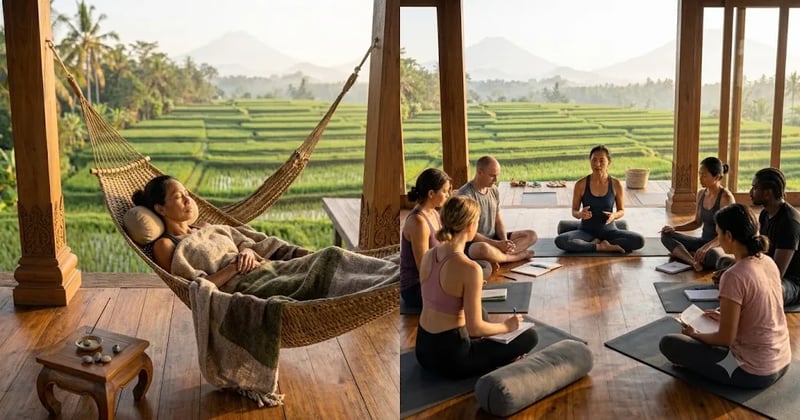
A retreat is a break for restoration and inspiration. You practise, rest, eat well, and step out of daily life, usually for a few days to a week. There is no assessment and no obligation beyond showing up. It is ideal when you want to reconnect with your practice and yourself without pressure.
What a Teacher Training Offers
A teacher training is a professional, immersive course, typically four weeks for a 200-hour, that qualifies you to teach. It includes study, practicum, feedback, and a real workload alongside the practice. You leave with a credential and a transformed relationship to yoga, but it asks far more of you than a retreat.

The Key Differences
Purpose: retreat for restoration; training for qualification and depth.
Effort: retreat is restful; training is demanding.
Length and cost: retreats are shorter and cheaper; trainings are longer and a bigger investment (here is the real Bali yoga teacher training cost).
Outcome: a retreat refreshes you; a training changes what you can do.
How to Choose
If you are tired and want to reconnect, choose a retreat. If you want to deepen your practice seriously or teach, choose a training; our review of the best yoga teacher trainings in Bali shows what to look for. Many people do a retreat first, then a training when they are ready to commit.
Comparing the cost and the time you commit
Money and time are usually the first practical questions, and the two options sit at genuinely different scales. A retreat is a short, contained investment, while a training is a larger commitment of both weeks and money, and understanding that gap upfront saves a lot of second-guessing later.
A yoga retreat typically runs from a long weekend to about 10 days, with all-inclusive packages covering accommodation, meals, and classes. It is designed to be a holiday you return from rested, and the cost reflects a shorter stay and a lighter schedule. You can book one on a few weeks’ notice and slot it into annual leave without upending your life.
A teacher training is a different order of thing. A 200-hour course usually spans three to four weeks of full, structured days, and the price covers not just accommodation and food but a serious education: certified teachers, a syllabus, assessment, and a qualification at the end. You are paying for training and credentials, not a break, and the value is measured over years rather than a single week.
Seen plainly, a retreat is an experience you consume and a training is a skill you keep. Neither is better value, they simply answer different questions about where your time and money are best spent right now.
What your days actually look like in each
The felt difference between the two lives in the shape of the day. On a retreat, the schedule breathes: a morning practice, a nourishing breakfast, and then open time for the beach, a massage, a book, or a day trip, with an evening session to close things out. Nothing is compulsory, and the rhythm bends around rest.
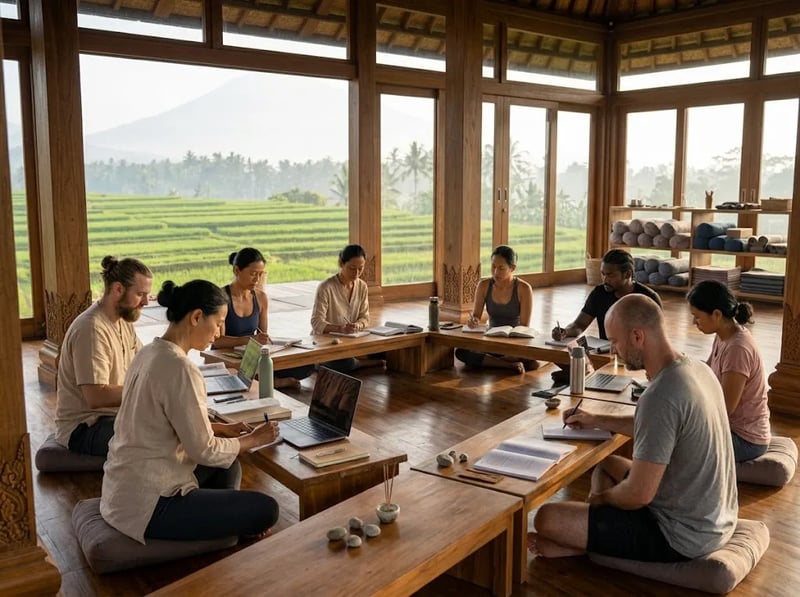
A training day is fuller and far more purposeful. You are up early, in the shala for practice, then in sessions on anatomy, philosophy, alignment, and teaching methodology, with practice teaching, study, and homework filling the spaces a retreat would leave open. It is deeply rewarding and it is also genuinely demanding, closer to an intensive at university than to a holiday. For a detailed walk through what those weeks involve, our guide to what to expect on a 200-hour yoga teacher training lays out the daily structure in full.
That single contrast, open time against structured study, is the clearest way to feel which one you are ready for. If the thought of a packed, disciplined schedule energises you, a training will suit. If your body and mind are asking for space, a retreat is the honest answer.
Using a retreat as a taste before you commit
You do not have to choose between the two as if it were a permanent decision. For a lot of people, a retreat is the natural first step, a way to test whether an immersive yoga environment feels right before committing weeks and a larger budget to training.
A few days of daily practice in a school setting tells you a great deal. You get a feel for practising every morning, for the community that forms, for the teaching style, and for the place itself, and you come away with a much clearer sense of whether you want more. Plenty of trainees describe a retreat as the moment the idea of teaching first became real rather than abstract.
If you can, choosing a retreat at a school that also runs teacher trainings gives you the best read of all. You experience the teachers you might one day study under, the food, the facilities, and the values of the place, and you can ask the questions that only occur to you once you are actually there. A retreat that leaves you wanting the deeper version is not a detour, it is a good decision made with real information. Going alone to either is more common than you might think; our guide to travelling solo to a yoga retreat covers what that is like.
Who each one genuinely suits
Stripped back, the two options serve different people at different moments, and sometimes the same person at different stages of their practice. Being honest about where you are makes the choice almost obvious.
A retreat suits you if you want to rest, reset, and deepen your own practice without pressure, if your time is limited, or if you are newer to yoga and simply want to enjoy it in a beautiful setting. It also suits experienced practitioners who love yoga but have no ambition to teach, and anyone who needs a genuine break more than a new qualification.
A training suits you if you want to understand yoga from the inside out, if you are drawn to teaching, or if you feel ready for the kind of personal change that a sustained, disciplined immersion tends to bring. Many trainees never intend to teach professionally and enrol purely for the depth, so wanting to lead a class is not a prerequisite. The 200-hour yoga teacher training at Loka welcomes committed students as much as future teachers, and the shared thread is readiness for something more than a holiday.
If you still cannot decide, let the honest state of your energy choose. Depleted and craving space points to a retreat. Curious, steady, and hungry to go deeper points to a training.
Doing both, and which one comes first
The comparison above sets these out as alternatives, which is the right way to choose if you are picking one. Plenty of people eventually do both, and in that case the more useful question is not which to choose but which order to take them in.
For most people, retreat first is the sensible order. It is shorter, less expensive and much less demanding, and it answers questions that are otherwise expensive to answer. Whether you enjoy practising daily, whether you cope well with group living, whether the style suits you, and whether you like being away from home for an extended period are all things a week will tell you clearly.
Retreat first also lets you meet a school before committing to a month with them. Spending a week somewhere tells you a great deal about how a place is run, how the teachers actually teach and whether the atmosphere suits you, and that is information no website provides. Several people arrive at a training having already been on retreat with the same school, and they tend to settle in noticeably faster.
There is a case for going straight to a training, and it applies to a narrower group. If you already have an established daily practice, you are confident about the style, and your circumstances offer one clear window rather than several, then adding a preliminary week may simply delay you. In that case, choose the school carefully and go.
Leave a real gap between the two if you do both. A few months at least, ideally more. The point of the gap is to see whether the enthusiasm survives contact with ordinary life, because a retreat produces a lot of enthusiasm and some of it is about being on holiday rather than about the practice. What you are still doing three months later is the honest signal.
Use the gap deliberately rather than just waiting. Build a home practice you can sustain without a teacher, read a little, and try a few different styles locally. Arriving at a training with an established practice changes the experience considerably, because you spend the month deepening something rather than starting it. If you would like to see what that month involves before deciding anything, our 200-hour yoga teacher training in Bali sets out the structure in full.
Budget for both from the start if you intend to do both, because the second one is easier to commit to when it was always part of the plan. Set the retreat against the year you are in and the training against the year after, and include the parts people forget: flights, visas, insurance, time off without pay, and the two buffer days at each end. Working out the full figure early occasionally changes the order you choose, and it is much better to discover that now than halfway through paying a deposit on something you cannot follow through on.
The questions worth asking before you book either
Whichever direction you lean, the booking decision goes better when you ask a few pointed questions first, because the quality range inside both categories is wide and the marketing rarely tells you what you need to know.
Ask who is actually teaching, and how much of the time. Named lead teachers with visible experience are a different proposition from a rotating cast, and on a training this matters doubly, since you are buying mentorship rather than accommodation. Ask about group size too: a retreat of twelve and a retreat of forty are different holidays, and a training cohort’s size shapes how much individual feedback you will get.
Ask exactly what the price includes. Meals, airport transfer, excursions, course materials, and certification fees are variously in or out across providers, and two prices that look far apart can converge once the extras are counted. Read the cancellation and deposit terms before paying anything, and note whether the dates you want are genuinely confirmed to run.
Then do the quiet research: recent reviews on independent platforms, and if you can, a short conversation with the school before you commit. How a place answers a few honest questions tells you a great deal about how it treats its guests and students. A provider that is patient and specific before it has your money will usually be generous with attention after.
None of this takes more than an evening, and it is the best insurance either purchase can have.
What the month afterwards tends to look like
The difference between these two shows up most clearly once you are home, and it is worth knowing about before you book either one.
After a retreat, most people come back rested and practise more for two or three weeks. Then work absorbs the time again and the practice settles roughly where it was. That is not a failure of the retreat. Rest was the point, and rest does not have to persist in order to have been worth having.
After a training, the first month is stranger. You come home with a certificate, a body that is tired in an unfamiliar way, and no room to teach in. Plenty of graduates do not teach for months. Some never teach at all and go on practising differently because of what they learnt, which is a legitimate outcome nobody puts in the brochure.
The graduates who keep their momentum usually do one small thing quickly: teach a friend in a living room, cover a class for somebody, or put a weekly practice slot in the diary and defend it. What the thing is matters less than how soon it happens. Confidence built over four weeks fades faster than you would expect.
So if you are weighing the two, ask which version of the month afterwards you actually want. One returns you to your life with more energy in it. The other changes what you do with your life, slowly, and mostly through the work you put in once you are back.
Train With Loka
If you are ready for the deeper path, our 200-Hour Yoga Teacher Training in Bali is a full four-week immersion. Still weighing it up? Read do you really need a yoga retreat, or compare 100-hour vs 200-hour training if you already know YTT is the path for you.
Frequently Asked Questions
Can a teacher training also feel like a retreat?
Parts of it can, but a training is real work with study and practicum. Expect growth and challenge, not just rest.
Which is better value?
It depends on your goal. A retreat is cheaper and restorative; a training is a bigger investment that qualifies you to teach.
Should I do a retreat before a teacher training?
Many people do, and it is a good way to test your commitment and reconnect with your practice first.
Do I need experience for either?
Retreats welcome all levels. A 200-hour training expects a few months of regular practice first.
Can I do a yoga teacher training if I have never been on a retreat?
Yes. A retreat is a helpful taste of immersive practice, but it is not a prerequisite. A 200-hour training welcomes students who arrive straight from a home or studio practice, provided you have a steady personal practice and are ready for full, structured days rather than a holiday pace.
How fit do I need to be for either one?
Less than you fear, for both. Retreats accommodate mixed levels by design, and trainings ask for a steady practice rather than an athletic one. What a training does demand is stamina for full scheduled days. If you can practise five mornings in a row comfortably, you are ready to consider either.

The Loka Newsletter
Enliven your routine with exclusive spiritual content. There’s so much to learn.

Find us on Instagram
@lokayogaschool