The Best Yoga Teacher Training in Bali for 2026: Eight Schools That Pass Their Own Maths
Bali has more than 30 schools selling a 200-hour yoga teacher training this year, and almost all of them say the same three things: Yoga Alliance registered, small group, life-changing. None of that is checkable. So we checked something that is. We took every school’s published daily timetable, counted the hours, subtracted the rest days they advertise, and compared the result to the 180 contact hours a Registered Yoga School is meant to deliver. Then we looked for a published cap on group size. The best yoga teacher training Bali offers should survive both of those questions, and most of the island does not: eleven schools fall short on their own published timetable, and three more will not tell you how many people are in the room.
Eight schools passed. This article is those eight, with the arithmetic shown for each one so you can repeat it yourself, and with what each of them does badly alongside what they do well.
One thing before the list. We run one of these schools. Loka Yoga School is in Kedungu, Tabanan, and it sits at number one, which is exactly what you would expect a school to do with its own ranking. So read our entry the way you would read a rival’s: check the timetable, check the cap, check the price against what it includes. Every claim in our entry is the same kind of claim we have asked of everyone else. We also have no affiliate or commission arrangement with any of the other seven schools, and nobody here has paid for a place on this list. If you book with Akira or Inner Yoga or Power of Now Oasis instead of us, we earn nothing, which is the point of publishing the numbers rather than the adjectives.
Our top three picks for 2026
Loka Yoga School, Kedungu. 28 days, 20 students, 216 contact hours across 24 teaching days, rice fields, a kilometre from the beach in a surf town that is still a town, an hour from the Ubud traffic. The longest immersion and the most taught hours on this list, with three buffet meals a day included, at a mid-range price.
Akira Yoga, Nusa Lembongan. 16 students, 181.5 contact hours you can count off their own timetable, two full styles taught in sequence with a real integration break between them, and the cheapest genuinely verifiable training on the island, from USD 1,995.
Inner Yoga Training, Ubud. 18 students, all-inclusive from USD 2,750 with airport pickup, and a specialist faculty of five where most schools run two. Their timetable lands on exactly 180 hours, which is honest and tight.
How we chose these eight schools
Three tests, in this order. A school had to pass all three.
Test one: do the hours add up
Yoga Alliance asks a Registered Yoga School to deliver 180 contact hours inside a 200-hour training, with the remaining 20 as non-contact work. Contact hours mean you and a teacher in the same room, or in a live session. They do not mean reading time, homework, or a pre-recorded course you were given access to.
The maths is not difficult. Take the advertised length in days. Subtract arrival and departure days, and subtract every rest day the school itself mentions. Divide 180 by what is left. That gives you the hours of actual teaching the school needs to run every single teaching day. Then look at their published timetable and see whether it gets there.
A 21-day course with three days off has 18 teaching days, which means ten hours of teaching a day, every day, with no exceptions. Very few timetables in Bali show ten hours. Many show seven. One school we checked publishes a seven-hour day inside a three-week course and states 200 hours on the same page, a gap of roughly 55 hours that nothing on the site accounts for.
Length changes what the day has to carry. A three-week course has to run ten-hour days to reach 180 at all. A four-week course could reach the same 180 on a seven-hour day, and a four-week course that keeps a long day instead lands well beyond the minimum. That is the one reason a number above 200 is ever believable, and it is believable solely when the timetable is published.
Eleven of the 30 schools we checked fall into that category. We left all of them out, including several with good reputations and beautiful venues, because the article has no meaning if the test bends.
Test two: will they tell you how many people are in the room
Group size changes a training more than the venue does. It decides how many times you teach in front of a lead trainer, whether anyone adjusts your Warrior II, and whether your name is known by week three.
We included a school when it publishes a number, and not otherwise. That sounds like a low bar and it is not: three otherwise strong schools were cut here, and one of them is instructive. One well-known school in Ubud runs several shalas at once and allocates you to one on arrival. Their own FAQ says class size “depends on the shala placement” and that groups average “about 20 to 30 students per shala”. Each shala gets a head teacher. There is no total published anywhere, so three concurrent shalas at their own average is somewhere between 60 and 90 people in a single intake, and you cannot know in advance which room you get. That is a legitimate way to run a business. It is not something you should find out after you have paid, and it sits badly with the eight limbs the school is there to teach. Satya, truthfulness, is the second of the yamas, the first limb; aparigraha, non-grasping, is the fifth. A page that leaves out the one number that decides your month fails the first, and a model built on filling three rooms at once fails the second. You cannot teach the limbs in the shala and skip them at the checkout.
Test three: who actually runs the school
Several of Bali’s cheapest trainings, the ones advertising USD 1,000 to 1,600 with accommodation and three meals, are branches of yoga schools based in India, managed from Rishikesh or Goa and staffed by teachers flown in for each intake. One states on its own page that its management and teachers come from Rishikesh. Another lists two contact addresses, one for its Bali centre and one for its Goa centre, and describes the course as running “at one of our yoga centres in India and Bali”.
There is nothing wrong with studying in the Indian tradition, and Rishikesh trainings can be excellent on their own terms. The problem is what you are buying. If the curriculum, the teachers, and the timetable are an Indian programme relocated to a villa in Ubud, then Bali is the backdrop and you are paying a premium for the backdrop. We left those schools out so the list compares like with like.
That decision has a consequence worth stating plainly: there is no training under USD 1,900 left on this list. Every genuine budget option in Bali belongs to that group. If USD 1,000 is your ceiling, the honest advice is that you will be choosing between those schools, and the questions to ask are how many hours you will actually be taught and who is teaching them.
The best yoga teacher training in Bali, ranked
| # | School | Where | Days | Group cap | Price | Contact hours |
|---|---|---|---|---|---|---|
| 1 | Loka Yoga School (that is us) | Kedungu, Tabanan | 28 | 20 | USD 2,800 incl. 3 buffet meals a day | 216 |
| 2 | Akira Yoga | Nusa Lembongan | 27 | 16 | USD 1,995 (EB 1,795); 2027 dates USD 2,195 (EB 1,995) | 181.5 |
| 3 | Inner Yoga Training | Ubud | 21 | 18 | USD 2,750–3,750 all-inclusive | 180 exactly |
| 4 | Power of Now Oasis | Sanur | 28 | 20 | USD 2,450 + room | 160+, their figure |
| 5 | All Yoga Training | Nusa Lembongan | 23 | 24 | USD 3,650 (EB 3,150, room included on most 2027 dates) | about 160 published |
| 6 | The Peaceful Warriors | Canggu | 27 | 25 | IDR 40–50m (about USD 2,350–2,950) + room | about 172 published |
| 7 | Ulu Yoga (28-day) | Uluwatu | 28 | 14–24 | USD 1,900–3,150 with a room | about 192 |
| 8 | Radiantly Alive | Ubud | 24 | 32 (avg 24) | IDR 40.3–49.2m | about 158 published |
Prices and dates were re-read on each school’s own site on 16 October 2026, and several are described as discounted. Read the full cost breakdown for a Bali yoga teacher training before you compare any two of these numbers, because they include wildly different things.
Two schools near the bottom, The Peaceful Warriors at about 172 hours and Radiantly Alive at about 158, fall short of 180 on their own published timetables, and we say so plainly rather than rounding them up. We kept them with a little leniency, because without it the list would be too short to be useful, and because both publish enough for you to see the gap for yourself. Power of Now Oasis and All Yoga also publish figures under 180; their entries explain why we read those numbers the way we do.
1. Loka Yoga School: best overall
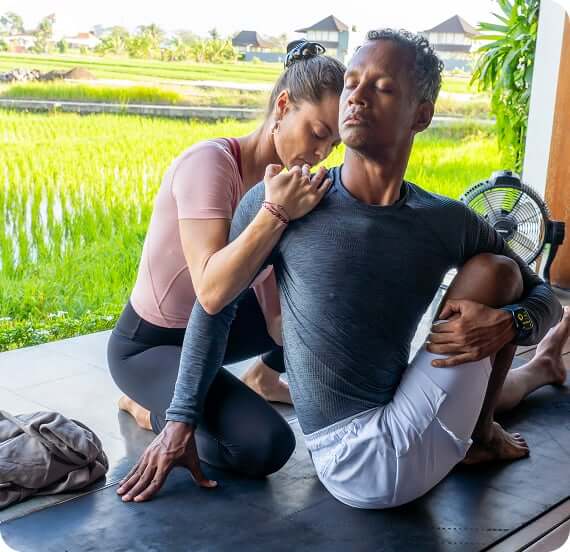
Kedungu, Tabanan. 28 days. 20 students. USD 2,800 at 2027 early bird prices, with three buffet meals a day included. Accommodation is optional.
Here is our day, which is the thing we have asked of everyone else on this page.
| Time | Session |
|---|---|
| 06:30 to 08:30 | Morning practice: meditation, mantra, mudras, pranayama, then a taught asana class |
| 08:30 to 09:30 | Breakfast |
| 09:30 to 11:00 | Anatomy, physiology and biomechanics |
| 11:00 to 12:30 | Techniques, training and practice |
| 12:30 to 14:00 | Lunch |
| 14:00 to 16:00 | Yoga philosophy and yoga humanities |
| 16:00 to 18:00 | Techniques, training and practice |
Nine contact hours a day, six days a week, across four weeks: 24 teaching days, 216 contact hours, four days off. Run the division on us. 180 divided by 24 teaching days is 7.5 hours a day, and we run 9. The margin is 36 hours, most of an extra week of teaching. We are not claiming a bigger number because we found a bigger adjective. We are claiming it because four weeks holds more days than three, and we did not shorten the day to match.
The foundation is hatha vinyasa, taught deeply enough that you can build, sequence and hold a class from it, with an introduction to restorative and yin, power, kirtan kriya, yin and yang, Ashtanga and Iyengar along the way. That foundation is what lets our graduates go on to teach any of those styles. Once you understand how a sequence is built and why a body responds the way it does, the other styles become variations on something you already own rather than new languages to learn from scratch.
Twenty-eight days is the longest immersion on this list, and the length is the point. A 21-day course has to move you from your first cue to your final practicum in three weeks, which means practice teaching starts early and stays shallow. Four weeks gives the middle of the training room to breathe. You teach a 30 minute class, you are corrected, and you come back later with a full 60 minute class on new material, carrying the correction into something you have not taught before. That second attempt is where the feedback actually lands, and it is the first thing a three-week timetable has to cut.
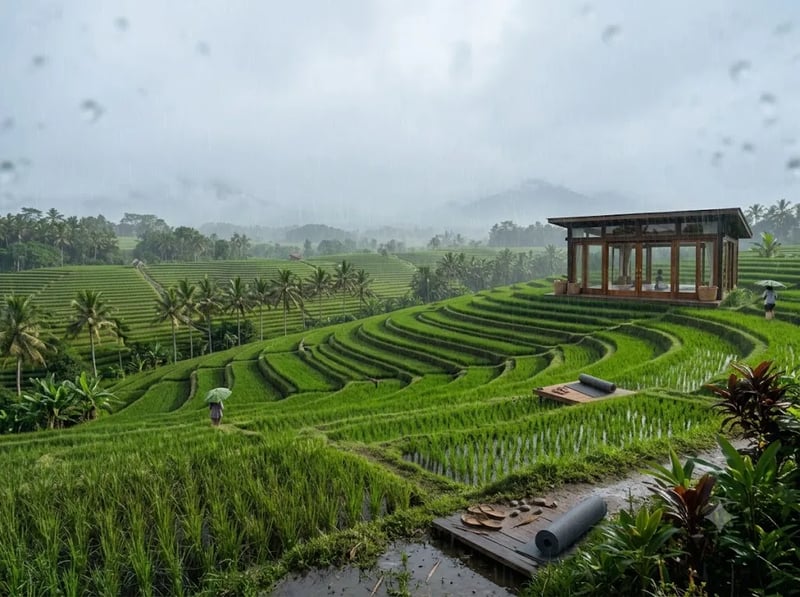
We are in Kedungu, in the rice fields a kilometre from the beach in Tabanan, 20 minutes north of Canggu and an hour from Ubud, and the location is one of the reasons people choose us. Kedungu is what Canggu was ten years ago: a small coastal town with good cafés, a surf break that works all year round for every level, and the easiest pace on the south coast, without the traffic, the construction and the exhaust that now come with Canggu and Ubud. Tanah Lot, one of the most iconic temples in Bali, is a few minutes down the coast. The UNESCO World Heritage rice terraces of Jatiluwih are a short drive up the road. You walk out of class into rice fields, with a sunset surf or a swim minutes away, and you walk back into a purpose-built shala, Bali Yoga Shala, with floor-to-ceiling glass, air conditioning, ceiling fans and proper sound and lighting. That last part matters more than it sounds in wet season, when the open-sided shalas elsewhere on the island are managing mosquitoes and 90 per cent humidity.
The group is capped at 20, and 20 over 28 days buys you the ratio across time rather than in a single room: more days at a similar group size means more turns in front of a lead teacher than a tighter cohort over three weeks delivers.
Two lead teachers. Anatomy and physiology are Yann’s, who came to them through cardiac surgery, intensive care nursing and tropical medicine, then years as an advanced care paramedic and remote site medic, long before he taught any of this, which shows in how the sessions are pitched: mechanism first, then the pose. Philosophy, meditation and pranayama are Taryn’s, E-RYT 500, with 15 years of teaching and a background in creative sequencing.
Registered with Yoga Alliance as an RYS 200 since December 2017. Yoga Alliance rating 4.89 from 61 reviews, Google 4.9 from 303. We ask for at least one year of dedicated practice before you start.
2027 intakes: 31 January to 27 February, 3 to 30 July, 4 September to 1 October, and 30 October to 26 November 2027.
Who it suits. People who want the longest runway and the most contact hours on the island, a coastal town that is still a town, and anatomy taught by someone who spent years keeping bodies working in hospitals and in the field before he ever taught a pose.
2. Akira Yoga: best small group and best value
The Yoga Garden, Nusa Lembongan. 27 days. Maximum 16. USD 1,995, early bird USD 1,795, for November 2026; USD 2,195, early bird USD 1,995, for 2027 dates.
This is the one that surprised us. Akira teaches two complete styles in sequence, a Yin phase and then a Vinyasa phase, with a two-day integration break between them and 1.5 rest days built into each phase. Five rest days across 27 days, 22 teaching days, and a timetable running 7:00 to 17:30 with real breaks. That comes to 181.5 contact hours, which clears 180 with 1.5 hours to spare. Besides Ulu Yoga, it is the one school on this list with any margin at all.
Their group cap is the tightest we found: “Our teacher trainings are intentionally limited to a maximum of 16 students.” Claire Green, from the UK, opened The Yoga Garden on Lembongan in August 2024 and leads the Yin phase with over 20 years of teaching and 3,000-plus training hours behind her. Fera Ariasih, from Yogyakarta, leads Vinyasa. There is a bonus online Yin and Traditional Chinese Medicine course, and to their credit they do not count it towards the 200.
Next intakes: 4 to 30 November 2026, then 4 to 30 January, 4 to 30 April, 4 to 30 July, 2 to 28 September and 4 to 30 November 2027.
Limitations. The price covers tuition and a daily breakfast, nothing more, so your room, lunches and dinners are on top, and Lembongan is an island: every arrival and departure is a boat, and a rough crossing can move your plans. Two styles in 27 days is also a lot of ground, and if you already know you want to teach Vinyasa and nothing else, half the course is a detour.
Who it suits. Anyone who wants to be known by name for a month, anyone on a real budget who refuses to compromise on hours, and anyone drawn to teaching Yin as well as flow.
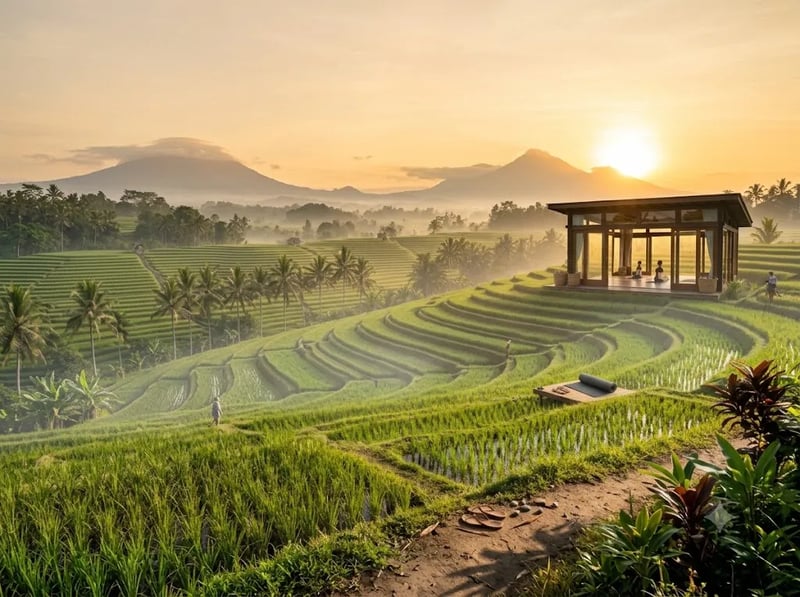
3. Inner Yoga Training: best all-inclusive in Ubud
Azadi Retreat, Ubud. 21 days. Capped at 18. USD 2,750 triple, 3,250 twin, 3,750 private, all-inclusive.
Founded by Georgina Watson in 2017 on a stated premise that most trainings leave students exhausted rather than trained, which is a quietly pointed thing for an Ubud school to say. The faculty is the strongest feature: five specialists rather than the usual two, covering Vinyasa and anatomy (José Luis Jiménez, E-RYT 500), Yin (Winé Pramiyanti), philosophy and Ayurveda (Dr Ravinjay Kucreja) and Traditional Chinese Medicine (Dr Marc Senator), with Georgina on Vinyasa and Yin.
The cap is explicit: “Every training is capped at 18 students. This is a deliberate decision that shapes everything about the experience.”
The price includes accommodation, meals and an airport pickup, which makes it the easiest number to compare on this list. At USD 2,750 for a triple share, all in, it is cheaper in total than several trainings priced on tuition alone that look cheaper on the surface.
Next intakes: 6 to 26 November 2026, then 1 to 21 January 2027 and monthly through 2027.
Limitations. The hours are exact and tight. Eighteen teaching days at the ten hours their timetable shows is precisely 180, with nothing spare: one shortened graduation day or one late arrival and the training is under. Ten-hour days for three straight weeks is also genuinely demanding, and the Ubud location means traffic and crowds if you plan to explore between sessions.
Who it suits. People who want one price and no arithmetic, people who value being taught philosophy by a philosophy specialist rather than by whoever is free that afternoon, and people who have just three weeks.
4. Power of Now Oasis: best for honesty about hours
Sanur beachfront. 28 days. Maximum 20 students and three lead teachers. USD 2,450 for the training alone.
This school does something no other school in Bali does. It publishes “160+ contact hours with experienced lead teachers” on its own page, and 160 is below the 180 threshold. They could have written 200 like everybody else. They wrote the number they actually deliver.
We rank them fourth rather than lower because of that, not in spite of it. Their published week is Monday to Friday 7:30 to 17:00 and Saturday 7:30 to 13:00 with Sundays off, which across four weeks is roughly 175 to 190 hours once you take out lunch and breaks, so the real figure is likely higher than the one they claim. A school that understates is a school whose other claims you can lean on.
The cap is stated as “a maximum of 20 students and three lead teachers”, which is a better student-to-teacher ratio than anything else here. All the faculty live in Bali rather than flying in per intake. The school describes itself as semi-non-profit, supporting the Sole Family Foundation. It is beachfront in Sanur, which is the calmest of Bali’s tourist towns and the one with the least nightlife, for better or worse.
Next intakes: 8 November to 4 December 2026, with USD 500 off that date when we checked, then 14 March to 9 April 2027 and seven more dates through December 2027.
Limitations. Accommodation is separate, at Kolonial House about five minutes’ walk away, so the USD 2,450 is not the number you will pay. And their own contact-hour claim sits under the Yoga Alliance guideline, which they should either recount or raise.
Who it suits. People who would rather be told the truth than sold the round number, and anyone who wants a four-week course with weekends structured in.
5. All Yoga Training: best Ashtanga-led training
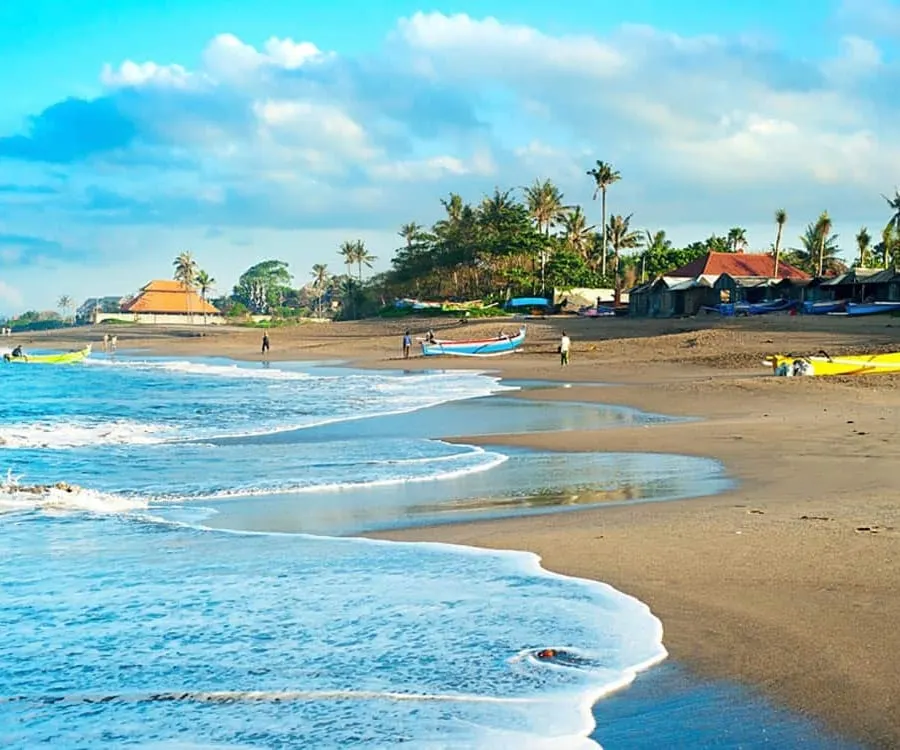
Nusa Lembongan. 23 days. Maximum 24. USD 3,650, early bird USD 3,150, and accommodation was included on most 2027 dates when we checked.
Operating since 2009 with a second base in Phuket, this is the most expensive training on the list and the most traditional in structure, built around a modified Ashtanga Primary Series practice with a day off every sixth day. The lead trainers are David Adame (E-RYT 500, Spain, with a contemporary dance background) and Marcela Mota (E-RYT 500, 15 years of international teaching). One of their lead trainers has trained with us at Loka, which we mention in the interest of full disclosure. Philosophy is taught partly by Dr Ganesh Rao, Director of Academics and Accreditation at the Indian Yoga Association and a consultant at Kaivalyadhama, which is a serious credential and not one the marketing leans on.
The cap is published plainly as “Max. 24 students”, and there is a free room for the first ten students on selected dates, which softens the price considerably if you book early.
Next intakes: 6 to 28 January 2027 (three places left when we checked), 1 to 23 February 2027, then roughly monthly through November 2027.
Limitations. Their published timetable comes to roughly 160 hours across 20 teaching days, about 20 short of 180, so either the day runs longer than the page shows or the non-contact portion is doing more work than it should. Tuition is also quoted alone, so at USD 3,650 plus a room plus most meals this is comfortably the priciest way onto this list. A daily Primary Series is not a gentle introduction if you have never practised Ashtanga.
Who it suits. Experienced practitioners who want a set sequence, a formal method, and teachers who have been doing this since 2009.
6. The Peaceful Warriors: best for not being rushed
Cosmos Oasis 2, Canggu. 27 days. Maximum 25. IDR 40m early bird (about USD 2,350), IDR 50m regular (about USD 2,950). Disclosure first: Maria and Bente, who founded The Peaceful Warriors, are friends of ours, and genuinely good people. Their numbers went through the same test as everyone else’s, and this is where the maths put them.
They publish something no other school on this list does: “we run a maximum of 5 trainings a year and do not run trainings parallel or back to back. We take in a maximum of 25 students per training.” Read that against the multi-shala problem earlier and you can see why it matters. It is a commitment that the group you paid to join is the one group in the building, and that your lead teachers are not on their fourth consecutive month.
They also publish their Yoga Alliance registry ID, 12580, which almost nobody does and which lets you verify the registration yourself in about 30 seconds. Twenty-seven days is the second-longest immersion here, and lifetime access to their online 200-hour training is bundled with the in-person course.
Next intakes: 27 March to 17 April 2027, then 31 July to 22 August 2027, both at early bird pricing when we checked on 16 October 2026.
Limitations. The published day runs 7:00 to 18:00 with long breaks and comes to about 7.5 teaching hours, roughly 172 hours across the course, which is short of 180 by about a day’s teaching. Tuition is quoted alone: rooms are an extra IDR 5m to 16.5m and one group breakfast a week is included, so the real cost is well above the headline. And it is Canggu, which means traffic, construction and a scene, if any of those matter to you.
Who it suits. People who want a long training in a busy, social part of the island, and who want a school that is transparent about how many cohorts it runs.
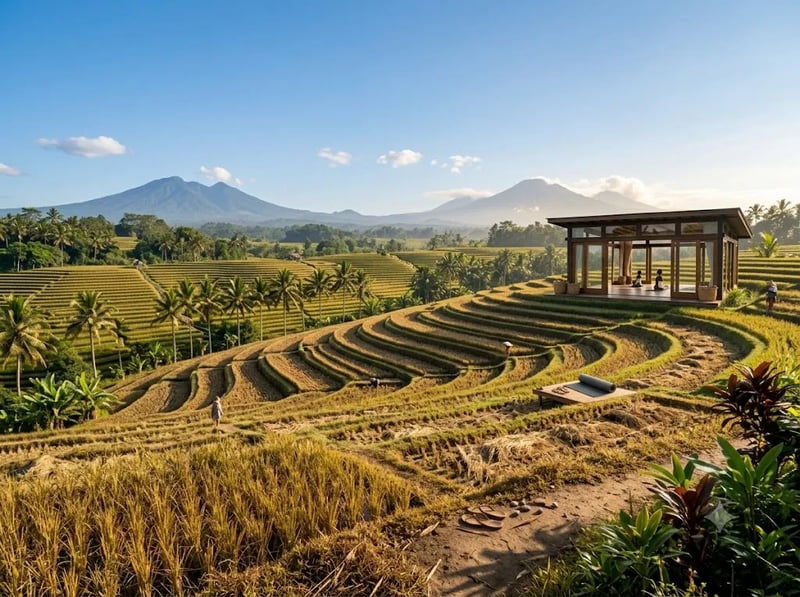
7. Ulu Yoga: best on the Bukit, if you take the 28-day
Bingin, Uluwatu. 28-day option. Class size 14 to 24. Roughly USD 1,900 to 3,150 with a room.
Read this entry carefully, because Ulu Yoga sells four different trainings under one 200-hour banner and just one of them belongs on this list.
Their 10-day option carries 110 hours online. The 14-day carries 80 online. The 21-day carries 30. The 28-day carries none: their page says “No online studies”, and it is the single version where the full 200 happens in Bali with a teacher in the room. At roughly 192 in-person hours it is also the largest margin over 180 of any school we checked.
We say this without much sympathy for how it is sold: a reader searching for a Bali yoga teacher training who books the 10-day is buying nine days in Bali and 110 hours at their kitchen table, and the headline price of USD 1,600 attaches to that version. If you want the real thing here, ask for the 28-day by name and confirm in writing that no online hours apply.
The faculty is genuinely international, six named instructors from Switzerland, India, the USA, Bali, Canada and Mexico, several trained in Rishikesh and Kerala, with the school itself Bali-based and single-location since 2014. One week of the 28-day specialises in aerial or Yin.
Next start dates shown: 1 November and 29 November 2026, then 7 February, 11 April and 13 June 2027. The page lists the same start dates for every length, with a 25 per cent discount on all prices until 1 December 2026, so ask them to confirm the 28-day in writing.
Limitations. The four-option structure is the problem. Comparison sites and search results quote the cheapest, shortest version, and the difference between what they sell and what you think you are buying is 110 hours. Class size of “14 to 24” is also a range rather than a cap. And Uluwatu is a long way from everywhere else on the island, with real traffic on the Bukit road.
Who it suits. Surfers, and anyone who wants the Bukit specifically. On the 28-day, and nothing shorter.
8. Radiantly Alive: best-known studio brand in Ubud
Jl. Jembawan, Ubud. 24 days. Maximum 32, average 24. IDR 40.3m early bird, IDR 49.2m regular.
Radiantly Alive has been an Ubud studio since 2010 and its RA Vinyasa method is the most recognisable house style in the town. Six intakes a year, a faculty team of five to seven, and a genuinely global alumni network, with gatherings in Berlin, Barcelona, Paris and Amsterdam.
Their cap is published precisely, which we like: “Maximum 32 students, in average 24 per cohort. A faculty team of 5–7.” Lead teachers rotate by cohort rather than being the same two people every time, which means you should check who is leading your specific dates: Denise de la Torre Ugarte takes November 2026, Niko Kisic January 2027, Zara Miranda March 2027, Laila El Idrissi May 2027.
Next intakes: 2 to 25 November 2026, then 11 January to 3 February, 1 to 24 March, 3 to 26 May, 2 to 25 August and 1 to 24 November 2027.
Limitations. Thirty-two is the largest group on this list, which at the top of the range means a faculty ratio around five to one and a lot of people waiting their turn to teach. The published timetable starts at 07:30 and its last listed session has no finish time, coming to roughly 7.5 visible hours against the 8.6 needed, so about 158 hours are actually shown. Tuition alone, no accommodation, in the most expensive part of Ubud to stay in. And a rotating lead teacher means the training you read about in a review may not be the training you get.
Who it suits. People who want the Ubud studio experience, a big alumni network, and a recognisable style with a name.
Eleven of the 30 Bali schools we checked fall short on their own published timetable.
Three traps to watch for on any Bali school’s page
The hours that do not add up
Covered above, and it is the single most common problem on the island. The tell is a page that states 200 hours, shows a seven or eight hour timetable, and mentions days off without counting them. Do the division yourself before you book.
The cohort you cannot see
If a school will not publish a maximum, assume the answer is a number you would not like. Watch particularly for wording like “small groups”, “intimate setting” and “personal attention” with no figure attached, and for any school that mentions multiple shalas, rooms or groups. Ask directly: what is the maximum number of students in my cohort, and will another cohort be running at the same time.
The permanent discount
Several Bali schools list a struck-through price alongside a “discounted” one that has been the actual price for years. The tell is a discount with no expiry date, or an expiry date that keeps moving. It is not illegal and it is not even unusual, but it means the price you are comparing is not a special offer, it is the price, and the school with the biggest apparent saving is not necessarily the cheapest. We have written about what a Bali yoga teacher training really costs in detail, including the flights, visa, insurance and days-off spending that no school quotes.
How to check any school yourself in ten minutes
You do not need us for this. Open any Bali school’s 200-hour page and do the following.
Find the course length in days, and find every mention of a day off, a rest day, an excursion day or a “free day”. Subtract the arrival and departure days, then subtract the rest days. Divide 180 by the number you are left with. That is the hours of teaching they must run every teaching day.
Now find their daily timetable and add up just the sessions where a teacher is present. Meals are not contact hours. “Self study”, “self practice”, “homework”, “journalling” and “silent study” are not contact hours, even when they sit inside the timetable grid. If the two numbers do not meet, the gap is real, and you are entitled to ask where it goes.
Then search the page for a maximum group size. Then search for the Yoga Alliance registry, and if they publish a registry ID, look it up. Then check whether any part of the 200 is delivered online, and if it is, how many hours.
Four questions, ten minutes, and it will tell you more than a week of reading reviews. If you want the longer version of this method applied to the whole decision, we have written a guide to choosing the right yoga teacher training school, and if you are still deciding between course lengths, start with 100-hour versus 200-hour.
Train with us in Kedungu
Our 200-hour runs over 28 days with 20 students, in a purpose-built air-conditioned shala in the rice fields, about a kilometre from the beach in Kedungu, Tabanan, with three buffet meals a day included. Twenty-four teaching days at nine contact hours, four days off, 216 hours in total. We have been a Yoga Alliance Registered Yoga School since December 2017, and we publish our timetable, our group cap and our prices for the same reason we published everyone else’s: they are the things that decide what your month is actually like.
The next intake is 31 January to 27 February 2027, and every 2027 date is open at early bird pricing. If you have questions about hours, accommodation, or whether you are ready, ask them before you pay a deposit anywhere, including here.
Frequently asked questions
Which is the best yoga teacher training school in Bali?
There is no single answer, because the schools that pass the basic checks suit different people. On the two tests that can be verified from a school’s own website, published contact hours and a published group cap, eight Bali schools qualify: Loka Yoga School, Akira Yoga, Inner Yoga Training, Power of Now Oasis, Ulu Yoga on its 28-day option, All Yoga Training, The Peaceful Warriors and Radiantly Alive. Akira has the smallest group at 16, Inner Yoga is the most straightforward all-inclusive price, and Loka runs the longest immersion at 28 days.
How much does a 200-hour yoga teacher training in Bali cost?
Tuition on this list runs from USD 1,995 to USD 3,650, and that range is misleading because some prices include accommodation and meals while others include neither. A course at USD 2,450 for tuition alone can cost more in total than an all-inclusive one at USD 2,750. Budget for flights, a visa, insurance, and money for your days off on top of everything. Trainings advertised under USD 1,900 in Bali are almost all run by schools based in India.
How many hours a day is a yoga teacher training in Bali?
Between seven and ten, depending on the school and the length of the course. A 21-day course with three days off needs ten hours of teaching every remaining day to reach the 180 contact hours a Registered Yoga School should deliver. A 28-day course needs about seven and a half. That is why course length and daily hours have to be read together: a four-week training that keeps a full day is delivering far more than the minimum, and a three-week training showing a seven-hour day is not reaching it at all.
Is a Bali yoga teacher training recognised internationally?
It is if the school is a Yoga Alliance Registered Yoga School at the 200-hour level, which lets you register as an RYT 200 after you graduate. Check the registration yourself on the Yoga Alliance directory rather than trusting a badge on a website, and be careful with wording like “Yoga Alliance accredited” or “follows the Yoga Alliance curriculum”, which are not the same thing as being registered.
Should I do my teacher training in Bali or India?
Both work, and they are different products. India is generally cheaper, more traditional, and more likely to be taught in an ashram structure with early starts and a fixed daily routine. Bali costs more and usually offers better accommodation, more style variety and easier travel logistics. What you should avoid is paying Bali prices for an Indian programme relocated to a Bali villa, which is what several of the island’s cheapest listings actually are.
When is the best time of year to do a yoga teacher training in Bali?
Dry season, roughly May to September, is the most comfortable and the most booked out, so plan several months ahead. Wet season, November to March, brings afternoon downpours and more mosquitoes, and it is when an enclosed shala stops being a detail and starts being the difference between a good day and a long one. Prices are often lower and groups smaller outside the peak.
Can I do a 200-hour yoga teacher training online instead?
You can, and Yoga Alliance recognises online 200-hour trainings, but at least 15 per cent of the training must be synchronous, meaning live with a teacher rather than pre-recorded. Some schools meet that properly and many do not. The larger difference is practice teaching: teaching a real room of people who are actually tired, distracted and differently shaped is the part an in-person immersion gives you and a video library cannot.
The Loka Newsletter
Enliven your routine with exclusive spiritual content. There’s so much to learn.

Find us on Instagram
@lokayogaschool