Last updated on October 24th, 2026 at 11:51 am
Bali Yoga Teacher Training Cost: What You'll Really Pay in 2026
Ask five schools what a 200 hour training in Bali costs and you’ll get five confident answers, each quietly measuring something different. One quotes tuition only. One includes a dorm bed but not food. One includes everything except the nights you actually sleep there. If you’re comparing Bali yoga teacher training cost by the number at the top of each pricing page, you’re comparing apples to frangipani. This guide puts the real 2026 numbers side by side, shows you what the headline price does and doesn’t buy, and walks through the traps that catch people who shop on price alone. We run a school here in Kedungu, on Bali’s south-west coast, so yes, we have skin in this game. We’d rather you compare everyone properly, including us, than book blind.
The short answer: expect USD $1,500 to $4,600
Across the major booking platforms, most 200 hour trainings in Bali in 2026 sit between $1,500 and $3,000, with a meaningful cluster from $1,700 to $2,400 and premium residential programs reaching past $4,500. The floor is around $1,455 for hybrid formats and the ceiling around $4,600 for private-room packages at the polished, better-known schools.
Here’s what named schools are actually charging at the time of writing. Every figure is taken from the school’s own website, or from its listing on a booking platform where that was the only published price, checked in August and September 2026:
| School | Length | Max group | Price (USD) | Accommodation | Meals |
|---|---|---|---|---|---|
| Budget ashram trainings in Rishikesh, India (for contrast, not a single school) | 28 days | varies widely | from $480 | shared, included | included |
| Yoga New Vision (Ubud) | 22 days | 20 to 25 | $1,999 tuition only; $2,299 to $4,599 with room | included in packages | included (not Sundays) |
| House of Om (Ubud) | 20 nights | 29 to 32 per group | $2,125 dorm to $3,900 private (early-bird rates lower) | included | included |
| Peaceful Warriors | 26 nights | 25 | ~$2,350 to $2,950 tuition | separate: ~$300 triple to ~$1,000 private | breakfasts weekly only |
| Salty Prana (Uluwatu) | 22 days | not published (“small group”) | €2,498 to €3,498 | included | included |
| Power of Now Oasis (Sanur) | 28 days | 20 | $2,450 tuition only | not included (partner hotel, booked separately) | breakfast only |
| Loka Yoga School (Kedungu, Tabanan) that’s us |
28 days | 20, in writing | $2,800 with three organic meals a day (2027 intakes, current early bird); $3,500 with a private ensuite room. See dates and what’s included | private ensuite in the $3,500 package | included daily, organic |
| All Yoga Training | 23 days | 24 | $3,150 to $3,650 | free dorm for first 10 only | not included |
| The Yoga Barn (visiting teachers) | varies | not published (guest-led programmes) | e.g. $3,800 early bird, tuition only | not included | not included |
Group sizes are each school’s own published figure, checked October 2026; where a school publishes no number, the cell says so. Every one of those numbers is the school’s own published price in August or September 2026. They move with early-bird windows and seasons, so treat the table as a snapshot. What doesn’t move is the pattern underneath it, and the pattern is the useful part.
Where Loka sits in that table
Our 28 day 200 hour training in Kedungu, Tabanan is $2,800 with three organic meals a day, or $3,500 with a private ensuite room, for the 2027 intakes at the current early bird rate. No tuition-only tier, no surprise extras, a maximum of 20 students, and Yoga Alliance RYS 200 registration. That is the whole price, and it is the one the rest of this article teaches you to ask every school for.
Tuition-only pricing is the first thing to check
Look at that table again and notice something: the cheapest-looking and most expensive-looking options can swap places once you add a bed and three meals a day.
A $2,700 tuition-only training sounds cheaper than a $3,500 all-inclusive one. Now add 22 nights of accommodation in a decent area of Bali. A basic private room near the southern coast runs $80 to $100 a night in the busy season, so that’s $1,760 to $2,200. Add food: eating out costs $20 to $30 a day now, so $440 to $660 for the three weeks, less if you cook or take a meal plan (ask us, we know the best ones). Your $2,700 training now costs $4,900 to $5,560, and you’re also the one organising it all, in a country you may not know, for a month when your brain will be full.
None of this makes tuition-only pricing dishonest. Some students live in Bali already, or want to choose their own villa, and unbundled pricing serves them well. It only becomes a problem when you compare a tuition-only number against an all-inclusive one and think you’re saving money. Before you compare anything else, rebuild every option into the same shape: training, bed, food, for the full length of the course. That single habit will do more for your budget than any discount code.
What actually drives Bali yoga teacher training cost
Four things separate a $1,800 training from a $3,800 one, and marketing photography is not one of them. The photos all look the same. These don’t:
Cohort size and teacher ratio. Training twelve to twenty people costs more per student than training forty. Schools that cap their groups say so publicly and put the number in writing. Schools that don’t cap them tend to say things like “intimate group setting” without a number attached. A 200 hour training is a month of someone watching your alignment, hearing you teach, and correcting you personally. Divide the teaching hours by the number of students and you’ll see exactly what you’re buying.
The venue itself. A dedicated training space costs more to run than a corner of a busy hostel or a studio rented by the week. It shows up in the price, and it shows up harder in the experience: whether your shala is yours for the month, whether three other trainings share the kitchen, whether you can hear construction through savasana.
Food, and who cooks it. Daily organic meals for twenty people for a month is a serious operational commitment. It’s also the thing that keeps you upright in week three. Schools that include proper food price it in; schools that don’t are handing that cost, and that risk, to you.
Length. A 17-day intensive and a 28-day immersion can both issue the same certificate. They are not the same training. Longer programs cost more because you’re housed and fed longer, but the pace difference matters more than the money: 200 hours compressed into two and a half weeks is a very different nervous-system experience from the same hours across four. Count the teaching days as well: a great many compressed trainings are not 200 hours at all except on the certificate.
Run those four against any school before you look at the price. For a worked example, our yoga teacher training in Bali answers all four on one page: 20 students maximum, a dedicated shala in Kedungu, three organic meals a day, 28 days, and the full price written down before you ask.
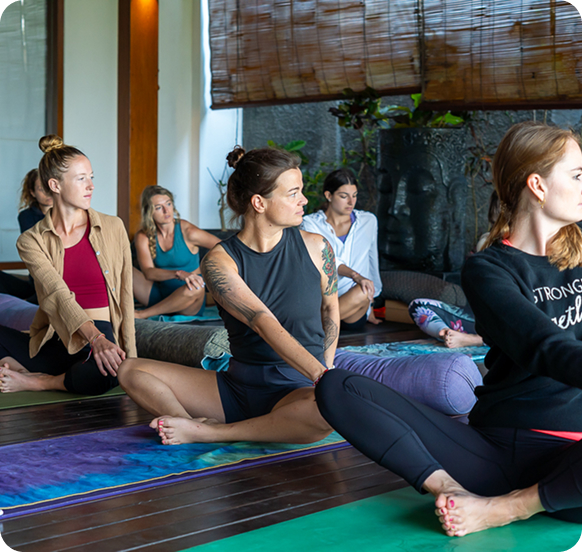
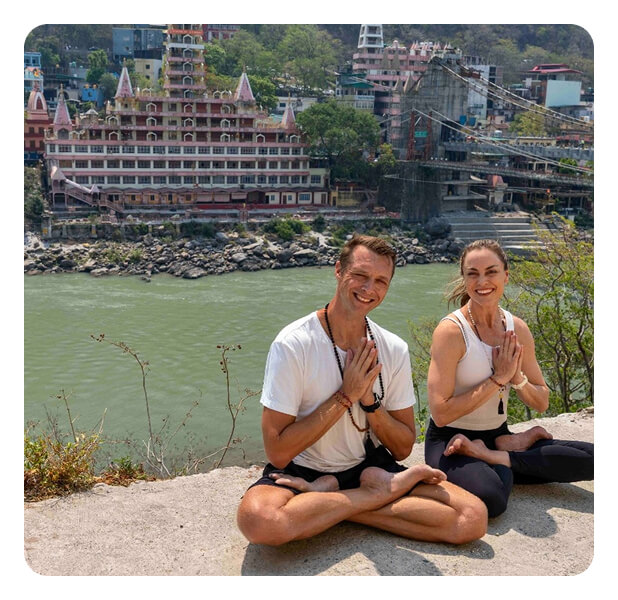
Bali vs India: the honest comparison
You can complete a Yoga Alliance registered 200 hour training in Rishikesh from around $480, accommodation and meals included. That is not a typo, and it deserves a fair treatment rather than a scare story.
What the cheap end of India genuinely offers: teachers with decades of practice, training in the town where much of this tradition took shape, full ashram immersion with fire ceremonies and Ganga aarti on the doorstep, and course inclusions (excursions, cleansing kits, airport pickup) that would cost extra anywhere else. Students who go in with open eyes often come back transformed. The mid range, $1,200 to $2,000, buys well-run schools with good reputations, and the premium Rishikesh academies at $2,100 to $2,750 rival anything in Bali.
What the cheap end also carries, documented repeatedly in student accounts rather than whispered: cohorts advertised at twenty that arrive at forty, split classrooms, food hygiene that puts a chunk of each intake out of action in week two, rooms that match neither the photos nor the season, and materials that feel photocopied rather than taught. None of these are universal. All of them are common enough that first-person reviews mention them again and again.
One thing the price tags do not capture is where you sleep. We have stayed several times at one of the most “luxurious” ashrams in Rishikesh, and its rooms do not come close to a mid-range Bali room, let alone a good one. Bali has its own version of the problem, thin accommodation dressed up as “eco”, so look at real room photos and recent reviews wherever you book, but the gap between the two countries is wide and it matters more the longer you stay.
There’s also a paperwork trap that surprisingly few schools mention: India’s e-Tourist visa explicitly excludes courses that issue a qualifying certificate. Students have had e-visa applications rejected for honestly naming a 200 hour YTT as their purpose. The correct route is a regular or student visa through an embassy, which is slower and dearer than the $25 e-visa the school’s FAQ told you was fine. Indonesia is simpler: a visa on arrival costs about $30, extends once to sixty days, and a month-long training fits inside it with a single extension.
The honest summary: India at its best is the cheapest authentic training on earth. Bali costs more because you’re paying for smaller groups, calmer logistics, gentler food-safety odds and an easier visa, in a place that’s a pleasure rather than a challenge to live in for a month. Neither is wrong. They’re different purchases.
“Rebuild every option into the same shape: training, bed, food, for the full length of the course.”
The hidden costs nobody puts on the pricing page
Whatever school you choose, the training fee is not the trip cost. Budget these on top:
Flights first. From Australia, Bali return fares run roughly A$220 from Perth to A$550 from the east coast if you book sensibly. From Europe or the Americas, $700 to $1,400 is realistic. India from Australia is similar money on sale fares, more on direct routes.
Then the small print items: Indonesia’s visa on arrival at about $30 plus the same again for the extension a 28 day trip usually needs, and Bali’s tourist levy of about $10. Travel insurance for a month runs $60 to $300 depending on cover and age; for a physical training it isn’t the place to economise. A scooter, if you ride, is about $65 to $80 a month. Most people arrive a night or two early and stay a night after graduation, so add two or three nights of accommodation. And the one almost everyone forgets: registering with Yoga Alliance after you graduate costs $50 to apply plus $65 for the first year. Your certificate is included in most course fees; your registration is not.
Deposits deserve their own sentence: they’re typically $350 to $500 and typically non-refundable, at good schools and bad ones alike. Read the refund clause before you pay anything, and keep a copy of it.
Put together, a realistic all-in budget for a mid-range Bali training from Australia looks like this: $2,700 to $3,500 for a genuinely all-inclusive course, $350 to $550 for flights, roughly $150 for visa, levy and transport, $100 to $300 for insurance, $100 or so for buffer nights and incidentals, and $115 for Yoga Alliance in year one. Call it $3,500 to $4,700 all in. A tuition-only course does not make that number smaller; it just moves more of it out of the brochure.
Take the checklist with you
Two pages: the same-shape worksheet, the seven questions to put to every school in writing, and the costs that never make it onto a pricing page. Enter your email and the PDF opens straight away.
Red flags that hide behind a cheap price
We’re not going to name schools here. We will tell you exactly what shows up, over and over, in one-star reviews of trainings across Bali and India, because the patterns are strikingly consistent and every one of them is checkable before you pay a deposit. They sit alongside the broader questions in our guide to choosing the right yoga teacher training school.
The vanishing group cap
The listing says twenty students. The training has forty, taught in shifts. Before booking, ask the school to confirm the maximum cohort size in writing, and ask how many are enrolled in your dates. A school with nothing to hide answers in one email.
The venue that isn't theirs
Some “schools” are a brand and a rented corner: a hostel that hosts three trainings simultaneously, shared showers that stop coping, WiFi that dies during your exam, breakfast that runs out when the other cohort eats first. Ask directly: is the venue dedicated to our training for the month? Who else will be operating there?
The refund that never arrives
The most damaging pattern in the reviews we studied isn’t bad teaching, it’s money: cancellations acknowledged, refunds promised within six weeks, then silence until the student’s credit card company forces the issue. Protect yourself the boring way: read the refund and date-change terms before you pay, screenshot them on the day you book, and ask in writing what happens if you have to move dates. A school with a fair policy answers that in one line.
The hours that don't add up
Count the days. A training sold as 200 hours in 18 days with Sundays off has 15 or 16 teaching days, which means more than eleven hours of contact time every day to reach the 180 contact hours Yoga Alliance requires. Almost nobody delivers that. When we ran the maths on the published timetables of 30 Bali schools in September 2026, only six added up fully (the Bali schools that pass their own maths are named in our roundup); eleven needed more teaching hours per day than their own schedule contains. Ask for the daily timetable, count the class and lecture hours yourself, and multiply by the teaching days. If the number is short, the 200 is only on the certificate.
Reviews with a gap in the middle
A wall of five stars and a handful of furious one-stars, with nothing between, is worth reading carefully. Read the one-stars first and look for the school’s replies: a defensive or absent response to a specific, factual complaint tells you how they’ll treat you if something goes wrong. Then check the school on more than one platform, because ratings can be curated on home turf.
Teachers who aren't settled
Reviews that mention staff complaining openly about the school, curriculum criticised by the people teaching it, or a different lead teacher than advertised are describing an organisation problem you’ll be living inside for a month. It’s fair to ask who exactly will lead your dates and how long they’ve taught there.
Timing: when the same training costs less
The price you pay depends partly on when you click book, because almost every school in the table runs the same three levers.
Early-bird windows are the big one, and they’re real money rather than marketing: $300 off at some of the larger schools, 15 percent off room categories at others, and in one case a $900 gap between the early-bird and regular rate for the identical course. The catch is that early-bird deadlines usually sit six to ten months before the start date, which is exactly when most people are still deciding. If you know you’re going, deciding early is worth more than any negotiation you’ll ever do later. If you’re not sure, don’t let a countdown timer decide for you: the deposit you’d lose by cancelling usually outweighs the discount you’d gain by rushing.
Season matters less than you’d expect for tuition but more for everything around it. Bali’s dry season, roughly May through September, is when flights from Australia and Europe peak and when the popular schools fill first, so the cheap room categories sell out and you end up in the private-room tier by default rather than by choice. Trainings in the shoulder months often have every accommodation tier still open a few weeks out, and your flights can cost half as much. The wet season, roughly November to March, is another matter: it is hot and humid in a way that feels worst at two in the afternoon in an open-sided shala, and it is when mosquitoes, and with them dengue, peak. A well-built school answers both with an enclosed, air-conditioned shala with fans, so ask before you book whether the practice space is enclosed or open to the weather. Ours is enclosed and air-conditioned, which is one of the less photogenic reasons students stay well through a month here.
Payment plans are now common and worth asking about even when they’re not advertised: a deposit followed by two or three instalments is standard at several schools in the table. Just be clear about which portion is refundable, because the plan spreads the payments, not the risk.
Finally, watch the currency you’re quoted in. Schools here price variously in US dollars, euros and rupiah, and a course that looks mid-range in euros can land differently in your own currency by the time your bank has finished with it. Convert everything to your home currency on the same day, add your card’s foreign transaction fee, and compare those numbers rather than the stickers. Booking directly with the school is also usually the same price or better than booking through a platform, and it starts the relationship with the people who’ll actually be teaching you, which is worth something a comparison table can’t show. It also matters when something goes wrong: a booking platform will not give you a cent back outside its terms, whereas a school you have a relationship with can move you to a later date, on conditions, and treat you like a person rather than a ticket. We do.
What a fair price looks like
After all of that, here’s the simple version. In Bali in 2026, a genuinely all-inclusive 200 hour training with a real group cap, a dedicated venue, daily meals and experienced lead teachers costs somewhere between $2,500 and $3,900. Cheaper than that, something in the list above has usually been unbundled or stretched. More than that, you’re often paying for location prestige rather than more teaching.
For transparency, since we’ve quoted everyone else: our own 28 day residential 200 hour training in Kedungu, Tabanan is $2,800 at the current early bird rate for the 2027 intakes, including daily organic meals, or $3,500 with private ensuite accommodation, capped at twenty students. We’re comfortable putting that in the same table as everyone else, which is rather the point of this article. Whoever you train with, insist on that same comfort: a school that will put its full, real, comparable price next to its competitors’ has already answered your most important question.
If you’re still weighing up whether a full training or a retreat is the right next step, we’ve written honestly about that decision too, and about what a month of training actually feels like from the inside. Read those, rebuild every price into the same shape, ask the cohort question in writing, and you’ll choose well.
Train with us in Kedungu
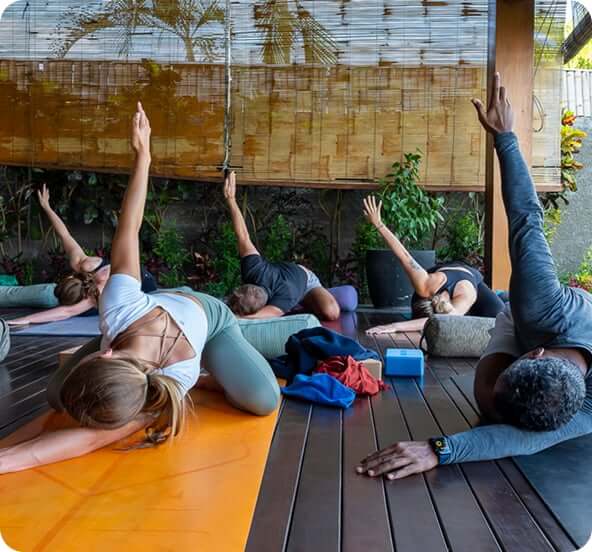
If the numbers above make sense and you want a training that puts its full price on the table, our 28 day 200 hour yoga teacher training runs from a dedicated shala beside the rice fields in Kedungu, with daily organic meals, a maximum class of 20 students, and Yoga Alliance RYS 200 registration.
Dates, packages and what each one includes are on the training page, and if anything is unclear, write to us and we will answer in one email.
Frequently asked questions
How much does a 200 hour yoga teacher training in Bali cost in 2026?
Most sit between $1,500 and $3,000, with all-inclusive residential programs typically $2,500 to $3,900 and premium private-room packages up to about $4,600. Always check whether accommodation and meals are included before comparing prices.
Is yoga teacher training cheaper in India than Bali?
Considerably. Rishikesh trainings start around $480 with room and meals included, and premium Indian academies top out near $2,750. Bali costs more but typically buys smaller cohorts, easier logistics and a simple visa on arrival, whereas certificate-issuing courses in India technically require a regular or student visa rather than the cheap e-Tourist visa.
What does the course fee usually not include?
Flights, visa and Bali’s tourist levy, travel insurance, transport, extra nights before and after the course, and Yoga Alliance registration after you graduate ($50 application plus $65 for the first year). Tuition-only courses also exclude accommodation and meals, which adds roughly $2,800 to $3,600 for a month at current room and restaurant prices.
How much should I budget in total for a Bali YTT?
From Australia, a realistic all-in figure for a mid-range, all-inclusive training is $3,500 to $4,700 including flights, visa, insurance and registration. Long-haul travellers should add $300 to $900 for airfare.
How much does Loka’s 200 hour training cost, and what is included?
For the 2027 intakes, $2,800 with three organic meals a day, or $3,500 with a private ensuite room, at the current early bird rate. Both are 28 days in a dedicated shala in Kedungu, Tabanan, with a maximum of 20 students and Yoga Alliance RYS 200 certification on completion. Flights, visa and insurance sit on top, as they do with every school in the table above. Dates and both packages are on the 200 hour training page.

The Loka Newsletter
Enliven your routine with exclusive spiritual content. There’s so much to learn.

Find us on Instagram
@lokayogaschool