Last updated on September 8th, 2026 at 11:32 am
What Is Pranayama? The Ancient Science of Breath Explained
What is pranayama? It is the fourth limb of classical yoga and one of the most powerful tools available to a modern practitioner. The word comes from prana, the vital life force, and ayama, meaning expansion or liberation. Together they describe a practice that does not simply regulate the breath. It expands the energy the breath carries.
Modern neuroscience is arriving at conclusions that the yogic tradition encoded thousands of years ago. The breath is the only autonomic physiological function accessible to conscious control. Through that control, you can reach every other system in the body. This is not philosophy. It is physiology.
What Is Pranayama, Exactly?
Pranayama is the conscious, deliberate regulation of breathing as a systematic practice. It is not just slow breathing or relaxation breathing, though both have value. In its full classical form, pranayama includes control of the inhale (puraka), the exhale (rechaka), and the spaces between them, called kumbhakas, the breath retentions.
Patanjali positions pranayama as the fourth limb of ashtanga yoga, placed after asana and before pratyahara. This is not arbitrary. A stable body supports a regulated breath, which prepares the mind for withdrawal from external distraction and, ultimately, meditation.
Patanjali’s own definition is narrower than the popular one. Yoga Sutra 2.49 describes pranayama as the regulation of the movement of inhalation and exhalation, taken up once the seat is steady, and the sutras that follow classify it by whether the breath is paused after the exhale or the inhale, by its length and count, and finally by a fourth kind of retention that arises on its own once the others are mastered.
Pranayama is one category inside the broader term breathwork, which also takes in modern methods such as Conscious Connected Breathwork and functional breathing retraining. This article stays with the classical practice. For how those modern methods differ from it, and what the evidence says for each, read our comparison of pranayama vs breathwork.
The Physiology Behind the Practice
Your breathing pattern is one of the few bodily functions that operates both automatically and under conscious control. This places it at the intersection of the voluntary and involuntary nervous systems. It is the primary lever available to consciously influence your physiological state in real time.
Slow, diaphragmatic breathing stimulates the vagus nerve, the longest cranial nerve in the body. Extended exhales are particularly powerful: a longer exhale than inhale shifts vagal tone and lowers heart rate within seconds. No equipment, no technique, no prior experience required.
Slow techniques such as nadi shodhana, ujjayi, and extended-exhale breathing reduce respiratory rate while maintaining or slightly raising carbon dioxide levels. Jerath and colleagues’ paper on the physiology of long pranayamic breathing proposes that slow, deep breathing shifts autonomic balance through stretch receptors in lung tissue and synchronising effects on neural elements. Gerritsen and Band’s respiratory vagal stimulation model offers a complementary account of why paced breathing sits at the centre of so many contemplative traditions.
Why the Breath Is Unique Among Bodily Functions
Every other vital function in the body is either entirely automatic or requires external intervention to change. You cannot decide to slow your heartbeat through willpower. You cannot consciously alter your digestion. But you can change your breathing right now, and that change will cascade through your entire physiology within seconds.
Researcher Linda Stone coined the term ’email apnea’ to describe the phenomenon of holding the breath or breathing shallowly when staring at screens. Studies suggest this affects a significant proportion of knowledge workers for much of their working day. The consequences accumulate: poor sleep, impaired immune function, elevated blood pressure, anxiety, and reduced cognitive performance. All of it addressable through attention to the breath.
Where the Classical Techniques Come From
The Yoga Sutras give the definition and almost no method. The techniques most students learn today come from the hatha texts, above all the Hatha Yoga Pradipika, compiled by Svatmarama around the fifteenth century, and the later Gheranda Samhita. Both treat pranayama as the centre of hatha practice, and both insist it is taken up only after the body has been prepared by asana and, where needed, by the cleansing practices.
The Hatha Yoga Pradipika names eight kumbhakas: surya bhedana, ujjayi, sitkari, sitali, bhastrika, bhramari, murccha, and plavini. Kapalabhati appears in the same text, but among the six shatkarmas rather than the kumbhakas, which is why it is described as a cleansing practice as often as a breathing one. Nadi shodhana is presented as the preparatory practice that clears the channels before any of the eight are attempted.
The text also gives the pacing rule that still holds. The breath is to be tamed gradually, the way a wild animal is, because a breath forced too soon injures the practitioner. That single line is the origin of every progression in this article.
The Classical Pranayama Techniques
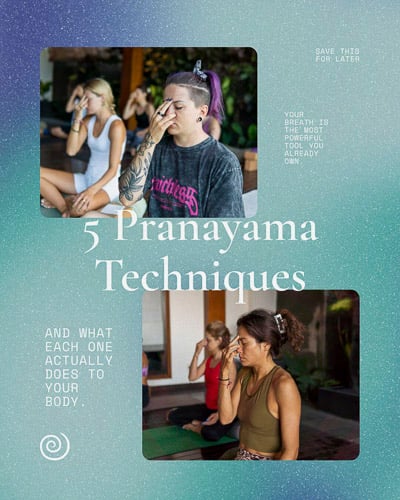
Nadi Shodhana (Alternate Nostril Breathing): balances the left and right hemispheres of the brain. Used to prepare for meditation.
Ujjayi (Ocean Breath): a slight constriction at the back of the throat creates an audible breath that anchors attention and generates internal heat.
Kapalabhati (Skull Shining Breath): rapid, forceful exhales energise the system, clear the nasal passages, and strengthen the respiratory muscles.
Bhastrika (Bellows Breath): both the inhale and the exhale are forced, in equal measure, and the round closes with a retention. It is the progression from kapalabhati, not a synonym for it.
Sitali and Sitkari (Cooling Breaths): the inhale is drawn over a curled tongue or through the teeth and the exhale leaves through the nose, the only classical pair that cools the body rather than heating it.
Bhramari (Humming Bee Breath): the vibration produced by humming on the exhale directly stimulates the vagus nerve and produces pronounced parasympathetic effects.
Kumbhaka (Breath Retention): holding the breath after the inhale or exhale to regulate the flow of prana and deepen states of concentration. And if guiding others with the breath calls you, our piece on breathwork facilitator training shows where that path leads.
What the Yogic Tradition Teaches
The yogic tradition has described the relationship between breath and consciousness for over five thousand years. The understanding that prana and the breath are inextricably linked is the foundation of the entire pranayama system. To control the breath is to begin to direct the life force. To direct the life force is to quiet the mind.
This understanding predates modern neuroscience by millennia. The fact that contemporary research on vagal tone, heart rate variability, and the default-mode network arrives at compatible conclusions through a completely different methodology is remarkable. Where science meets spirituality, the evidence converges.
The Five Vayus
Classical texts describe prana not as one thing but as five movements, each with a direction and a job. Prana vayu moves inward and upward, and governs how you take things in. Apana vayu moves downward and outward, and governs elimination.
Vyana vayu circulates through the whole body, samana vayu gathers towards the centre and relates to digestion, and udana vayu moves upward through the throat and is linked with speech and effort. Of the five, prana and apana are the pair the tradition returns to most often, because they move in opposite directions and much of the practice is described as bringing them into balance.
These are not anatomical structures and the texts are not making an anatomical claim. They are a map of felt experience: directions of movement you can notice in your own body during practice, organised into categories that have been useful for a long time. Treat them as a framework for attention rather than a description of physiology, and they earn their place.
What the Research Actually Supports
The gap between what pranayama is claimed to do and what has been demonstrated is wide, and worth mapping before you commit years to a practice.
The strongest evidence sits with slow breathing. Russo and colleagues’ review of slow breathing physiology documents increased heart rate variability, improved baroreflex sensitivity, and more efficient gas exchange in healthy adults. Zaccaro and colleagues’ systematic review of slow breathing correlates adds consistent reductions in self-reported arousal and measurable EEG changes across a wide range of protocols.
Jayawardena and colleagues’ systematic review of pranayama’s therapeutic benefits is the broadest survey of clinical applications, covering respiratory function, cardiovascular measures, and outcomes in conditions including asthma and hypertension. The reported effects are frequently positive, and the authors are explicit about the methodological limits: small samples, short interventions, and controls that rarely account for expectation.
Saoji and colleagues’ narrative review of yogic breath regulation reaches a similar position, noting that different techniques produce different physiological signatures rather than one general effect. Slow techniques and fast techniques are not interchangeable, and the literature that pools them obscures more than it reveals.
Where claims run ahead of evidence is in the specifics: that a particular ratio detoxifies, that a given technique treats a named disease, or that breath practice substitutes for medical treatment. None of that is supported. What is supported is that slow, regulated breathing shifts autonomic balance and subjective state in reliably measurable ways.
Safety, Contraindications, and Who Should Skip What
Pranayama is generally low risk, and the risk is not zero. The techniques that carry it are the forceful ones, not the slow ones.
Kapalabhati and bhastrika involve rapid, forceful abdominal contractions and steep intrathoracic pressure changes. Johnson and colleagues reported a case of pneumothorax following kapalabhati practice, in a practitioner with no prior lung disease. A single case report does not establish incidence, and it does establish that the risk is real rather than theoretical.
Telles and colleagues’ work on HRV during high frequency yoga breathing makes the point sharply for kapalabhati: the practice reduced parasympathetic activity compared with simple breath awareness. Calling it relaxing misdescribes what it does.
Avoid forceful and hyperventilatory techniques if you are pregnant, have uncontrolled hypertension, epilepsy or a seizure history, glaucoma or recent eye surgery, a history of pneumothorax, unstable cardiovascular disease, or an abdominal or thoracic surgery within the last few months. Fincham’s review of high ventilation practices lists further cautions around psychiatric conditions where dissociation is a concern.
Breath retention deserves its own line. Never practise retention in or near water, and never in a position where losing consciousness would injure you. Shallow water blackout kills competent swimmers.
Light-headedness, tingling in the hands and face, and visual disturbance during fast breathing are signs of falling carbon dioxide, not signs of progress. Stop and return to normal breathing. Claims about tetany as a desirable outcome are not supported by evidence: hypocapnia and respiratory alkalosis are documented, involuntary muscular spasm as a therapeutic marker is not.
Slow techniques with no retention and no force are appropriate for almost everyone, including during pregnancy.
How to Start a Pranayama Practice
You do not need equipment, a special space, or prior experience to begin. You need attention and five minutes. Start with diaphragmatic breathing: one hand on the belly, breathing in through the nose so the belly rises, then exhaling slowly so the belly falls. Make the exhale slightly longer than the inhale. Practise this before sleep, in the transition between tasks, or whenever you notice tension in the body.
Notice what changes. That noticing is the beginning of a practice.
A Progression Path for Your First Eight Weeks
Most people fail at pranayama by starting with the complicated techniques. This sequence starts with the ones that work.
Weeks one and two: observation only. Five to 10 minutes daily, seated, watching the breath without altering it. Count your resting breaths per minute once at the start of each week and note it down. You are establishing a baseline and, more usefully, the habit.
Weeks three and four: equal breathing. Inhale for a count of four, exhale for a count of four, for 10 minutes. If four feels rushed, use five. No retention. The aim is a smooth, silent breath with no catch at the turnaround.
Weeks five and six: extended exhale. Move to a 4:6 or 5:7 ratio. Van Diest and colleagues’ study on inhalation to exhalation ratio and slow breathing found that the advantage of a longer exhale on high frequency HRV appeared mainly during slow breathing, and that the effect on subjective relaxation was more robust than the HRV effect itself. Expect it to feel calmer before it shows up in any measurement.
Weeks seven and eight: resonance pacing. Settle at roughly six breaths a minute, a five-second inhale and a five-second exhale. Lehrer and Gevirtz’s work on HRV biofeedback identifies this as the rate producing maximum heart rate oscillation. Experiment between 4.5 and 6.5 breaths per minute and keep the rate that feels most effortless.
Nadi shodhana and any retention work come after this foundation, not before it. Our online breathwork training follows a comparable progression with feedback at each stage.
That order is the classical one. The hatha texts stage the practice as a steady seat first, then the channels cleared through nadi shodhana, then ratio, then retention, and only then the bandhas that hold a retention in place. Each stage is kept until it is effortless before the next is added, which is the same rule the eight weeks above apply to the count.
Common Mistakes That Stall a Practice
Forcing the breath is the most common. Pranayama is regulation, not exertion. If your shoulders lift, your jaw tightens, or the inhale ends with a gasp, the volume is too large and the count too ambitious.
Chasing long counts is the second. A 4:8 ratio held with strain produces less benefit than a 4:6 held with ease, and the strain itself recruits the sympathetic response you are trying to reduce.
Practising after eating is the third, and it is more disruptive than most people expect. Leave at least two hours after a substantial meal.
The fourth is inconsistency dressed as intensity. Yilmaz Balban and colleagues’ trial of brief structured respiration practices had participants practise for five minutes daily over a month. Cyclic sighing, an emphasis on extended exhalation, produced the greatest improvement in mood and the largest reduction in respiratory rate, outperforming box breathing, cyclic hyperventilation, and mindfulness meditation. Five minutes daily beat everything more elaborate done less often.
The fifth is assuming the dramatic techniques are the effective ones. Fincham and colleagues’ randomised placebo-controlled trial of brief high ventilation breathwork found no advantage over an active placebo on mental health and wellbeing outcomes. Intensity of experience is not evidence of effect, and a technique that produces vivid sensations is not thereby doing more for you than one that produces almost none.
Take Your Pranayama Further With Loka
Understanding what pranayama is opens the door; learning to practise and teach it safely is the next step. Loka Yoga School’s Online Breathwork Training provides a structured, accredited pathway through the full spectrum of pranayama and modern breathwork, from classical techniques to somatic modalities, covering 25+ techniques with anatomy and physiology led by a medical professional.
Our Online Breathwork Training teaches the classical pranayama techniques with full anatomy, pacing, and safety guidance.
And if you want the breath taught alongside the rest of the practice, our 200-hour yoga teacher training in Bali works with pranayama daily, with the anatomy and the cautions that belong with it.
Frequently Asked Questions
What does pranayama mean in Sanskrit?
Pranayama combines prana (vital life force or breath) and ayama (expansion, extension, liberation). It describes both breath control and the liberation of life force energy through conscious breathing practice.
How many types of pranayama are there?
The Hatha Yoga Pradipika lists eight classical kumbhakas: surya bhedana, ujjayi, sitkari, sitali, bhastrika, bhramari, murccha, and plavini, with nadi shodhana taught as the preparation for all of them and kapalabhati classed separately as a cleansing practice. Modern teaching adds simpler entry points such as diaphragmatic and equal-ratio breathing, so the number you meet in a class depends on the lineage.
How does pranayama affect the nervous system?
Pranayama techniques, particularly those involving extended exhales, activate the parasympathetic nervous system through vagus nerve stimulation. This lowers cortisol and adrenaline, reduces heart rate, and initiates the rest and digest response. The effect is both immediate and cumulative. If you want to explore the subject further, our list of books about breathwork you should read is a good next stop. You can explore the rest of our breathwork guides from there.
How long should I practise pranayama each day?
Even five to ten minutes daily produces measurable changes in stress levels, sleep quality, and nervous system resilience over two to four weeks of consistent practice.
Is pranayama safe for beginners?
Gentle techniques such as diaphragmatic breathing, Nadi Shodhana, and Bhramari are safe for most beginners. More advanced techniques including Kapalabhati and Kumbhaka should be learnt with a qualified teacher, particularly if you have cardiovascular conditions, epilepsy, or are pregnant.
The Loka Newsletter
Enliven your routine with exclusive spiritual content. There’s so much to learn.

Find us on Instagram
@lokayogaschool