Last updated on October 22nd, 2026 at 08:45 am
The Differences Between Yoga for Kids and Yoga for Adults
Teaching yoga to children is not simply a gentler version of teaching adults. It requires a fundamentally different approach to pacing, language, structure, and engagement. If you are considering expanding your teaching into children’s yoga, or if you are already doing it and want to teach more effectively, understanding these differences is essential. The same adaptability applies at the other end of life, which is where chair yoga shines.
Why Age Changes Everything
Adults come to yoga with a purpose. They are managing stress, building strength, recovering from injury, or seeking something quieter than their daily lives. They can hold a pose for several minutes, sit with discomfort, and benefit from sustained silence.
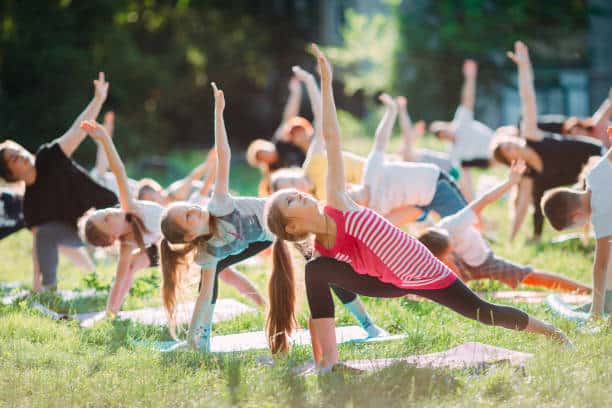
Children are driven by play, novelty, and immediate feedback. Their attention spans vary significantly by age, their bodies are still developing proprioceptive and interoceptive awareness, and their relationship to stillness is completely different. Expecting a child to behave like a small adult in a yoga class is a setup for frustration on both sides.
Understanding the developmental stage of the children you are teaching shapes every decision you make in the room.
Teaching Across Age Groups
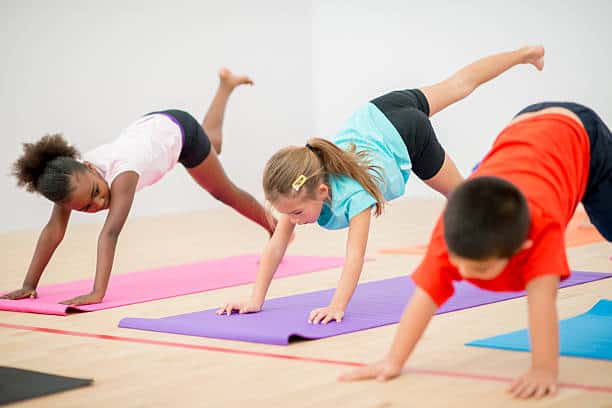
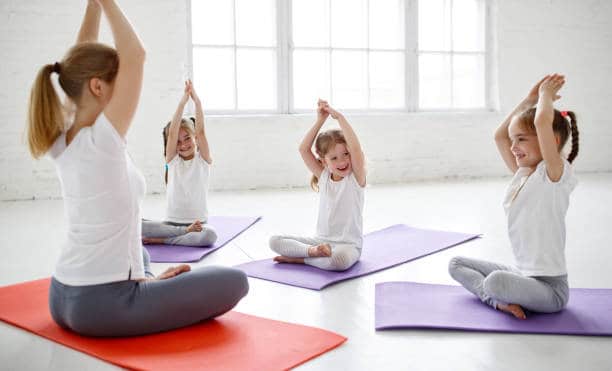
Under seven years old. Children in this range are just beginning to develop body awareness. They learn primarily through movement, sensory input, and imitation. Yoga for this group should be highly active, image-based, and playful. Poses taught through animal names, nature imagery, and storytelling land far better than anatomical instruction. Sessions should be short, perhaps twenty to thirty minutes, with frequent transitions between activities.
Seven to twelve years. Children in this range can sustain focus for longer periods and begin to benefit from simple breathwork and mindfulness concepts if presented accessibly. They respond well to challenges, games, and peer engagement. Emotional regulation themes are increasingly relevant and can be woven into the practice naturally.
Teenagers. Adolescent yoga needs to acknowledge the self-consciousness of this age group. Choice and autonomy matter more here. Creating a non-competitive, physically safe, and emotionally non-judgmental space is the primary task. For simple poses you can share at home, our guide to family yoga poses is a good starting point. Working with children also sharpens questions of consent and privacy, something we explore in why we never photograph students in savasana.
Structural Differences in the Classroom
In an adult class, you can offer detailed verbal cues and allow students to hold postures independently while you observe, adjust, and guide verbally. The energy in the room is usually self-contained and directed.
In a children’s class, you are leading from the front at all times. The energy must shift regularly, with active sequences, rest periods, creative elements, and moments of connection woven together. Adjustments are minimal, and consent practices with children require careful navigation.
Discipline approaches differ too. The most effective approach is engagement rather than enforcement. One of the most reliable tools is relating what you are doing to something children already care about: an animal, a superhero, a favourite story, a piece of music.
What Children's Yoga Gives Back
The challenges of teaching children are real: constant movement, shifting attention spans, unpredictable energy, and the need for relentless creativity. The rewards are also real. Children respond with unfiltered enthusiasm when a class lands well. They have no pretence, no performance, and no agenda. When they feel safe and engaged, their joy is completely genuine.
Teaching children yoga also sharpens adult teaching skills considerably. If you can keep a room of eight-year-olds engaged through a breathwork exercise, your adult class cueing will become significantly more precise.
Safety and Safeguarding With Young Students
Teaching children carries responsibilities that adult classes do not. The American Academy of Pediatrics describes yoga as a safe and developmentally supportive activity for children when it is adapted to their age and never forced. That means avoiding deep passive stretches and intense backbends in young, still-developing bodies, watching for hypermobility rather than chasing flexibility, and letting children opt out of any pose without explanation.
The wellbeing case is well supported. Harvard Health notes that movement and mindfulness help children build the emotional resilience they need as they grow. Alongside the physical care, safeguarding matters: clear consent around any hands-on assistance, appropriate supervision, and a transparent, boundaried environment are non-negotiable when you teach minors.
A Closer Look at Each Age Band
Age bands are rough, and the child in front of you outranks the chart. Planning by band still saves you from designing a class that suits nobody.
With three to five year olds, plan 20 to 30 minutes and expect only 10 to 15 of those to look like yoga. They learn by copying, so face them and demonstrate rather than describing, and skip left and right cues because most of them have not sorted that out yet. Animal shapes, songs, a story that moves from one shape to the next, and a mat treated as an island all work. Hold nothing for more than a few breaths, and take wandering as normal rather than as failure.
Six to nine year olds can hold a sequence of two or three linked shapes and repeat it, which changes what you can build. This is the age for partner poses, games with a rule, and stories they help finish. They will turn everything into a competition, so give the effort somewhere to go: balance challenges measured against their own last attempt rather than against each other. Thirty to 45 minutes is plenty, with three to five minutes of guided relaxation at the end.
Ten to 12 year olds arrive with self-consciousness. Stop asking anyone to demonstrate in front of peers unless they volunteer, and offer real skills instead: balance work, strength progressions, simple anatomy explained honestly. Growth spurts make previously coordinated children stiff and awkward, and saying so out loud, matter of factly, spares them the assumption that they are getting worse.
Teenagers can handle an adult class format, but not adult class assumptions. Autonomy is the whole game: options offered rather than corrections issued, no hands-on adjustment without asking every time, no commentary about bodies, and a genuine right to rest without justifying it. Let them keep their eyes open in savasana, give them the reasoning behind what you ask, and let them opt out of any spiritual framing. With teenagers, how you say something matters more than what you say.
Growing Bodies, Growth Plates, and Why Long Holds Wait
Children’s bones are not small adult bones. Until late adolescence, growth happens at cartilage plates near the ends of the long bones, and that cartilage is softer than the bone around it. A child’s load tolerance is therefore distributed differently from an adult’s, which is reason enough to avoid heavy end-range compression, prolonged weight bearing on the hands, and forceful levering of a joint.
Most children are also naturally more mobile than adults, and a meaningful number are hypermobile. A seven year old folding flat in a forward bend is showing you their ligaments, not their skill, and praising it teaches them to hunt end range for approval. Look for elbows and knees that snap backwards past straight, cue a soft bend with active muscle, and treat strength and control as the goals in a mobile young body.
Long passive holds are the wrong tool here. The reasoning behind them, gradual loading of connective tissue over several minutes, was developed for adult tissue, and children have neither the need for it nor the interior awareness to tell you when a hold has stopped being useful. Our comparison of yin yoga and vinyasa sets out what each is designed to do, and why one of them does not scale down to children.
Build children’s classes from short holds, dynamic movement, balance, coordination and body-weight strength. Deep passive stretching, aggressive backbends, forced splits and headstands do not belong in a general children’s class, and temporary tightness during a growth spurt is not something to stretch out of a child. If a student reports pain that is sharp, sits close to a joint, or keeps coming back, stop the activity and tell the parent or guardian so they can seek proper advice. Naming what you saw is your job. Working out what it is, is not.
Teaching Breath to Children Without Forcing It
Breathwork for children is about awareness and settling, not technique. The aim is that a child notices their own breath and finds it can change, which is a portable and quietly useful thing to own.
Some things stay off the table entirely. No breath retention of any kind, held in or held out. No rapid forceful techniques such as kapalabhati, bhastrika or breath of fire. No long counted ratios. Nothing framed as a contest, because who can hold their breath longest is genuinely dangerous and children will keep going past the point an adult would stop. Adult pranayama does not work by scaling down the numbers, which is why our explanation of how pranayama is structured and staged is written for adult practice.
What works is concrete and short. A soft toy on the belly that rises and falls. Smelling a flower and blowing out a candle. Bee breath, humming on the exhale, which naturally lengthens the out breath. Blowing bubbles or a pinwheel. For older children, a simple count in and out, matched rather than extended.
Keep it to a minute or two for the youngest, stop immediately if anyone reports dizziness or looks pale, and never insist on closed eyes. Keep the claims modest with children, parents and schools: many children settle noticeably after a few minutes of slow breathing, and that is worth having on its own terms. Yoga breathing is not a treatment for anxiety or any diagnosed condition, and it should never be presented as one.
Behaviour Is Communication, and the Room Is Your Instrument
A child who cannot settle is telling you something. They are hungry, tired, overstimulated, anxious, unable to see you, unclear on what you asked, or fresh out of a PE lesson that wound them up. Treating disruption as information rather than defiance changes what you do next, and it usually works better.
Set two or three rules at the start, phrased as what to do rather than what to stop: feet on your own mat, hands to yourself, listen for the bell. Then run the class in waves instead of holding one steady state: something loud, something focused, something on the floor, something still. Children cannot sustain quiet, but they will come back to it repeatedly if you keep giving the energy somewhere to go.
Dropping your volume works better than raising it, and a chime or a call-and-response pulls a room back faster than competing with it. Name the behaviour rather than the child, give a restless student a job such as demonstrating or holding the timer, and let a child who refuses to join in sit and watch, because watching is participating and most of them return within 10 minutes.
Never use physical restraint, shame, or exclusion from relaxation as a consequence. Plan roughly twice the material you need and be ready to abandon half of it.
Knowing Your Scope, and Working With the Adults Around the Child
You will teach neurodivergent children, and much of what helps them helps everyone. Keep the structure predictable, with the same opening and closing each week, and warn transitions before they happen. Think about sensory load: overhead lights, music volume, a gong, strong scents, unexpected touch. Let a child keep their shoes on, sit at the edge, use a chair, or step out and return, and do not treat eye contact or stillness as proof of engagement. Ask the parent or classroom teacher what usually works, because they already know.
The same care applies with children who have experienced trauma, though you will often not know which children those are. Offer choices rather than instructions, ask before any hands-on contact and accept a no without comment, keep exits visible, and be careful with long closed-eye relaxation. Avoid prompts that invite children to disclose difficult material, and know in advance who you pass a disclosure to. Yoga is supportive, not therapeutic, and describing it as treatment for autism, ADHD, anxiety or trauma is both inaccurate and a scope-of-practice problem. To work in a clinical setting, do it alongside the relevant professionals and under supervision.
Parents are part of the class whether or not they are in the room. Tell them in writing beforehand what you actually do, invite them to share anything relevant about their child, and be clear about whether they stay or go. A specific one-line handover at pickup builds more trust than a term of newsletters.
Schools will expect a contract, a risk assessment, proof of insurance that explicitly covers minors, and adherence to their own behaviour and child-protection policies, which take precedence over yours. Background checks, child-protection training and first aid requirements differ between countries and often between states, and it is your responsibility to meet the ones that apply where you teach rather than the ones you completed somewhere else. A 200-hour yoga teacher training in Bali gives you the foundations underneath all of this. Teaching children well is a specialisation you build on top of it, deliberately.
Teach Young Yogis Well
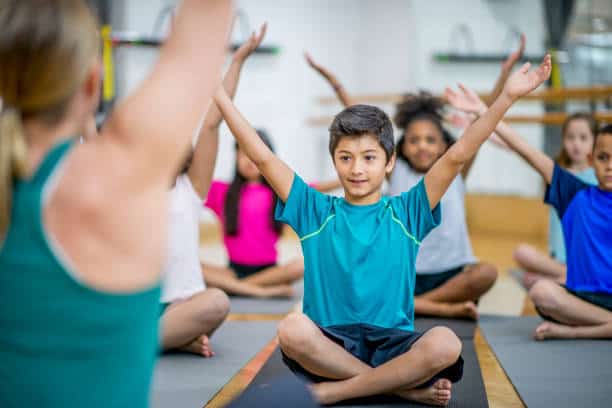
Great teaching principles carry across ages and populations, whether you are working with children, teens, or adults.
Our Kids Yoga Teacher Training gives you the tools to teach children safely and joyfully.
Frequently Asked Questions
Do I need special training to teach yoga to children?
A specialised children’s yoga training is strongly recommended. Standard YTT programmes are not designed to address child development, age-appropriate sequencing, safeguarding, or the pedagogical differences involved in teaching minors.
What age can children start yoga?
Children can begin yoga-based movement from as young as three or four years old in play-based formats. Structured yoga classes become appropriate from around five to six years, with content adapted carefully to developmental stage.
How long should a yoga class be for children?
Around twenty to thirty minutes for under-sixes, thirty to forty-five minutes for primary school ages, and forty-five to sixty minutes for older children and adolescents. Shorter, more active sessions work better than long, slow ones for younger groups.
Is breathwork appropriate for children?
Yes, when taught accessibly and gently. Simple techniques like belly breathing, star breathing (five-count inhale and exhale), and lion’s breath are safe, effective, and often popular with children. Extended pranayama practices are more appropriate for teenagers and adults.
How do I manage a disruptive child in a yoga class?
The most effective approach is engagement rather than correction. Redirect attention through movement, make the child part of a demonstration, or introduce a new element to shift the energy. Clear, calm expectations set at the start of each class also reduce disruption significantly.
The Loka Newsletter
Enliven your routine with exclusive spiritual content. There’s so much to learn.

Find us on Instagram
@lokayogaschool