Last updated on October 21st, 2026 at 08:45 am
Family Yoga: Simple Poses to Practise With Your Kids
Family yoga is less about perfect poses and more about play, connection, and movement you share. Practising with your children turns yoga into something joyful and calming for everyone, and it is far simpler than it sounds.
The same spirit of squeezing movement into daily life applies to grown-ups too, whether that is a few yoga poses at the office desk or, for grandparents and less mobile family members, chair yoga for limited mobility that lets everyone join in. For a bit of fun to share between poses, our 10 shocking facts about yoga makes good mat-side trivia.
Why Practise Yoga as a Family
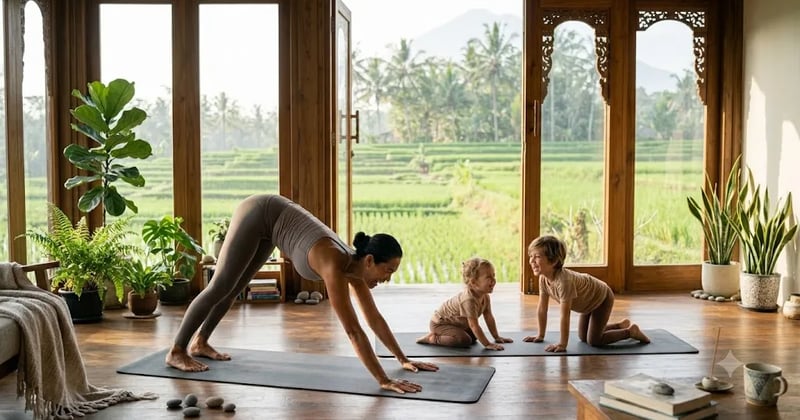
Yoga gives children a gentle way to move, focus, and settle, and it gives you a shared, screen-free activity. It builds body awareness and calm in kids, models healthy habits, and creates easy moments of connection in a busy week.
Simple Poses to Try Together
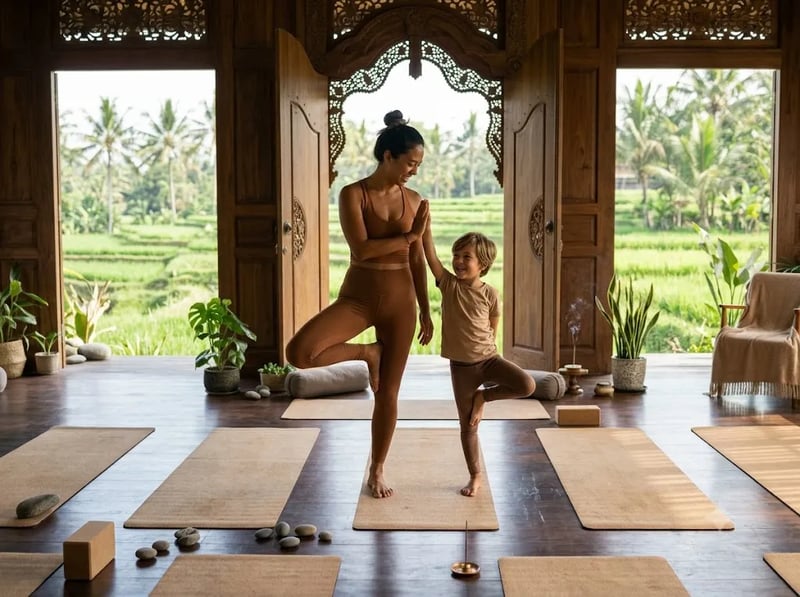
Tree Pose: stand tall on one leg and grow like a tree. Wobbling is part of the fun.
Cat and Cow: on hands and knees, arch and round the back while making the animal sounds.
Downward Dog: make an upside-down V and bark like a dog.
Butterfly: sit with soles together and flap the knees like wings.
Rest like a starfish: lie down, spread out, and take a few calm breaths together.
Keeping It Fun
With children, playfulness beats precision. Use animal names and stories, keep sessions short, and follow their energy. If it turns into giggles and a pile of limbs, it is working. The goal is joyful movement, not a perfect class.
Matching shapes to your child's age
A three-year-old and a nine-year-old need almost opposite things from a shared practice, so match the shapes to the child in front of you rather than to a generic list. Toddlers respond to big, simple, animal-flavoured movements they can copy: cat and cow on all fours, a wobbly tree standing tall, a downward dog they call a mountain. Precision does not matter; participation does.
Younger children also have short attention spans by design, so keep each shape brief and let them move on before they lose interest. Two or three minutes of enthusiastic cat-cow beats ten minutes of a pose held past the point of fun. You are building a warm association with movement, not correct alignment.
Older children, from roughly seven upwards, can hold poses a little longer, follow a short sequence, and enjoy a gentle challenge like balancing on one leg or moving slowly between two shapes. They start to take pride in what their bodies can do, and a small sense of achievement keeps them coming back.
Across every age, let the child lead as much as they follow. Invite them to name a pose, invent an animal, or choose what comes next, and the practice stops being something done to them and becomes something they own. That sense of ownership is what turns a one-off novelty into a habit the whole family keeps.
Partner shapes parents and children can do safely
Partner poses are where family yoga becomes something you could not do alone, and the safest ones share weight gently rather than lifting or bearing down. A back-to-back seated breath, where you and your child sit spine to spine and feel each other breathe, is calm, connecting, and impossible to get wrong. It is a lovely way to start or finish.
A double forward fold works the same way: sit facing each other with legs apart and soles nearly touching, hold hands, and take turns leaning gently back and forwards so each of you gets an easy stretch. The movement is small, the child controls how far they go, and nobody is pulled into anything.
Avoid the dramatic ones you see online, especially anything where an adult balances a child overhead or on their feet. Those acrobatic shapes look charming in a photo and carry real risk if a child wriggles or a grip slips. Family yoga at home is not the place for tricks that need a spotter.
The rule for any partner shape is that the smaller, lighter person sets the limit. Let your child decide how far to lean, when to stop, and when they are finished, and follow their lead rather than your own idea of how the pose should look. Shared movement should feel like play between equals, not a performance one of you directs.
Turning the practice into a game or a story
Children learn through play, so the fastest way to lose them is to run a class and the fastest way to keep them is to tell a story. String the poses into a journey: you are a mountain at dawn, then a tree in the forest, then a dog stretching, then a cat waking up, then a butterfly resting in a meadow. Each shape becomes a character in the tale.
Sound and imitation do a lot of the work. Let toddlers hiss like a snake in cobra, bark quietly in downward dog, or sway like a tree in the wind. The noise is not a distraction from the practice; for a small child it is the practice, and it keeps them moving without you having to correct anything.
Games work brilliantly for slightly older children. Try a yoga freeze game where everyone flows and then holds a shape when the music stops, or a dice roll where each number is a different pose. The structure gives them just enough challenge to stay engaged while the movement takes care of itself.
Keep your own expectations loose. If the story wanders, a pose collapses into giggles, or your child abandons the plan to invent their own animal, that is the session working, not failing. The measure of family yoga is whether everyone wants to do it again, not whether it looked like a studio class.
Safety notes and a short sequence to try tonight
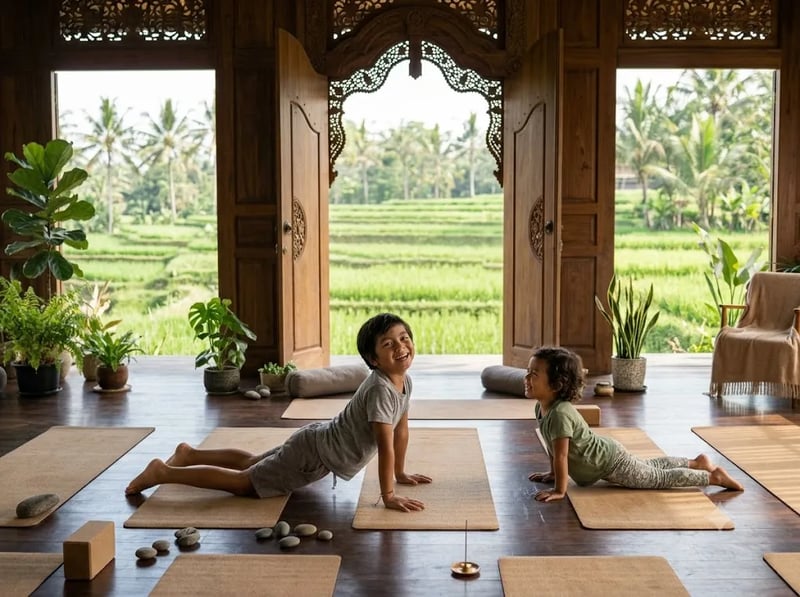
A few simple rules keep family yoga safe. Never push or pull a child into a deeper shape, and never use their natural flexibility as a goal to chase, because young joints and growing bodies do not need to be stretched to a limit. Their range of movement is not a target to beat. Stay within easy, comfortable movement and let the child stop whenever they want.
Supervise throughout, keep the space clear of hard corners and clutter, and skip anything involving one person bearing another’s full weight. If a child has a health condition or you have any concern about a particular movement, check with your doctor first. Comfort, breath, and enjoyment matter far more than how a pose looks.
Here is a gentle 10-minute sequence to try tonight. Begin sitting back to back for one minute, just breathing together. Move to all fours for a minute of cat and cow, letting everyone make the animal sounds. Stand tall in tree pose for a minute a side, wobbling allowed, then fold forwards loosely for a minute to hang like rag dolls.
Come to the floor for a shared butterfly, soles together, gently bouncing the knees for a minute, then face each other for a two-minute double forward fold, taking turns to lean. Finish flat on your backs side by side for two minutes of rest, watching your bellies rise and fall. If practising with children draws you towards teaching them properly, our comparison of yoga for kids and yoga for adults is a useful next read, and a 200-hour yoga teacher training gives you the grounding to teach any age safely.
Keeping it going when the novelty wears off
The first few sessions with children are usually easy, because it is new and being invited to move about and make animal noises with a parent is inherently appealing. Somewhere around the fourth or fifth attempt the novelty goes, and that is where most family practices quietly end.
Shorten it before that happens rather than after. Ten minutes that finishes while everyone is still enjoying it does far more for the long run than half an hour that ends in negotiation. Children will ask for more of something that stopped too soon and will resist more of something that went on too long, and stopping early is the most reliable technique available to you.
Hand over some of the control. Letting a child choose the order, name the poses, or invent one entirely changes their relationship to the activity from something being done to them into something they are part of. The poses they invent will not be anatomically thoughtful, which does not matter at all, and the enthusiasm this generates is worth more than correct form.
Attach it to a moment that already exists. After bath time, before a story, on a particular morning of the week. Practices that depend on someone remembering to suggest them fade within a fortnight. Practices attached to an existing routine survive, because the routine does the remembering.
Expect it to be uneven, and expect that to be fine. Some sessions will be focused and some will dissolve into laughing on the floor within four minutes. The second sort is not a failed session, and treating it as one is the fastest way to make the whole thing feel like a chore for everyone. If a child does not want to join in on a given day, practise anyway and let them watch. They frequently join partway through, and they are much more likely to if it was not required.
Keep the safety points simple, because they matter more with children than adults. No pushing or pulling anyone into a shape, no weight on anyone’s head or neck, no competing over who can go further, and stop immediately if anything hurts. Children are generally more flexible than adults and less able to judge when they have gone too far, which is precisely why the practice should be led by enjoyment rather than by range.
Mixed ages in one session need a small adjustment. Rather than pitching to the middle, which tends to lose both ends, give the older child a job: naming the poses, leading a section, or helping the younger one. That turns a gap in ability into a role and usually holds their interest far longer than a harder variation would. Younger children will drift in and out regardless, and letting them do that without comment keeps the session pleasant for everyone. Aim for the whole thing to feel like play with a shape to it rather than a class with an age range problem. If you would like to take this further and teach children’s yoga properly, our kids yoga teacher training is a good next step.
When one child opts out
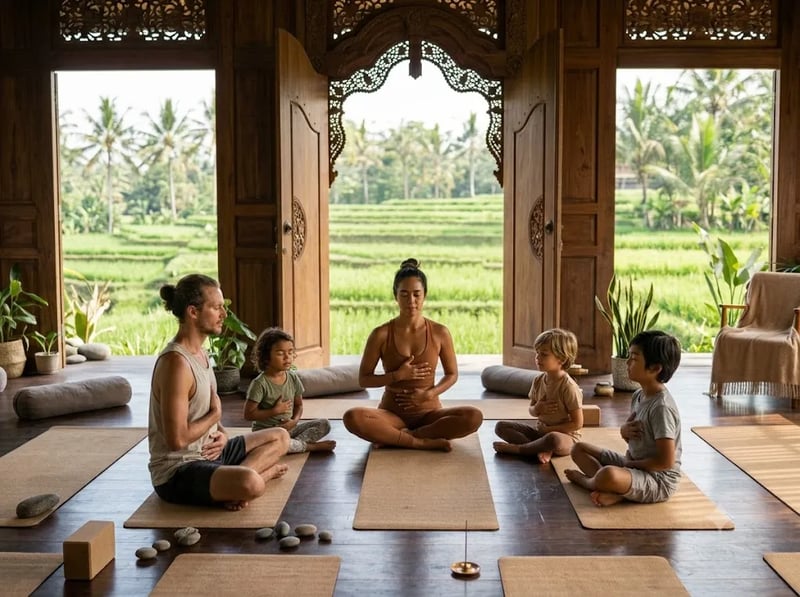
Sooner or later one of them will not want to. A sibling joins in happily while the other sits on the sofa and watches, or the child who asked for this last week has decided it is boring. This is normal, and how you handle it decides whether the practice survives the month.
What works is to keep going without commentary. Carry on with whoever is willing, leave the mat out, and do not negotiate, bribe, or explain why it would be good for them. Children who feel watched for signs of participation tend to dig in. Children who see something happening nearby, week after week, often join in halfway through without announcing it.
Wide age gaps are the other common sticking point. A four-year-old and an 11-year-old want completely different things from the same 20 minutes, and hunting for a shared level usually leaves both of them bored. It works better to give them different jobs in the same session: the older one leads a pose and counts the breaths, the younger one is the animal in the story. Nobody is being held back or dragged along.
Your own practice is worth protecting separately from all of this. Shared sessions are play, connection, and a bit of movement, and they will not give you what a proper practice gives you. Teachers on our 200-hour yoga teacher training often arrive believing they should be able to combine the two, then find that 15 honest minutes alone before the house wakes up does more for them than an hour of shared time ever did.
Keep the shared sessions short, end them while everyone still wants more, and let frequency matter more than length. Ten minutes on four evenings will build something. An ambitious hour on a Sunday that ends in an argument will not.
Train With Loka
If sharing yoga with children lights you up, you can learn to teach them well. Our Kids Yoga Teacher Training gives you the tools to guide young ones safely and joyfully. See also yoga for kids vs yoga for adults.
Frequently Asked Questions
What age can children start yoga?
Toddlers can join playful movement, and most children enjoy simple poses from around three or four. Keep it light and fun.
How long should family yoga last?
Short and sweet. Ten to twenty minutes suits most children; follow their energy rather than a fixed plan.
Do I need to be good at yoga to practise with my kids?
Not at all. Family yoga is about play and connection, not perfect poses.
How do I keep children engaged?
Use animal names, stories, and sounds, keep it playful, and let a bit of chaos be part of the fun.
How do I get a reluctant child to try yoga?
Do not sell it; just practise where they can see you, and let curiosity do the inviting. Children join games, not disciplines, so lead with animal shapes and stories rather than instructions. If they drift in for two minutes and leave, that was a success, and the next visit is usually longer.
Are partner yoga poses safe for young children?
Gentle ones are, when the weight is shared rather than lifted. Back-to-back breathing and a seated double forward fold are calm and low-risk because the child controls how far they go. Avoid acrobatic poses where an adult balances a child overhead or on their feet, always supervise, and let the smaller person set the limit.

The Loka Newsletter
Enliven your routine with exclusive spiritual content. There’s so much to learn.

Find us on Instagram
@lokayogaschool