Last updated on October 21st, 2026 at 02:31 pm
The Best Time of Year to Visit Bali for Yoga
Bali is a year-round yoga destination, but the season you choose shapes the experience. The island has two clear seasons, and each has its own character for practice and travel.
Once you know when you are going, our guide to what to pack for a Bali retreat helps you prepare, and a first-timer’s guide to Ubud is a great next stop if that is where you are headed.
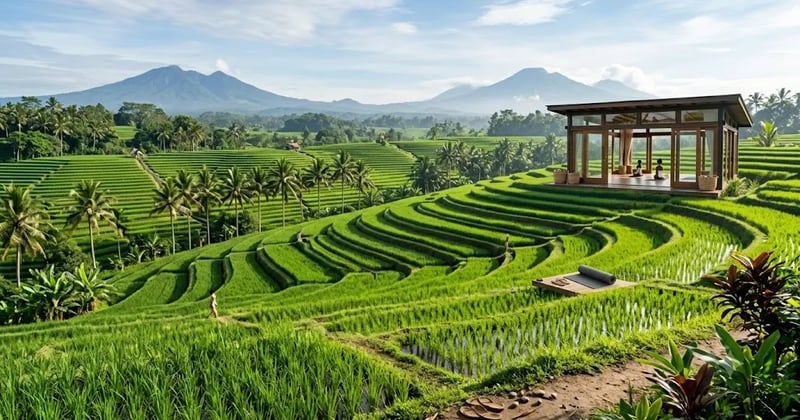
The Dry Season (April to October)
This is the most popular time to visit. Days are sunny and less humid, evenings are pleasant, and outdoor practice is at its best. The trade-off is that the peak months of July and August are busier and pricier. For a balance of good weather and fewer crowds, the shoulder months of April, May, and September are ideal.
The Wet Season (November to March)
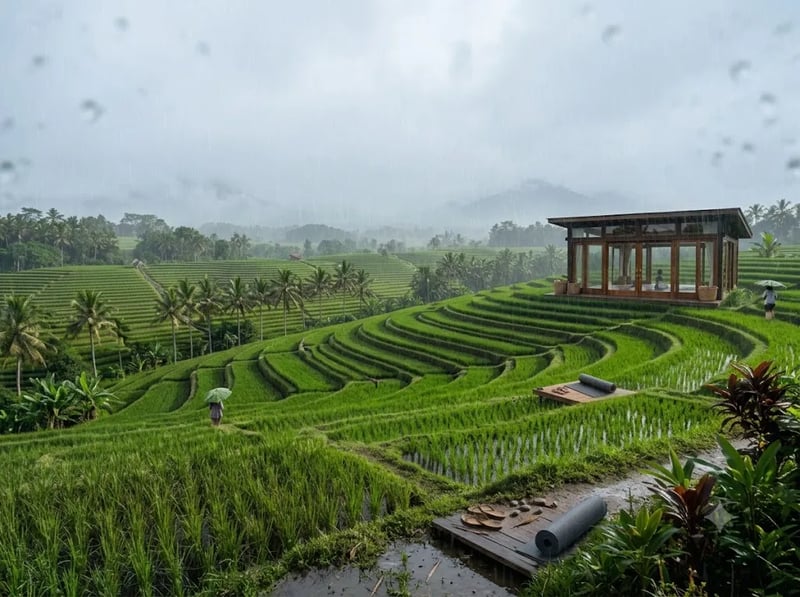
The wet season brings warm temperatures and short, heavy afternoon downpours, usually followed by sunshine. Mornings are often clear, which suits an early practice, and the island is lush, quiet, and more affordable. If you do not mind some rain and prefer a calmer, greener Bali, this season has real charm.
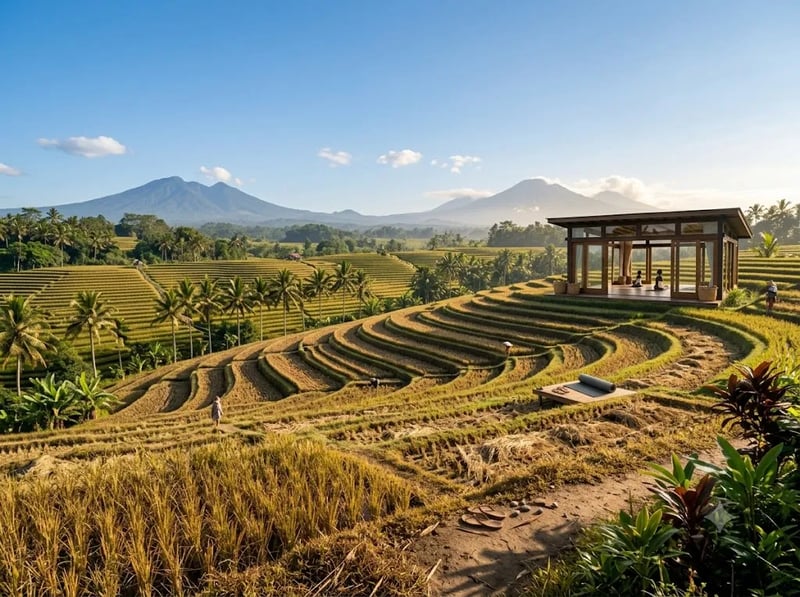
Choosing for Your Practice
For reliable sunshine and social energy: June to August.
For good weather with fewer people and better value: April, May, September, October.
For a quiet, lush, budget-friendly retreat: November to March, embracing the afternoon rains.
How each month actually feels on the ground
Averages tell you the weather, but they do not tell you how a month feels once you are practising in it. Bali shifts in mood across the year, and knowing the texture of each stretch helps you pick a window that matches what you are after.
January and February sit at the heart of the wet season: green, lush, and quiet, with warm mornings and reliable afternoon rain. March starts to dry out and is one of the island’s underrated months, still green from the rains but with more clear afternoons. April through June is the sweet spot for many, warm and bright without the peak-season crush, and the rice fields around Kedungu look their best.
July and August are the driest, coolest, and busiest months, with lower humidity that makes long practice sessions feel effortless and a buzz that fills every cafe and studio. September and October hold onto the dry weather while the crowds thin, which is why a lot of returning visitors quietly favour them. November and December ease back into the wet, warm and atmospheric, with the first real downpours returning.
None of these months is a write-off for yoga. They simply reward different temperaments, and the “best” one is the one whose pace suits yours.
Crowds, prices, and the value of the shoulder months
When you travel changes what you pay and how the island feels, sometimes more than the weather does. Peak season runs through July, August, and the Christmas and New Year fortnight, when accommodation books out early and prices climb across flights, rooms, and popular classes.
The shoulder months are where the real value sits. April to June and September to October give you most of the dry season’s ease with noticeably softer prices and far more breathing room, and studios feel spacious rather than scrambled. You will book more easily, spend less, and share your mornings with fewer people, which for many practitioners is the whole point. Planning a teacher training rather than a holiday? We have counted the whole month in our Bali teacher training cost breakdown.
The wet season, roughly November to March, is the quietest and cheapest window of all, Christmas aside. If your budget matters more than guaranteed sunshine, and you do not mind rearranging an afternoon around a downpour, you will find the same teachers and the same spaces at a fraction of peak cost. Knowing what to bring for that window helps, and our guide on what to pack for a yoga retreat in Bali covers wet-season packing in detail.
What the rainy months are really like
The phrase “wet season” scares people off far more than it should. The reality is not weeks of grey drizzle, it is warm, humid days that are often bright well into the afternoon, punctuated by heavy showers that tend to arrive late in the day and move through quickly.
Morning practice, which is when most retreats and trainings schedule their strongest sessions, usually happens under clear or lightly clouded skies. The rain has a rhythm you learn within a day or two: you plan beach time and long outings for the morning, and you let the afternoon downpour become the hour you rest, journal, or nap through savasana. There is something genuinely restorative about practising to the sound of rain on a thatched roof.
The trade-offs are real but small. Humidity is higher, some roads flood briefly, and a scooter ride can catch you out, which is why a light rain layer and a relaxed attitude go a long way. What you get in return is the island at its greenest, its calmest, and its most affordable, with waterfalls in full flow and rice terraces impossibly vivid.
Nyepi and the quiet days worth knowing about
One date deserves special attention if you are planning around March. Nyepi, the Balinese day of silence, marks the Saka new year and brings the entire island to a complete stop for 24 hours, usually in March, though the exact date shifts with the lunar calendar each year.
On Nyepi nobody travels, the airport closes, shops shut, lights stay dim, and even quiet activity outdoors is set aside for reflection. Retreat centres and villas continue with a pared-back rhythm inside their grounds, which can make for a uniquely still, inward day of practice, but you cannot arrive, leave, or explore. The evening before is the opposite: loud, joyful ogoh-ogoh processions fill the streets as effigies are paraded and burned.
If you value the experience, planning to be settled somewhere before Nyepi is a rare kind of retreat within a retreat. If you would rather keep moving, simply build your travel days around it. Beyond Nyepi, the days around Galungan and Kuningan, and the many temple anniversaries, bring ceremonies that are beautiful to witness and worth checking against your dates.
Matching the timing to your goal
The right month depends less on the calendar than on why you are coming. A short holiday with some yoga folded in, a dedicated retreat, and a full teacher training each reward a slightly different window.
If you are here mainly to holiday and want dependable sun for beaches and day trips, aim squarely at the dry season, ideally the shoulder months of May, June, September, or October. If you are booking a retreat to rest and reset, the wet season’s quiet and lower prices can be a gift, since you are indoors practising through the rain anyway and the stillness suits the intention.
A teacher training is the one case where weather matters least. You will spend most daylight hours in the shala studying, moving, and learning, so comfort, focus, and value tend to outweigh sunshine, and the quieter months can actually deepen the container by removing distraction. If a training is what you are weighing, our overview of the 200-hour yoga teacher training explains how the days are structured so you can picture your season inside it.
Whatever you choose, Bali gives you something worth practising in every month of the year. Pick the pace, the budget, and the intention first, and the timing tends to sort itself out.
Working backwards from your own calendar
The weather guidance above tells you what the island is doing at a given time of year. It cannot tell you which weeks will actually work for you, and for most people the constraints of their own life narrow the choice long before rainfall does.
Start with the fixed points. Annual leave, school terms, work seasons you cannot leave, family commitments and anything that would be difficult to be away for. Most people find this leaves two or three viable windows rather than a free choice, which is a far easier problem than choosing from a whole year.
Then apply the weather guidance to those windows rather than the other way around. A slightly wetter month that you can actually take, and arrive at unhurried, will give you a better experience than an ideal month you reached by rearranging your life and then spent worrying about what you left behind. Presence is worth more here than climate.
Give yourself buffer days at both ends. A day between arriving and starting anything makes a real difference, because the journey is long and the time difference is substantial from most places. A day at home before returning to work matters at least as much. People consistently underestimate the second one and arrive back at their desk still adjusting, which colours how they remember the whole trip.
Book earlier for the busy windows and later for the quiet ones. The popular months fill genuinely, and late booking there means less choice of accommodation and higher prices. In quieter months the pressure is off and you can decide closer to the time, which suits people whose schedules firm up late.
Consider what else is happening while you are there. Major local ceremonies and public holidays change the atmosphere, sometimes beautifully and sometimes in ways that affect transport and opening hours, and Nyepi in particular brings the island to a complete stop for a day. None of that is a reason to avoid a period, and knowing about it in advance turns a surprise into part of the trip. A quick check of the ceremonial calendar for your window is five minutes well spent.
The shoulder periods either side of the main seasons are worth a specific look, and they are often the best value. You get a mixture of conditions rather than a settled pattern, which means some days go one way and some the other, but you also get lower prices, quieter rooms and easier booking. If you are relaxed about weather and would rather not share a studio with a full house, those in-between weeks are frequently the sweet spot. If a guaranteed run of dry mornings matters to you, they are not, and it is worth being honest with yourself about which you are.
How far ahead to book, season by season
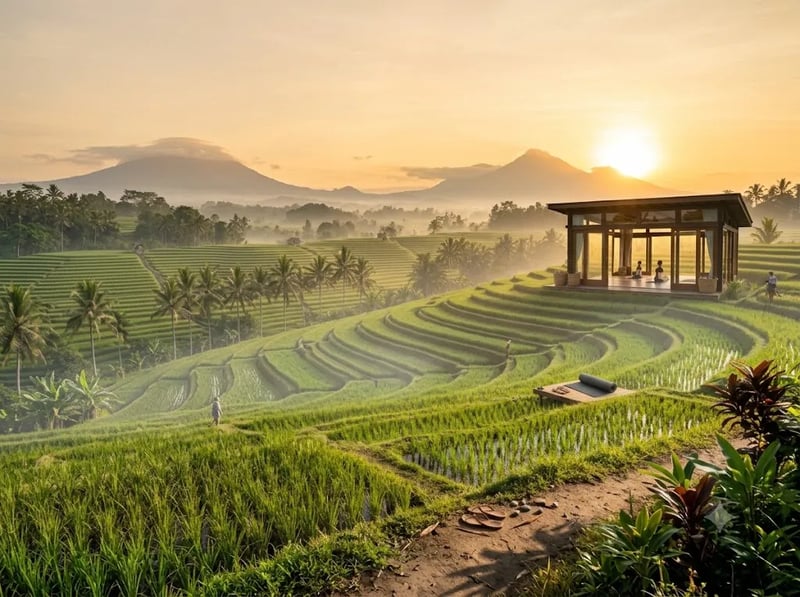
Once you have chosen your window, the remaining question is lead time, and it varies more by season than people expect. For July, August, and the Christmas fortnight, treat three to six months ahead as the sensible booking horizon for retreats and trainings: the well-regarded programmes fill first, and late bookers choose from what remains rather than what suits them.
The shoulder months are kinder. Six to ten weeks ahead usually secures a good room and a fair flight price for April to June and September to October, though a specific programme with fixed dates deserves earlier commitment regardless of season, since a course either has a place for you or it does not.
Wet-season travel is the most forgiving of all, and genuinely spontaneous trips are workable outside the holiday peak. Flights are the exception to all of this: prices firm up as departure approaches in every season, so book them once your dates are certain rather than waiting on a better fare.
Two housekeeping notes whatever your month: check current visa and entry requirements for your nationality well before flying, as rules change, and confirm your travel insurance covers the activities you plan. Both take an evening and remove the only surprises worth avoiding.
Where on the island you stay changes the season
Bali is small enough that people talk about its weather as one thing, and it is not. The island has a spine of volcanoes down the middle, and the two coasts get noticeably different versions of the same month.
The south and west, where most of the studios and schools sit, take the brunt of the wet season. Rain arrives off the Indian Ocean, the surf on that side is at its best from about April to October, and the beaches are busiest across those months for exactly that reason. Kedungu and the coast around it follow this pattern closely.
The east and north-east work almost in reverse. Amed and the villages along that shore stay drier and calmer while the south is being rained on, and the water is clearest there in the months people avoid everywhere else. If your trip lands in January and you want a few settled days afterwards, that is the direction to point.
Altitude does its own thing. Ubud sits inland and higher, so it is greener, cooler at night, and wetter year-round than the coast. People often plan a week by the sea and a few days up there without realising they will want a jumper for the second half.
None of this changes the broad advice above. The dry season is still the straightforward choice, and the shoulder months are still the best value. It does mean a wet-season trip is not the compromise it sounds like, provided you are willing to move once while you are here.
If you are coming for a 200-hour yoga teacher training rather than a holiday, this matters less. You will be where the course is, on a fixed timetable, and the weather becomes something that happens between sessions rather than something you plan around.
Train With Loka
Whenever you come, the practice is what you make of it. Our 200-Hour Yoga Teacher Training runs across the year in Kedungu, Tabanan, so you can choose the season that suits you. To feel the culture you will be arriving into, read the meaning of Bali offerings.
Frequently Asked Questions
When is the best time to visit Bali for yoga?
The dry season, April to October, offers the most reliable weather. The shoulder months balance good conditions with fewer crowds.
Is the wet season a bad time for a yoga retreat?
Not at all. Rain tends to come in short afternoon bursts, mornings are often clear, and the island is quieter, greener, and cheaper.
What are the busiest months in Bali?
July and August are the peak, with the most visitors and highest prices.
Is Bali hot all year?
Yes, temperatures stay warm year round. The main difference between seasons is humidity and rainfall, not temperature.
What is the weather actually like in the wet season?
Warm and humid, with bright mornings more often than not and heavy showers concentrated in the afternoons that typically pass within an hour or two. Sustained grey washout days are the exception. Morning practice runs largely undisturbed, which is why the season deters fewer yoga travellers than its name suggests.
When is the cheapest time to do a yoga retreat in Bali?
The wet season, roughly November to March, is the cheapest window apart from the Christmas and New Year peak. The shoulder months of April to June and September to October offer the best balance of dry weather and lower prices, with fewer crowds than July and August.
The Loka Newsletter
Enliven your routine with exclusive spiritual content. There’s so much to learn.

Find us on Instagram
@lokayogaschool