Last updated on July 29th, 2026 at 03:40 pm
A First-Timer's Guide to Ubud: Bali's Yoga Heart
Ubud is Bali’s cultural and spiritual centre, and for many travellers it is the island’s yoga heart. Set among rice terraces and temples inland from the coast, it draws practitioners from around the world. If it is your first visit, a little context helps you enjoy it well.
Timing your trip well starts with knowing the best time to visit Bali for yoga. And if you are still deciding whether a trip like this is worth it at all, our honest look at whether you really need a yoga retreat is a good place to start.

What to Expect
Ubud is green, humid, and busy in the centre, quieter as you move out into the rice fields. You will find studios, healthy cafes, craft markets, and temples within easy reach. It is walkable in parts, though the traffic and narrow footpaths mean many people use scooters or arrange drivers.
Practising Yoga in Ubud
Ubud has a rich yoga scene, from large drop-in studios to small, intimate shalas. Morning classes are popular before the heat builds. Whatever your style, you will find it here, and practising surrounded by this landscape is part of the appeal.

Beyond the Mat
Visit a temple or a rice-terrace walk early, before the crowds and heat.
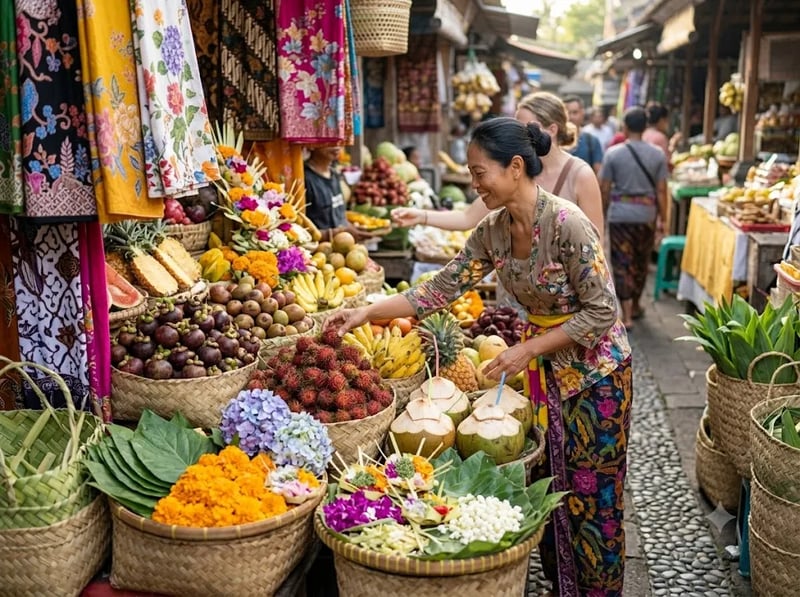
Explore the local markets, and haggle gently and good-naturedly.
Try the cafe culture, which caters generously to plant-based and wellness diets.
Travelling Respectfully
Ubud is a living Balinese community, not a theme park. Dress modestly at temples, step around the daily offerings on the ground rather than over them, and meet the warmth of the Balinese with the same. A little respect deepens the whole experience.
Getting there and finding your way around
Ubud sits inland in Bali’s central highlands, and almost everyone arrives the same way: a flight into Ngurah Rai International Airport near Denpasar, then a transfer north. The drive takes roughly 90 minutes to two hours depending on traffic, which in Bali is less predictable than distance suggests, so it pays to expect the longer end.
The easiest first move is to arrange an airport pickup through your accommodation. Having a name on a sign after a long flight removes every decision at the point you least want to make one, and the fixed price spares you a tired negotiation. If you would rather sort it yourself, ride-hailing apps like Grab and Gojek work well in Bali and take the guesswork out of fares.
Once you are settled, getting around Ubud town itself is best done on foot, since the centre is compact and walkable, if busy. For anything further afield, most first-timers hire a private driver for the day, which is affordable when shared and turns transport into a guided outing. Scooters are the local default and give real freedom, but Ubud’s traffic, narrow roads, and confident local riders make them a poor choice for a nervous first-timer, so be honest about your experience before you rent one.
Where to stay for every budget
Ubud has grown a place to stay for almost every price point, and the differences are more about setting than quality. Deciding whether you want to be in the buzz of the centre or tucked into the rice fields on the edge matters as much as the nightly rate.
At the budget end, guesthouses and family-run homestays are one of Ubud’s great pleasures, offering clean, simple rooms, a warm welcome, and often breakfast, frequently within a family compound so you feel part of daily life. Mid-range money goes a long way here, buying boutique hotels and villas with pools, garden settings, and thoughtful design that would cost several times as much at home. At the top end, luxury resorts perched over river valleys and rice terraces deliver the kind of view that fills camera rolls.
A word on location. Staying in central Ubud puts cafes, shops, and yoga studios at your doorstep but comes with noise and traffic, while properties a short ride out trade convenience for calm, birdsong, and green. For a first visit, somewhere on the quieter edge of the centre often gives you the best of both, close enough to walk in, far enough to sleep.
Day trips beyond the town
Part of Ubud’s appeal is how much sits within an easy drive, and a hired driver for a day turns the surrounding countryside into an unhurried loop of highlights. Plan these for the morning, especially in the wetter months when afternoon rain tends to roll in.
The rice terraces are the obvious and worthy first stop. Tegallalang, just north of town, gives you the classic tiered green amphitheatre, and going early beats both the heat and the crowds. Temples reward the effort too: Tirta Empul, with its holy spring water purification ritual, and the dramatic clifftop and cave settings elsewhere on the island give you the sacred side of Bali up close, always dressed respectfully with shoulders and knees covered.
Then there are the waterfalls. The countryside around Ubud hides several, from easy roadside cascades to those reached by a sweaty flight of steps, and standing under cool falling water after the climb is its own small reward. If you want to time these outings for the season with the fewest washouts and the greenest scenery, our guide to the best time to visit Bali for yoga maps the dry and wet windows against exactly this kind of trip.
Eating well in the food capital
Ubud has quietly become one of Asia’s best places to eat if you love fresh, plant-forward food, and eating well here is easy on both the palate and the wallet. The town is dense with cafes built around wholefoods, smoothie bowls, and inventive vegetarian and vegan menus, which makes it a natural fit for a yoga-minded trip.
For the full local experience, seek out a warung, the small family-run eateries serving Balinese and Indonesian home cooking at gentle prices. A plate of nasi campur, rice with a spread of vegetables, tempeh, and sambal, is cheap, satisfying, and about as authentic as food gets. Sitting down in a busy warung is also where you feel the everyday rhythm of the town rather than its tourist layer.
A few sensible habits keep your stomach happy. Drink bottled or filtered water rather than tap, refilling where you can to cut plastic, and ease into new foods rather than sampling everything at once on day one. Busy places with high turnover are generally your safest bet, and the warung packed with locals is usually packed for good reason.
Ubud is one option, not the only one
It would be easy to finish a guide like this thinking Ubud is where Bali yoga begins and ends, so here is an honest word. Ubud is Bali’s most famous yoga town for good reason, but it is a jungle-and-rice-field setting inland, and it is not the whole island, nor the right fit for everyone.
Loka Yoga School itself is not in Ubud. We are on the other side of the island in Kedungu, Tabanan, set among rice fields about a kilometre from the coast, which is a very different feel: sea breezes, surf beaches within reach, and open sky rather than dense jungle. Some people know instinctively they want Ubud’s lively, spiritual, cafe-culture buzz, while others are drawn to the quieter, coastal calm we sit in, and both are valid ways to experience yoga in Bali.
If a first trip to Ubud is where your curiosity starts, treat it as one chapter and stay open to the rest. When you are ready to picture the coastal alternative, our 200-hour yoga teacher training in Kedungu shows what practising away from the crowds looks like, so you can choose the setting that actually suits you rather than the one you have simply heard the most about.

Finding your feet in the first two days
The first 48 hours shape how the rest of a stay feels, and they are also when you are most tired and least oriented. A little structure across those two days is worth more than any amount of advance reading.
Do very little on the first day. The journey is long from almost anywhere, the heat and humidity are noticeable if you are not used to them, and most people significantly overestimate what they will feel like doing on arrival. Get to where you are staying, eat something, walk for twenty minutes to see the immediate area, and stop there. Booking anything demanding for day one is a reliable way to spend day two recovering.
Sort out the practical basics early, because doing so removes a low hum of friction from the whole trip. Cash, a local data connection, and knowing which way is which from your front door. Ubud is walkable in parts and much less so in others, and pavements are uneven enough that walking at night without a torch is genuinely awkward. Your phone torch counts.
Get your bearings from one fixed reference point rather than trying to hold a map of the whole town. Pick a landmark near where you are staying and learn the routes out from it in two or three directions. The layout makes more sense from a single anchor than from an overview, and you will stop needing your phone within a couple of days.
Expect the traffic to be the main adjustment. The roads are busy, narrow and shared with a great many scooters, and crossing takes a different rhythm than you may be used to: steady and predictable rather than quick and hesitant. If you are considering hiring a scooter, be honest about your experience, and know that riding without the correct licence will invalidate your travel insurance entirely.
Eat and drink sensibly for the first few days while you adjust. Bottled or filtered water, including for brushing your teeth, and busy places with high turnover for food. Carry any medication you rely on rather than assuming you can buy it, keep something for an upset stomach in your bag, and take out travel insurance that covers medical treatment before you leave. Most people have no trouble at all, and the small precautions are what keep it that way.
Leave the centre at least once. The area within walking distance of the main streets is only a small part of what is around you, and a half day heading out in almost any direction changes the character of a trip considerably. Arrange a driver for the day rather than piecing together transport, agree the price before you set off, and let them suggest the route, since local knowledge produces a better day than a list from the internet. Go early if you can. Mornings are cooler, quieter and consistently the best few hours available.
Paying for things, and what to carry
Ubud runs on a mix of cash and QR payments, and knowing which is which saves a lot of standing around. Warungs, drivers, market stalls and most small studios take cash. Cafés, larger studios and supermarkets take cards, though some add a surcharge for the privilege.
Carry small notes. Drivers and stallholders often have no change for a large note early in the day, and the transaction stalls while somebody walks off to find some. Break your big notes at supermarkets or cafés and keep the small ones for everything else.
QRIS, Indonesia’s national QR payment standard, now works in a surprising number of small places, including warungs that take no cards at all. If your bank supports it, set it up before you arrive. It removes the change problem and settles the amount before you scan, which takes the guesswork out of paying.
Use the ATMs attached to bank branches rather than the freestanding machines inside convenience stores. Withdraw larger amounts less often, since each withdrawal carries a fee at both ends. Watch which comes out first, the card or the cash, because some machines return the cash first and that is exactly how people walk away without their card.
Prices move, so treat any figure you read online as a rough guide rather than a quote. As a rule of thumb, a meal at a local warung costs a fraction of the same dish in a café with a rice-field view, and what you are paying for is the view. Studios usually sell class packs at a real discount over drop-ins, so if you are staying more than a few days it is worth asking before your first class rather than after your fourth.
Train With Loka
Ubud is inland; our home is on the coast at Kedungu, Tabanan, a quieter, wilder side of Bali. If a Bali immersion is calling, our 200-Hour Yoga Teacher Training is set in that landscape. To understand the culture you will meet, read the true meaning of Bali offerings.
Frequently Asked Questions
Is Ubud good for yoga beginners?
Yes. It has classes for every level, from gentle drop-ins to advanced workshops.
How do I get around Ubud?
Many people walk in the centre and use scooters or arranged drivers for longer trips. Traffic can be slow.
When is the best time to visit Ubud?
The dry season, April to October, offers the most reliable weather, though Ubud is green and worth visiting year round.
Is Ubud on the coast?
No, Ubud is inland among rice terraces. For beaches you head to the south or west coasts, such as Canggu or Kedungu.
How many days do you need in Ubud for a first visit?
Three to four full days is a comfortable first stay. That gives you time to settle in, take morning yoga classes, wander the town and markets, and fit one or two day trips to rice terraces, temples, or waterfalls without rushing. Add a few more days if you want to slow right down or fold in a retreat.
Is Ubud expensive to visit?
It spans the full range. Warung meals, homestays, and drop-in yoga classes are genuinely affordable, while boutique villas and resort spas reach international prices. A comfortable mid-range day, accommodation, three meals, a class, and transport, costs far less than the equivalent in most Western cities, which is a large part of Ubud’s appeal.

The Loka Newsletter
Enliven your routine with exclusive spiritual content. There’s so much to learn.

Find us on Instagram
@lokayogaschool