Last updated on October 24th, 2026 at 11:50 am
Restorative Yoga: What It Is and Why It Helps
Restorative yoga is the practice of complete rest. Using props to fully support the body, you hold a small number of gentle poses for long, still minutes, doing as little as possible. In a culture of constant effort, it can be the most challenging practice of all: the practice of not trying.
If this slow approach resonates, it is worth knowing what is involved in starting a Yin yoga teacher training, and for an even more still practice, try Yoga Nidra, the practice of conscious sleep.
How It Works
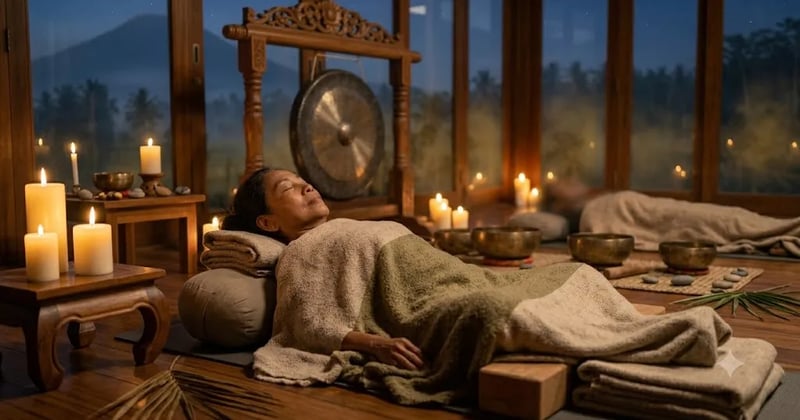
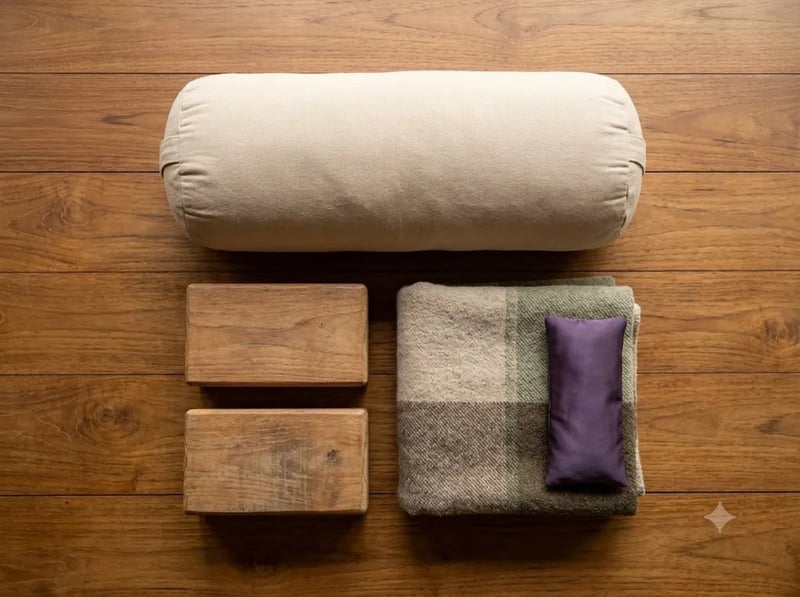
In restorative yoga, props such as bolsters, blankets, and blocks hold you in shape so your muscles can switch off entirely. Poses are held for anywhere from three to twenty minutes. With nothing to hold and nowhere to go, the nervous system slides into deep rest, and the body’s own repair processes have room to work.
Restorative vs Yin Yoga
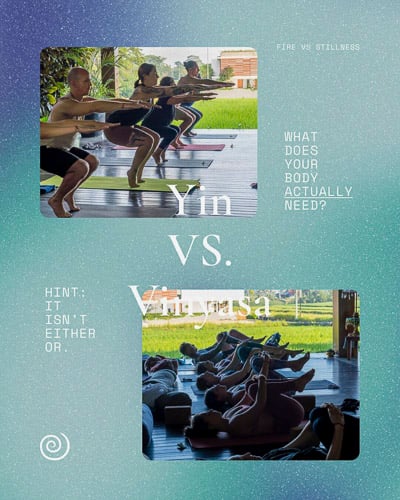
The two are often confused. Yin yoga applies gentle, sustained stress to connective tissue, so you feel a stretch. Restorative yoga removes stress entirely; you should feel only support and ease. Yin works the body; restorative lets it recover. Many people practise both, for different reasons.
The Benefits
Activates the rest and digest response, lowering stress.
Improves sleep and eases tension held in the body.
Offers a genuine counterbalance to busy, stimulating lives.
Requires no strength or flexibility, so it suits every body.
Who It Is For
Restorative yoga suits anyone who is tired, stressed, recovering, or simply craving stillness. It is especially valuable for people who find it hard to slow down, precisely because it makes rest the practice rather than an afterthought.
Props and how to set up the common shapes
The props are what make this style work, so it helps to know what they do rather than treat them as optional extras. Bolsters, folded blankets, blocks, and a strap exist for one purpose: to hold your body in a shape so completely that your muscles have nothing left to do.
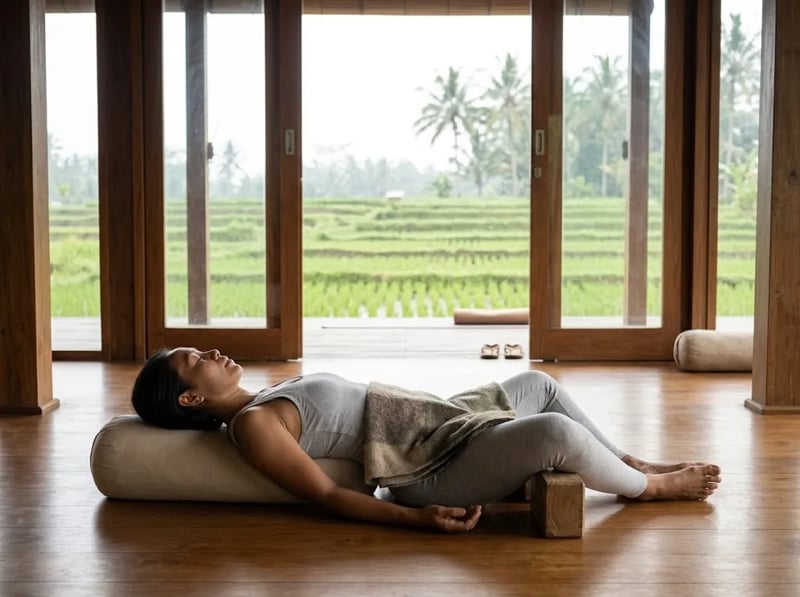
Take a supported reclined pose as the classic example. Sit in front of a bolster, lie back along its length so it runs up your spine, and let a folded blanket cradle your head slightly higher than your chest. Your arms rest wide, your knees fall open with a block or cushion under each thigh, and once you are set, nothing should feel like it is working.
A forward fold is similar in spirit. Sit with your legs apart, stack one or two bolsters between them, and drape your torso forward so your chest and head are fully carried by the props rather than by your back. If you feel a stretch, you have gone too far and need more height under you.
The test for every set-up is the same. If you could hold the shape for five minutes and then 10 without fidgeting, the props are doing their job. If you cannot, add support until you can.
What the stress research actually found
This is where honesty serves you better than a sales pitch. The intuitive story is that deeply relaxing poses should lower your stress hormones, and it is a reasonable hypothesis, but the best trial on the question complicates it.
The 2014 PRYSMS randomised trial by Sarah Corey in Psychoneuroendocrinology compared a restorative programme with a simple stretching programme in women with metabolic syndrome and measured their daily cortisol patterns. The finding that surprises people is that stretching, not the restorative practice, produced the more favourable cortisol change.
That does not mean the practice is worthless. It means the specific claim that it uniquely lowers cortisol is not well supported, and you should be wary of anyone who states it as fact. What the practice reliably offers is a felt sense of rest and a rare, unhurried pause, which has genuine value even where the hormone data is mixed.
Holding both of those truths at once is the grown-up position: a practice can be worth your time for how it helps you feel while the physiological claims around it remain modest and unsettled.
Building a short sequence at home
A useful home practice can be simple. Four or five well-supported poses held for a few minutes each will fill 30 to 40 minutes and leave you noticeably slower by the end. You do not need a studio’s worth of equipment; firm cushions, folded blankets, and a couple of books can stand in for props while you start.
A gentle order works well: begin with a supported reclined pose to open the chest, move to a supported forward fold to quieten the mind, then a gentle supported twist to each side, and finish lying with your lower legs resting up on a chair seat. Close with a few minutes flat and covered, doing nothing at all.
Set a soft timer so you are not checking a clock, and let the exhale lengthen naturally rather than forcing it. If your attention wanders, that is fine; the aim is rest, not perfect focus. For an even deeper wind-down, a guided yoga nidra session pairs naturally with this kind of sequence.
Taking care in pregnancy and with injuries
Gentle does not mean risk-free, and a few adjustments keep the practice safe. In pregnancy, avoid lying flat on your back for long stretches, especially later on, and set yourself up on your side or well propped upright with plenty of support instead. Deep twists are best kept open and light rather than closed and strong.
If you are managing an injury or a specific condition, let comfort be the rule and pain be the veto. A supported pose should never produce a sharp or nagging sensation; if it does, add height, change the angle, or leave the pose out. Recent surgery, acute disc issues, or unstable joints all warrant a word with your physiotherapist or doctor before you begin.
None of this is a reason to avoid the practice, only to approach it with the same care you would give any other. When a shape is set up well for your body, it should feel like relief.
If teaching this kind of practice safely appeals to you, Loka’s 200-hour yoga teacher training covers props, contraindications, and sequencing in depth.
Setting up at home without a studio prop cupboard
A studio room has bolsters, blocks, straps, blankets and eye pillows in quantity, and a home practice usually has none of them. The good news is that this style asks for volume and firmness rather than for branded equipment, and most homes already contain everything you need.
A bolster is the one thing worth improvising well, because almost every shape depends on it. Roll a thick blanket or a doona tightly and tie it in two places with a belt or a dressing gown cord. The tie is what makes it work. An untied roll collapses under your weight within a minute and you spend the pose rebuilding it instead of resting in it. Firm is more comfortable than soft here, which surprises people.
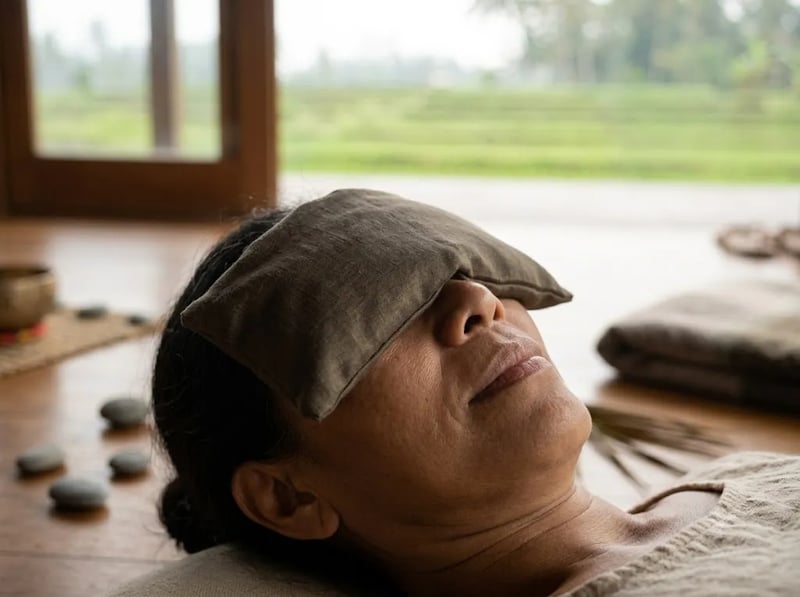
Blocks are replaced by books. Hardbacks of matching size, stacked and squared off, are stable and easy to fine tune by adding or removing one. Keep a small pile within reach rather than getting up mid-pose. A strap is a dressing gown cord, a scarf or a belt. An eye pillow is a small folded towel, and a bag of rice inside a pillowcase is a very close match to the real thing.
Warmth is the prop people forget, and it matters more than any of the others. Body temperature drops when you stop moving, and being slightly cold will keep you subtly braced for the entire pose no matter how well it is set up. Socks, a jumper and a blanket over you, put in place before you settle rather than fetched once you are cold.
Judge each set-up by one question: could you stay here for five minutes without adjusting. If the answer is no, add support rather than trying to relax harder. Almost every unsuccessful pose in this style is under-propped. Height under the knees, height under the head, and something to fill the gap wherever a limb is hanging in space with nothing beneath it.
Keep the whole kit in one bag or basket by the wall. The practical barrier to home practice is rarely motivation, it is the ten minutes of gathering things from four rooms, which is enough friction to stop most sessions before they begin. With the bundle ready, setting up takes two minutes, and a practice that starts in two minutes is a practice you will actually do.
On length, fewer and longer is the rule. Three or four poses held for five to ten minutes each will do more than eight poses held for two, because the settling this style depends on takes several minutes to begin. A session of thirty to forty minutes is plenty, and even two well-supported poses is a real practice on a busy evening. Set a soft timer rather than checking a clock, since watching the time keeps a part of you on duty. If a pose becomes uncomfortable before the timer, come out. Enduring is not what is being trained here.
Why doing less is the hard part
The physical side of this practice asks almost nothing of you, which is exactly why so many people find it difficult. Lying supported and still for ten minutes sounds like a gift until you try it, at which point the mind produces its full catalogue of objections: this is boring, this is unproductive, you are wasting time, you should be doing the harder class next door. That chatter is not a sign the practice is failing. It is the practice.
Restlessness usually peaks a few minutes into a hold and then softens, if you let it. The urge to fidget, adjust, or check the time passes like weather when it is not acted on, and learning to watch it pass is a skill that transfers to every impatient moment in your week. If you must move, move slowly and deliberately, then settle again rather than abandoning the shape.
Guilt about rest runs deeper than restlessness, and it deserves naming. Many people have spent years treating exhaustion as a work ethic, and lying down in daylight feels faintly wrong to them. A supported practice is a structured way to unlearn that, because the format gives you permission the culture does not: this hour has one job, and the job is rest.
Give your mind something small to hold if it will not settle on its own. Following the breath, counting exhales quietly to ten and starting again, or resting attention on the points where your body touches the props all work. The aim is not a blank mind. It is a mind gently occupied enough to stop planning.
Expect the benefit to sneak up on you rather than announce itself. People rarely leave their first session transformed. They notice, three or four sessions in, that they slept better that night, or that the evening after class went softer than usual. Judge the practice on that timescale and it will earn its place in your week.
One more reframe helps the sceptics: think of a supported hold as training the same capacity you need for every waiting room, delayed flight, and sleepless hour of ordinary life. The ability to be somewhere without needing it to be different is not a small skill, and there are very few places left that deliberately teach it. This practice does, ten quiet minutes at a time, and the props are just the classroom.
If you fall asleep, does it still count
Almost everyone falls asleep in a class like this at some point, usually in the third or fourth shape, and it is the thing people are most sheepish about afterwards.
It counts, in the sense that rest is rest and a body that drops off the moment it is fully supported is telling you something worth hearing. It does not count in the sense the practice intends, because the state being cultivated is a wakeful one: the body settled, the mind still present. Sleep skips that part, which is also the difference between this and a practice built around staying just awake while completely still.
If it happens once or twice, ignore it. If it happens every time, treat it as information about your sleep rather than about your practice. Consistently dropping off within ten minutes of lying down is a reasonable thing to mention to a doctor, particularly alongside daytime tiredness.
There are practical adjustments that keep you on the right side of the line. Practise earlier in the evening rather than at bedtime. Keep the room slightly cooler and a little lighter than you would for sleep. Prop the head marginally higher, since a flat head position invites the body to switch off. Some people do better sitting supported against a wall for the first shape and only lying down later.
A gentle anchor helps too. Counting the exhale, or resting attention on the sound of the room, gives the mind a thread to hold without demanding effort. If the thread keeps disappearing, that is normal, and picking it up again is the practice rather than a failure of it.
And if you are genuinely exhausted, let yourself sleep. A tired body will not learn to rest wakefully until it has caught up. The wakeful version will still be there in a week or two, once the debt is paid.
Train With Loka
If your life runs fast, learning to truly rest is a skill worth building. Our Online Yin Yoga Teacher Training explores the slow, supported end of practice in depth, and our review of online yin yoga teacher trainings shows how it sits against the alternatives. To see how slow and dynamic styles compare, read Yin yoga vs Vinyasa.
Frequently Asked Questions
Is restorative yoga the same as Yin?
No. Yin stretches connective tissue so you feel a stretch; restorative removes all effort so you feel only support and ease.
How long are restorative poses held?
Typically three to twenty minutes, fully supported by props.
Is restorative yoga good for beginners?
Yes. It needs no strength or flexibility and suits every body, which makes it an ideal entry point.
Can restorative yoga help with sleep?
Yes. By calming the nervous system, it often improves sleep and eases tension held in the body.
Does restorative yoga lower cortisol?
The evidence is mixed. In the 2014 PRYSMS trial, a simple stretching programme actually produced a more favourable cortisol change than the restorative practice, so the claim that it uniquely lowers stress hormones is not well supported. What it reliably offers is a felt sense of deep rest, which has value in its own right.
The Loka Newsletter
Enliven your routine with exclusive spiritual content. There’s so much to learn.

Find us on Instagram
@lokayogaschool