Last updated on September 6th, 2026 at 09:35 am
6 Things to Know Before Starting Your Yin Yoga Teacher Training
Yin Yoga Teacher Training equips you to teach one of the most therapeutically powerful and anatomically distinct yoga styles available. Before you enrol, there are six things worth understanding clearly, from what Yin actually is to how to choose a programme that prepares you to teach with genuine depth.
Yin is often mistaken for a soft, stretchy add-on to a stronger practice. In truth it is anatomically and philosophically distinct, and teaching it well asks more of you than demonstrating long holds. The six areas below cover what Yin actually is, why your reasons for training matter, what a serious curriculum contains, how the online format works, how to prepare, and what happens after you qualify. Read them before you enrol and you will choose your programme with clarity rather than guesswork.
1. Yin Yoga Is Not Restorative Yoga
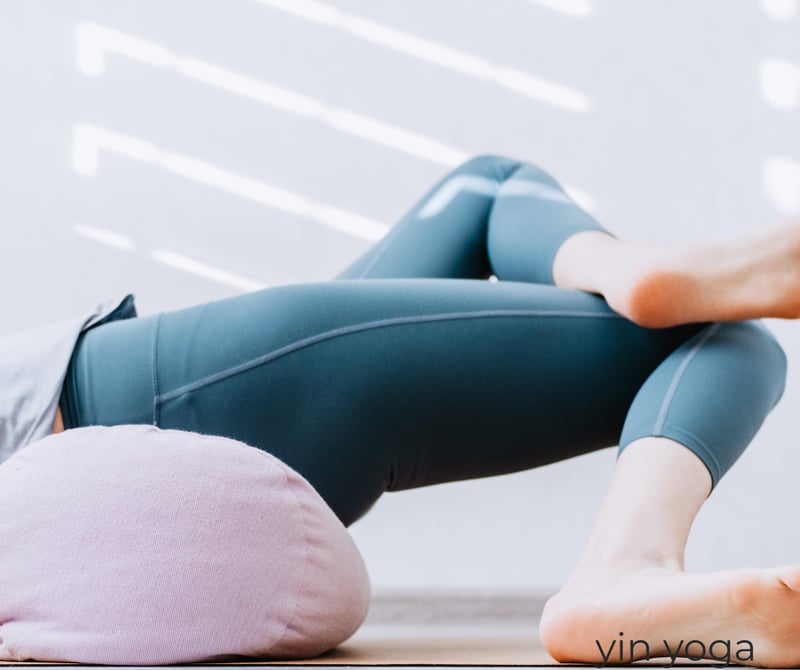
This distinction matters enormously, and it’s one of the most common misconceptions we encounter. Yin Yoga and restorative yoga are both slow and quiet, but they work differently and serve different physiological purposes.
Restorative yoga uses props extensively to place the body in positions of complete ease and support. The aim is deep rest with minimal physical demand. There is no intentional stress applied to tissues.
Yin Yoga, by contrast, intentionally applies a mild, sustained stress to the deeper connective tissues: the fascia, ligaments, joint capsules, and tendons. These are the yin tissues. They respond to slow, passive loading held for two to five minutes or longer, not to dynamic movement. This is why Yin targets mobility and tissue hydration at a level that yang practices simply cannot reach.
Understanding this distinction is foundational to teaching Yin safely and confidently. A good training will ground you thoroughly in this science from day one.
Start, too, by letting go of the idea that Yin is simply gentle stretching. Stretching as most people practise it targets muscle and is over in seconds. Yin works on a longer timescale and a different material, applying steady, tolerable stress to connective tissue that only responds when it is held. Understanding that difference is what lets you explain the practice honestly to a new student, and what stops you teaching it as a slower version of something else.
The Core Principles: Edge, Stillness, and Time
Three principles hold Yin together. The first is finding your edge, the point of clear sensation that is honest but never sharp or painful. The second is a resolve to stay still, because fidgeting keeps the load in the muscles and never reaches the deeper tissue. The third is time: poses are held for two to five minutes, sometimes longer, so the connective tissue has a chance to respond. These are not arbitrary rules. They are what makes the practice work on the tissues it targets, and a good training grounds you in each one before you ever cue a class.
Yin Tissues, Yang Movement, and the Energetic Layer
Yang styles such as Vinyasa and Ashtanga build heat and move quickly, working the muscles and the cardiovascular system. Yin does the opposite. Slow, cool, and passive, it loads the fascia, ligaments, and joint capsules that dynamic movement rarely reaches. Many trainings also introduce the energetic dimension drawn from Traditional Chinese Medicine: the meridian pathways and the concept of Chi, the life force said to move through them. You will not qualify as a TCM practitioner, but a working grasp of meridian theory gives your sequencing a coherent framework rather than a set of disconnected shapes.
2. Understanding Your "Why" Shapes Your Experience
People come to Yin Yoga Teacher Training for different reasons. Some want to deepen their personal practice. Some want to teach professionally. Some want to add Yin as a specialisation to an existing 200-hour base. Some are drawn by the anatomy, others by the meditative and meridian-based dimensions of the practice.
None of these reasons is more valid than another. But being clear on your own motivations helps you choose the right programme and approach the training with realistic expectations.
If you’re primarily deepening your personal practice, the emphasis on self-inquiry and personal transformation in a well-designed Yin training will be deeply satisfying. If you’re training to teach, prioritise programmes that include strong teaching methodology and supervised practicum hours. If you want to add Yin as a continuing education module, verify that the programme is Yoga Alliance YACEP-accredited or equivalent.
Take time with this question before you enrol. It will shape everything.
Your current foundation matters as well. You do not need to be a flexible, advanced practitioner, but a consistent practice of any style gives you the body awareness and class familiarity that make the anatomy easier to absorb. If you are newer to yoga, a general 200-hour base first, or a Yin course explicitly designed as an entry point, is the more sensible route.
Be honest about the emotional side too. Long holds and quiet introspection can surface feelings and patterns that a faster practice keeps at bay. A well-run training holds space for that, but arriving with some self-awareness of your own emotional landscape helps you meet it rather than be caught off guard. This element of self-discovery is one of the real benefits of the training, not a side effect to manage.
Time is the other honest question. Even a self-paced online course asks for real hours, not only for the lectures but for personal practice, reading, and reflection. Look at how the course is structured and map it against your work, family, and other commitments before you commit, so the training has room to land rather than becoming one more thing you are behind on.
3. What a Quality Yin Yoga Curriculum Must Include
Not all Yin Yoga trainings are equal. A thorough curriculum will cover the following non-negotiable areas.
Functional anatomy for Yin practice. This goes beyond standard yoga anatomy. You need to understand fascia: what it is, how it responds to sustained loading, how it differs from muscle tissue, and what happens when it’s under- or over-stressed. You also need to understand skeletal variation, because every human skeleton is unique, and this directly determines how each student will express a given pose. Rigid aesthetic alignment has no place in Yin teaching.
The asana library. This means thorough analysis of each Yin pose: its target area, how it applies stress to specific tissues, what contraindications apply, how to use props effectively, and how to offer the modifications each body might need. Rebound, the rest between poses, should also be covered.
Yin philosophy and history. The roots of Yin Yoga sit at the intersection of Taoist philosophy, Traditional Chinese Medicine, and modern fascia research. A quality training introduces you to yin/yang theory, the concept of Chi, and the meridian system. This layer gives your teaching intellectual and energetic depth.
Sequencing and teaching methodology. How do you construct a class that is safe, coherent, and thematically resonant? What cueing language is appropriate for the quiet, introspective quality of Yin? How do you create a container that allows students to settle into sensation without being pushed through it? These are skills, and they require direct instruction and practice.
Practicum and feedback. You need to teach, and you need to be observed and given honest feedback. There is no shortcut here.
Our Online Yin Yoga Teacher Training covers all of these areas comprehensively.
Within the anatomy, skeletal variation deserves particular attention. Every skeleton is shaped differently, and those differences decide how far a given student can move in a pose and where they will feel it. A teacher trained in functional anatomy stops chasing a single correct shape and starts reading the body in front of them. This is one of the clearest markers of a serious Yin curriculum.
A thorough curriculum also gives you the roots of the practice. Yin sits at the meeting point of Taoist thought, Traditional Chinese Medicine, and modern fascia research. Yin and yang theory explains why a slow, cooling practice balances a hot, active life, and a little history gives your teaching context that students can feel even when you never name it directly.
Props and rebound round out the practical skills. You will learn to use bolsters, blocks, blankets, and straps to support a body into a pose and to modulate its intensity, and you will learn to guide the rebound, the still pause after a pose where much of the effect is felt. Alongside this sits safety: knowing which poses are contraindicated for which conditions, and how to offer a modification rather than push a student past what their body can hold. Teaching Yin safely is not optional, it is the baseline of competent practice.
Cueing is its own skill in Yin. The language that works in a dynamic flow, all momentum and count, is wrong for a practice built on stillness. You will learn to cue invitationally and with care, to hold a quiet, non-judgemental space, and to guide students into sensation without pushing them through it. For many trainees this is the hardest and most rewarding part of learning to teach.
4. Online Yin Training Can Be Excellent, with the Right Structure
The online format suits Yin Yoga Teacher Training particularly well. The practice itself can be explored deeply in your own home environment. The anatomy, philosophy, and meridian theory translate effectively to video and written materials. The self-paced format allows genuine absorption rather than rushed exposure.
That said, not all online programmes are equivalent. Look specifically for high-quality video demonstrations and detailed manuals, opportunities for interaction and question submission, a clear and logical curriculum progression, and reputable accreditation.
Self-discipline is essential in an online programme. The flexibility is real, but so is the temptation to deprioritise study when life gets busy. Build dedicated time into your schedule, create a study space at home, and treat the training with the seriousness it deserves.
If you’re curious about the depth and structure of a well-designed online Yin training, explore the details of our programme here.
The online format carries some specific advantages worth naming. It removes geography as a barrier, so you can study with experienced teachers wherever you happen to live. It is often more affordable than an in-person immersion, since there is no travel or accommodation to fund. And you can replay every lecture, demonstration, and guided practice as many times as you need, which is a genuine learning advantage a single live session cannot match.
When you compare online options, weigh more than the price. Look for high-quality video and detailed manuals, but look just as hard for the human elements: live question-and-answer sessions, a forum or group where students talk to each other, and real feedback from instructors on your teaching. A clear, logical progression through the material and reputable accreditation, Yoga Alliance recognition for continuing education for example, tell you the programme was built with care rather than assembled quickly.
Practical requirements are modest. A reliable internet connection and a device that plays video will cover most programmes, so check the technical notes before you enrol but do not expect anything demanding. The larger requirement is self-discipline: the same flexibility that makes online study convenient also makes it easy to postpone, so treat the timetable as fixed rather than optional.
5. How to Prepare Before Your Training Begins
Physical preparation for Yin training is less about getting more flexible and more about familiarising yourself with the quality of attention Yin requires. If your practice is primarily Vinyasa or Ashtanga, start incorporating Yin or restorative classes into your week. Let your nervous system learn to settle in stillness. This is genuinely different from learning to move well.
Intellectually, reading Paul Grilley’s “Yin Yoga” or Bernie Clark’s “The Complete Guide to Yin Yoga” before your training begins will give you a significant head start. These are the foundational texts of the practice, and arriving with familiarity with the core concepts means your training can go deeper faster.
Practically, set up a study space, inform the people around you that you’re committing time to this, and look at the curriculum timeline before your start date. Building this structure in advance makes the training itself far more effective.
Journaling is worth starting before day one. Recording your current practice, your intentions for the training, and the questions that arise as you prepare gives you a thread to follow through the course and something to look back on afterwards. It also builds the reflective habit that good Yin teaching draws on.
Finally, protect your time and tell the people around you what you are committing to. Block dedicated hours for lectures, practice, study, and assignments, and let family or housemates know when you need uninterrupted space. Good time management is what separates a training you complete from one you drift out of, especially in the self-paced online format.
6. Certification Is the Beginning, Not the End
Your Yin Yoga teacher training certificate marks the start of your teaching journey, not its completion. The field of fascia research is evolving rapidly, and what we understand about connective tissue continues to deepen. Great Yin teachers commit to ongoing education.
Beyond the anatomy, teaching Yin requires a quality of presence that only develops through sustained personal practice and actual teaching experience. You learn to hold space more effectively by doing it again and again, with different students, in different settings.
If you plan to teach professionally, familiarise yourself with the practical requirements: professional liability insurance, any local regulations that apply in your area, and Yoga Alliance registration if relevant to your market.
The responsibility of guiding someone into stillness and sensation is real. It requires sensitivity, skill, and genuine commitment to the student’s experience. That’s what makes Yin teaching so meaningful, and so worth doing well.
When you’re ready to take that step, explore the Loka Yoga School Online Yin Yoga Teacher Training.
As you begin teaching, you will also start to find your own voice. Style is not something you copy from your trainer; it emerges from your own practice, your reading, and the experience of guiding real students. Give it time, and resist the urge to sound like anyone else.
Community makes all of this sustainable. Staying connected to other Yin teachers gives you people to ask, compare notes with, and lean on as your teaching develops. The practical business side belongs here too: liability insurance, any local regulations that apply where you teach, and Yoga Alliance registration, where a 50-hour Yin certificate usually counts as continuing education for an existing RYT. None of it is glamorous, but it is what turns a certificate into a working practice.
Treat the years after your training as the real curriculum. Workshops, advanced modules, further reading, and your own steady practice are what turn a new certificate into genuine expertise. The teachers students return to are rarely the ones who trained longest ago; they are the ones who never stopped learning.
Train in Yin With Loka
New to the style? Our comparison of yin yoga vs vinyasa explains what makes Yin distinct.
Our Online Yin Yoga Teacher Training covers the anatomy, philosophy, and sequencing of a slow, deep practice.
If you are still working towards your foundational qualification, our 200-hour yoga teacher training in Bali is the usual starting point, and a yin specialisation sits well on top of it.
If you are deciding between the 90-day and lifetime options, the yin training prices page shows both.
Frequently Asked Questions
Do I need a 200-hour yoga certification before doing a Yin Yoga Teacher Training?
It depends on the programme. Some Yin trainings are designed as foundational courses and are accessible without a prior 200-hour certificate. Others are structured as specialisation or continuing education courses for teachers who already hold an RYT 200. Check the prerequisites carefully. If you’re building towards a full teaching career, completing a 200-hour base certificate first is the more strategic path.
How long is a Yin Yoga Teacher Training?
Most Yin Yoga Teacher Trainings are 50 hours, which aligns with Yoga Alliance continuing education standards. Shorter introductory formats of 20 to 30 hours are also available. A 50-hour programme gives you enough depth to teach confidently and to register the credential with Yoga Alliance as continuing education hours.
Will I learn about Traditional Chinese Medicine in a Yin training?
A quality Yin training will introduce you to TCM concepts, particularly the meridian system and the role of Chi in the energetic body. You won’t qualify as a TCM practitioner, but you’ll understand the theoretical framework well enough to incorporate meridian themes into your class sequencing and to speak about this dimension of the practice authentically.
Is Yin Yoga safe for people with injuries?
Yin Yoga can be highly beneficial for people with many types of injury or chronic tension, but it must be approached knowledgeably. Certain poses are contraindicated for specific conditions. Your Yin training will teach you to identify these situations, offer appropriate modifications, and guide students safely. This is one of the most clinically useful skills a yoga teacher can develop.
Can I teach Yin Yoga online after completing an online training?
Yes. Many Yin teachers teach very effectively online. The verbal cueing and guidance-based style of Yin translates well to the online format for students. Your own training format doesn’t limit how you teach after graduating.

The Loka Newsletter
Enliven your routine with exclusive spiritual content. There’s so much to learn.

Find us on Instagram
@lokayogaschool