Why Are Your Hamstrings So Tight in Forward Folds?
If your forward folds feel stuck, you are not alone. Tight hamstrings are one of the most common complaints in yoga. But tightness is not always what it seems, and forcing the stretch is rarely the answer.
Often the real culprit is nearby rather than in the hamstring itself, so it is worth learning about hip flexor muscles in yoga. Getting your downward dog alignment cues right also takes pressure off tight hamstrings.

What "Tight" Actually Means
Hamstring tightness has several possible causes. Sometimes the muscle is genuinely short from prolonged sitting. Often, though, the sensation of tightness is the nervous system protecting a range it does not yet trust, rather than a true limit in the tissue. Pushing hard past that protective signal can trigger more guarding, not less.
The Anatomy in Brief
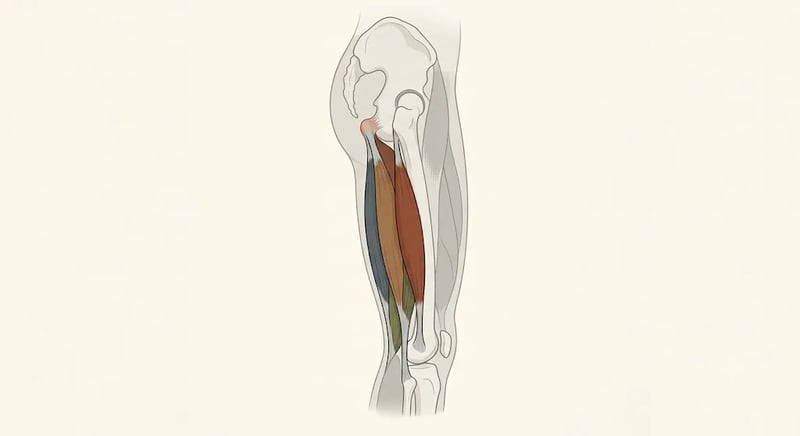
The hamstrings run from the sitting bones down to below the knee, crossing both the hip and the knee. Because they cross the hip, a forward fold that rounds the lower back can pull on them from the wrong end and mask what is really happening. Length comes more safely from tilting the pelvis forward than from rounding the spine.
The Safer Approach
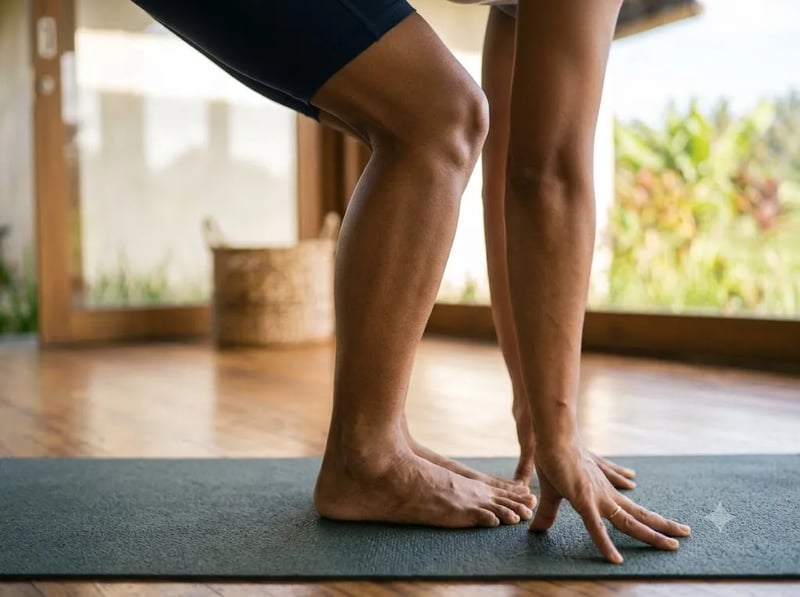
Bend your knees in forward folds so you can tilt the pelvis and keep a long spine.
Favour gentle, longer holds and regular practice over aggressive, occasional stretching.
Warm the tissue first; hamstrings lengthen more willingly when the body is warm.
Strengthen as well as stretch. Eccentric strengthening builds usable range that sticks.
What stretching actually changes
The intuitive belief about stretching is that a tight muscle is short, and that pulling on it makes it longer, like easing tension out of a rope. It is a tidy picture, and the evidence does not support it. When your range of motion improves, the tissue is very probably not the thing that changed.
A study by Konrad and colleagues in Clinical Biomechanics examined what happens after a period of static stretching and found that the increases in range of motion were not explained by any measurable change in the structure of the muscle or the tendon. The tissue did not lengthen. What changed was the participants’ tolerance of the stretch: how much sensation they could accept before the body called a stop.
This is not a minor technicality. It reframes the entire project. You are not remodelling a short muscle into a long one; you are teaching your nervous system that a given range is safe, so it stops guarding against it. Flexibility, in other words, is largely a permission problem, not a length problem.
Once you accept that, a lot of common practice looks misguided. Gritting your teeth through an aggressive fold is not stretching the tissue longer, because that is not how the gains happen. It is just delivering a large, threatening dose of sensation to a system whose cooperation you actually need.
Why forcing and pain work against you
If flexibility is your nervous system granting permission for a range, then pain is precisely the wrong signal to send it. Sharp, forced stretching tells the body that this range is dangerous, and a body that feels threatened protects itself by guarding harder. You can end up tighter for having tried so aggressively.
There is also a straightforward tissue-safety point. Forcing a fold you are nowhere near ready for loads the hamstring, and often its attachment near the sitting bone, at a length and intensity it cannot handle. Proximal hamstring strains from over-enthusiastic stretching are common in yoga, and they are slow, stubborn injuries to recover from.
The productive dose is mild. You want a clear, tolerable sensation of stretch that lets you keep breathing evenly, not a white-knuckle maximum. Research on stretching effects, including Wilke’s work showing that stretching one part of the body can change range of motion elsewhere, points to how much of this is a whole-system, neurally mediated response rather than a local tearing-open of tissue.
So the pace is gentle and the frequency is regular. Little and often, staying well short of pain, shifts tolerance far more reliably than occasional brutal sessions. If a stretch makes you hold your breath, you have already gone too far to get the benefit you were after.
Strengthening through the full range
The piece most people miss is that strength, not just stretching, is one of the most effective ways to feel less tight. A muscle that is strong through its full length is a muscle the nervous system trusts, and a trusted muscle guards less. This is why strong, mobile people often feel loose without doing much dedicated stretching at all.
Eccentric work is particularly useful here. An eccentric contraction is when the muscle produces force while it is lengthening, and loading a hamstring in that lengthened, working position both builds strength and expands the range your body is willing to give you. It teaches the system that the end of your range is a place you can be strong, not just a place you dangle.
In practical terms this means poses and movements where the hamstrings are working under load through a long range, not just passive folds where you hang on your ligaments. A slow, controlled forward fold where the legs stay active, or a lengthened lunge where the front leg is genuinely working, does more than a limp hang ever will. Control is the operative word.
This is also why a well-built movement practice beats a stretching routine bolted on at the end. When strength and mobility are trained together through real ranges, tightness tends to resolve as a side effect. Building that kind of intelligent, load-aware practice is a core part of our 200-hour yoga teacher training in Bali.
Neural tightness versus structural tightness
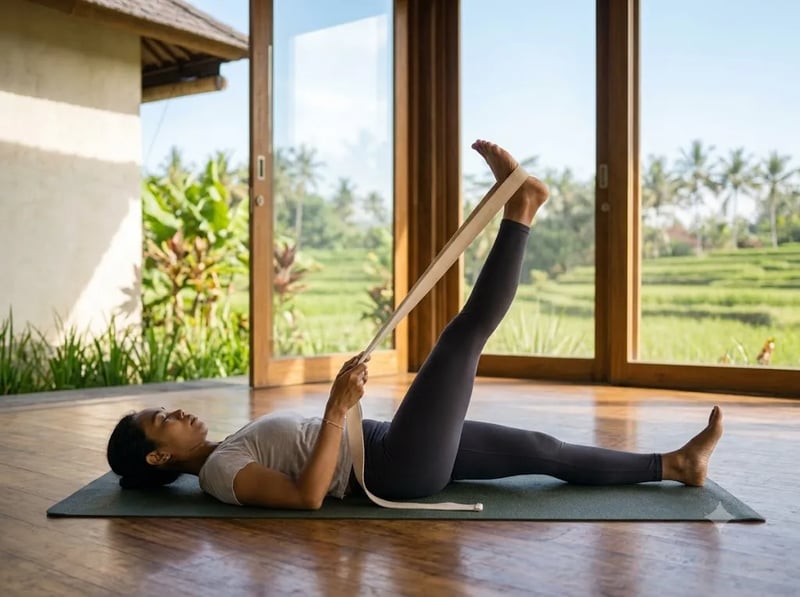
It helps to separate two very different reasons a hamstring can feel tight, because they call for opposite responses. Most everyday tightness is neural, meaning the tissue has plenty of available length but the nervous system is limiting access to it, usually out of habit, disuse, or a protective response to load it does not trust.
Neural tightness responds beautifully to the approach above: gentle, regular exposure well short of pain, and strengthening through range so the system grants more access. Nothing needs to be torn or lengthened, because the length was there all along. This is the situation the great majority of desk-bound, stiff-feeling people are actually in.
True structural tightness, where the tissue itself is genuinely shortened or scarred, is far less common and usually has a specific history behind it: a past surgery, a serious injury, a long period of immobilisation in a cast. Even then, the response is patient, progressive loading over months, not aggressive forcing, and it is the province of a physiotherapist rather than a keener yoga class.
The reason this distinction matters is that it should lower the stakes for almost everyone reading. Your tight hamstrings are very unlikely to be a structural problem, which means the fix is not force but consistency, and the timeline is measured in patient weeks. If a specific pose is where your tightness shows up most, our guide to setting up downward dog with bent knees for tight hamstrings puts these principles to work in a shape you probably practise every session.
Judging progress across a season rather than a session
Hamstring length is one of the slowest things in the body to change, and it is measured with one of the least reliable instruments available, which is how far you happen to fold on a given morning. That combination produces a lot of unnecessary discouragement.
Your daily range moves substantially for reasons that have nothing to do with progress. Time of day, how warm you are, how much you slept, what you trained yesterday, how long you sat, and how anxious you feel all shift it. The same person can be several inches apart between a cold Monday morning and a warm Thursday evening with no change in tissue whatsoever.
So measure deliberately, and measure rarely. Once a month, under conditions you can repeat: same time of day, same short warm-up, same position. Note where you reach against a fixed reference such as a mark on the wall beside you or a point on your own leg. Then leave it alone until the next month. Checking weekly guarantees you will mostly be reading noise and reacting to it.
Track how it feels as well as how far it goes, because that often changes first. A fold that reaches the same place but no longer feels like a threat, or a hamstring that stops complaining on the stairs, is real progress that a tape measure will not show. Many people gain comfort well before they gain range, and only noticing distance means missing the improvement that is actually happening.
Expect a realistic timeline. Meaningful change here is measured in months of consistent, moderate work, not weeks, and the people who progress fastest are generally the ones doing a modest amount very regularly rather than a lot occasionally. Three or four short sessions a week will outperform one long aggressive one, and will do it without the setbacks.
Know when it is not a flexibility problem. Pain that sits high up where the hamstring meets the sitting bone, that feels sharp rather than broad, that is worse first thing, or that has persisted for months despite sensible work is worth having looked at by a physiotherapist. Tendon irritation at that attachment responds to loading rather than to stretching, and continuing to stretch into it will keep it going indefinitely. Numbness, tingling or pain travelling down the back of the leg is a separate matter again and needs proper assessment rather than more range work.
Warm up before you work on range, and keep it brief. Five minutes of easy walking, some gentle leg swings, or a few rounds of light movement is enough to change what is available to you considerably. Working into cold hamstrings first thing in the morning is where most strains happen, and it is also when your range is at its least representative, so you get the worst reading and the highest risk at the same time. If mornings are the only time you have, shorten the stretching and lengthen the warm-up rather than the other way around.
A simple weekly template to work from
Knowing the principles is one thing; a week you can actually follow is another. Here is a modest template that puts the evidence into practice without taking over your calendar.
Most days, take two minutes of easy folding, well short of any strain: a bent-knee forward fold at the kitchen bench while the kettle boils is genuinely enough. The purpose is frequent, friendly exposure, teaching your nervous system that this range is ordinary and safe.
Twice a week, add ten minutes of loaded work through range: slow, controlled folds with active legs, long lunges where the front leg genuinely works, held for breaths rather than bounced. This is the strength-through-length work that shifts tolerance fastest, and it should feel like effort, not pain.
Once a week, do nothing and notice. Move through a few everyday actions, tying shoes, picking something off the floor, and observe whether they feel different from last month. That observation day matters, because hamstring progress hides in ordinary movements long before it shows in any dramatic pose, and catching the change is what keeps the habit alive.
When the limit is not the hamstrings at all
Not every stuck forward fold is a hamstring problem. The hamstrings are simply the tissue you feel, and sensation is a poor guide to what is actually stopping the movement.
The first alternative is the pelvis. A forward fold is mostly hip flexion, and if the pelvis is not rotating forward over the femurs then the hamstrings never lengthen much regardless of how long you hold the position. People who have spent years folding from the lumbar spine often have adequate length at the back of the leg and very little control of the pelvis, and the two feel identical from the inside.
The second is bony. Hip socket depth and orientation vary considerably between individuals, and in some hips the neck of the femur meets the rim of the socket well before soft tissue becomes the limit. Where that is happening the end of the movement feels abrupt, and it often pinches at the front of the hip rather than pulling at the back of the thigh. No amount of stretching changes bone.
The third is the nervous system, which the section on neural versus structural limits above deals with in more detail, and which is one part of how the nervous system responds to the practice generally.
A rough way to tell the first two apart: fold seated with the knees bent enough that the pelvis can tip forward freely. If the range improves substantially, the limit was position or muscle length. If it barely changes and the front of the hip still stops you, structure is a reasonable explanation and forcing it is a poor idea.
Worth saying plainly that the research on hip morphology and range of motion is largely descriptive, drawn from imaging studies of specific populations rather than from yoga practitioners. It explains why people differ better than it predicts what any one person will achieve. Treat it as a reason to stop chasing a particular shape, not as a diagnosis of your own hips.
Train With Loka
Understanding the tissue changes how you practise. Our Online Yoga Mechanics Course teaches the functional anatomy behind flexibility, so you can work with your body rather than against it. See also fascia and flexibility.
Frequently Asked Questions
Will daily stretching fix tight hamstrings?
Regular, gentle practice helps more than hard, occasional stretching, which can increase protective guarding.
Should I feel pain in a hamstring stretch?
No. Work at a strong but comfortable sensation. Sharp pain, especially near the sitting bone, is a signal to back off.
Why are my hamstrings tighter on one side?
Asymmetry is normal and often relates to posture, past injury, or how you sit. Work both sides and avoid forcing the tighter one.
Does strengthening help flexibility?
Yes. Building strength through range gives you flexibility your body can actually control and keep.
Can yoga actually lengthen tight hamstrings?
Not in the literal sense most people imagine. Research suggests the flexibility you gain from stretching comes mainly from increased tolerance of the stretch, not from the muscle physically lengthening. Yoga still improves how much range you can comfortably access, especially when it combines gentle regular stretching with strengthening the hamstrings through their full length.
How long does it take to improve hamstring flexibility?
Most people notice a real difference in four to eight weeks of consistent, gentle work, and it shows up in ordinary movements like tying shoes before it shows in any dramatic pose. The timeline lengthens if you force: pain makes a protective nervous system guard harder. Little, often, and comfortably is the fastest route.

The Loka Newsletter
Enliven your routine with exclusive spiritual content. There’s so much to learn.

Find us on Instagram
@lokayogaschool