Last updated on October 22nd, 2026 at 08:45 am
Hip Flexor Muscles and Yoga: What You Should Know
The hip flexors are a group of muscles responsible for bringing the thigh toward the torso, a movement called hip flexion. They are also among the most commonly tight and underappreciated muscles in modern bodies. Understanding their anatomy, their dysfunction, and the yoga approaches that address them is foundational knowledge for any yoga teacher or serious practitioner.
What Happens When Hip Flexors Are Tight
Tight hip flexors are among the most common postural dysfunctions in clinical yoga and physiotherapy settings. Prolonged sitting keeps the hip in a flexed position, and the muscles adapt to that shortened length over time.
The consequences extend well beyond the hip. A shortened iliopsoas pulls the lumbar vertebrae anteriorly and increases lordotic curve and compresses the posterior intervertebral discs. This is a direct mechanical contributor to lower back pain. A shortened TFL can increase lateral tension on the IT band and create compressive forces at the lateral knee.
Range of motion at the hip joint decreases, affecting walking mechanics, running economy, and the depth and comfort of yoga postures like lunges, backbends, and standing balances. Students often compensate by over-recruiting the lumbar extensors or collapsing through the lower back, which compounds existing dysfunction.
Yoga Poses That Effectively Address the Hip Flexors
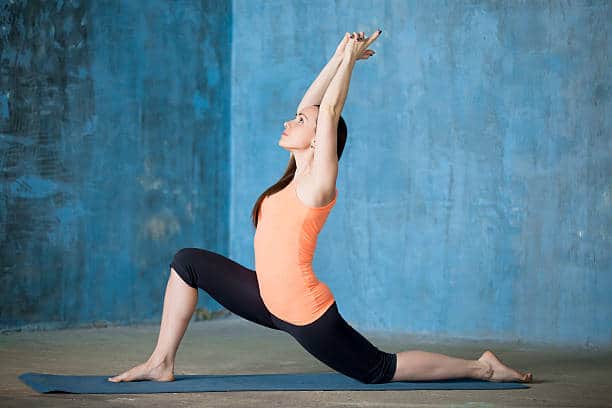
Low lunge (Anjaneyasana) is the most direct entry point for the iliopsoas and rectus femoris. The key is posterior pelvic tilt: actively drawing the tailbone down and the front hip crests back. Without this, most students simply arch their lower backs and never actually load the hip flexors into elongation.
Half pigeon (Eka Pada Rajakapotasana) targets the TFL and deep external rotators of the hip-flexed leg, while the extended rear leg loads the iliopsoas of that side. Hold times of two to four minutes allow fascial adaptation, not just muscular stretch.
Butterfly stretch (Baddha Konasana) mobilises the adductors, pectineus, and medial hip structures. Sitting tall with a neutral pelvis maximises the stretch effect.
Malasana (yogi squat) loads the hip flexors eccentrically while demanding ankle dorsiflexion and thoracic mobility. It is a functional position that many people lose entirely from years of chair-sitting.
Supta Virasana (reclined hero pose) is one of the most effective hip flexor lengthening postures available, simultaneously loading the rectus femoris and iliopsoas of both legs. It requires good knee health and should be approached progressively.
What Healthy, Balanced Hip Flexors Give You
When the hip flexors are both mobile and strong, the benefits reach well beyond the hip itself. Range of motion at the hip improves, which shows up as deeper, more comfortable lunges, cleaner standing balances, and an easier squat. Walking and running mechanics become more efficient because the leg can extend fully behind you rather than being tethered by a short psoas.
Balanced hip flexors also take load off the lower back. Because the iliopsoas ties directly into the lumbar spine, hip flexors that release well allow the pelvis to sit in a neutral position, which eases the chronic lower-back and hip tension that so many desk-bound students carry. Better pelvic position tends to improve overall posture too, since the whole chain above it stacks more easily.
Strengthen, Do Not Only Stretch
Length without strength is not the goal. Hip flexors that are stretched but weak can leave the front of the hip unstable, which raises the risk of impingement or a cranky sacroiliac joint. The aim is a hip flexor that can both lengthen under load and contract with control, so lengthening work and strengthening work belong together.
Practically, that means pairing your release poses with active loading: controlled leg lifts, slow marching in a supported position, and standing balances that ask the lifted-leg hip flexor to hold. Just as important is changing the daily input that shortens these muscles in the first place. Break up long periods of sitting, vary your positions through the day, and treat regular movement as maintenance rather than a cure applied once the hip is already tight.
To develop a deep, anatomy-informed understanding of posture and movement for yoga teaching, explore our Yoga Mechanics Course and our 200-Hour YTT in Bali, where anatomy and physiology are taught by Yann Cadic, a specialist in movement science and yoga anatomy.
What the Psoas Actually Does, and What It Does Not
No other muscle in the body carries the mythology the psoas has accumulated. It gets called the muscle of the soul, the seat of the fight-or-flight response, and the place the body files away fear. The anatomy is more specific and, once you know it, more useful.
Bogduk’s analysis of the anatomy and biomechanics of psoas major modelled its action at each lumbar segment and found that it exerts only very small moments on the lumbar spine while generating large compression and shear forces across those joints. Put plainly, the psoas is a hip flexor that uses the lumbar spine as an anchor, and the cost of that anchoring is load through the lumbar segments.
Penning’s work on the psoas muscle and lumbar spine stability makes the complementary point. That compressive load is not a design fault, it is part of how the lumbar spine holds itself steady in upright postures. A psoas working hard is doing its job, not misbehaving.
Now the mythology. There is no evidence that the psoas stores emotion or trauma, and no proposed mechanism that survives examination. What is true is more ordinary and still worth teaching: muscle tone tracks autonomic state, deep hip flexors work hard in guarded or braced postures, and people commonly report strong feelings during sustained hip work.
One practical consequence follows. The psoas sits behind the abdominal contents and cannot be palpated with any precision through the abdominal wall, so claims about manually releasing it deserve scepticism regardless of who is making them.
How Long to Hold a Hip Flexor Stretch, and When It Stops Helping
Duration is where hip flexor work most often goes wrong, in both directions. Too brief to matter, or long enough to cost the student something.
A meta-analysis on stretching the hip flexors and performance found that acute stretching durations up to 120 seconds were neutral to positive for performance outcomes. Longer exposures, in the range of 270 to 480 seconds, were slightly detrimental. If a student is about to do anything demanding, a few controlled holds are plenty and a marathon session is a poor trade.
How you hold matters as much as how long. A randomised trial comparing passive and active stretching of the hip flexors in people with limited hip extension found gains in both groups, with the active stretching group improving more. Adding your own muscular effort at end range appears to beat hanging there.
There is a further caution worth passing on. A hip flexor stretching programme in runners with limited passive hip extension improved measured range of motion but did not change running kinematics. The participants gained available range and did not use it while running.
That gap is the honest headline of hip flexor work. Range of motion is an input, not an outcome. If you want a student to actually extend the hip when they walk, run, or step through to a lunge, they need to practise the movement under load, not only acquire the range in a supported stretch.
Do Tight Hip Flexors Cause Back Pain?
The chain sounds airtight: sitting shortens the hip flexors, short hip flexors tilt the pelvis forward, the tilted pelvis extends the lumbar spine, and the extended lumbar spine hurts. Each link is weaker than the sentence suggests.
Take the last link first. A study of hip flexor shortening and chronic low back pain in resistance training practitioners found no significant association between shortening of the iliopsoas or rectus femoris and the presence of chronic low back pain. That is one population and one design, and it is the kind of result that should temper a confident causal story.
The middle link fares no better. A systematic review of non-surgical interventions for excessive anterior pelvic tilt found no overall evidence that conservative treatment reduces anterior pelvic tilt, with the certainty of evidence rated very low. Teachers routinely promise to correct pelvic tilt through stretching. The literature does not currently back that promise.
None of this makes hip flexor work pointless. It means the reason to do it is not that you are treating someone’s back pain. Bogduk’s finding that the psoas loads the lumbar spine in compression and shear is a good reason to care how the hip flexors are working, and it is a mechanical argument about load rather than a claim about causing pain.
When a student with back pain asks whether their tight hips are the cause, the credible answer is that it might contribute, that the evidence linking the two is weak, and that back pain usually has more than one input. Saying so does not undermine you. It stops you from making a promise you cannot keep.
Sitting, Hip Extension, and Frequency Over Duration
Sitting does show up in the measurements, just not always where people assume. A cross-sectional study on prolonged sitting, physical inactivity, and limited hip extension found that people who sat for long periods averaged about 6.1 degrees less passive hip extension than their more active counterparts.
That is a real difference and a modest one. It is also cross-sectional, so it tells you the two travel together rather than proving which causes which. Treat it as a reason to attend to hip extension, not as a diagnosis of anyone in your room.
What follows practically is a shift in emphasis. Someone who sits for eight hours will get more from short, frequent bouts of hip extension across the day than from one long stretch in an evening class. Standing up, walking, low lunges held briefly, and bridging all count.
Strength belongs here too. Hip extension is produced by the gluteals and hamstrings, and a student who cannot generate hip extension actively will not keep whatever passive range you give them. Loaded work matters more than length work for anything you want retained, a principle that runs through connective tissue adaptation as well, as covered in our article on what yoga teachers should know about the fascia.
If you want to teach this properly rather than repeat what you were told, the anatomy modules in our 200-hour yoga teacher training in Bali work through hip mechanics with the evidence attached, including where the evidence runs out.
The Six Primary Hip Flexor Muscles
Psoas Major
The deepest and most clinically significant hip flexor. It originates at the lumbar vertebrae (L1-L5) and inserts at the lesser trochanter of the femur. Because it crosses both the spine and the hip, a tight psoas does not just limit hip extension. It also pulls the lumbar spine into excessive lordosis, contributing directly to lower back pain. It is tonically active during sitting, which means most people who spend long hours at a desk have chronically shortened psoas muscles.
Iliacus
Originates at the inner surface of the ilium (the bowl of the pelvis) and joins the psoas to share the same insertion point. Together they form the iliopsoas, which is the primary hip flexor and one of the most powerful muscles in the body. Like the psoas, it shortens in prolonged sitting and can generate significant anterior pelvic tilt when chronically tight.
Rectus Femoris
The only quadriceps muscle that crosses the hip. It originates at the anterior inferior iliac spine and runs down to the patella. Because it spans both the hip and the knee, it is stretched effectively only when the hip is extended and the knee is flexed simultaneously, which is why a simple standing quad stretch often does not reach it fully. Anterior knee pain and hip flexor tightness frequently involve this muscle.
Tensor Fasciae Latae (TFL)
Originates at the anterior superior iliac spine and inserts into the iliotibial (IT) band, which then attaches at the lateral knee. The TFL assists with hip flexion, abduction, and internal rotation. It is frequently overactive in runners and cyclists and contributes to IT band syndrome when chronically tight.
Pectineus
A short adductor that also contributes to hip flexion. It originates at the superior pubic ramus and inserts just below the lesser trochanter. Groin strains often involve the pectineus and adjacent adductors.
Sartorius
The longest muscle in the body, crossing both the hip and the knee. It originates at the anterior superior iliac spine and spirals down to insert at the medial tibia. It assists with hip flexion, abduction, and external rotation, and is engaged in cross-legged seated positions.
Know the Body You Teach
The hip flexors never work alone. Our guide to fascia for yoga teachers shows how tissue and muscle interact.
Our Online Yoga Mechanics Course covers functional anatomy so you can cue safely and effectively.
Frequently Asked Questions
What causes tight hip flexors?
Prolonged sitting is the primary cause. When the hip stays in flexion for hours, the iliopsoas and rectus femoris adapt to a shortened resting length. Poor posture, insufficient movement variety, and high-volume running or cycling can also contribute.
How do tight hip flexors cause lower back pain?
A shortened iliopsoas pulls the lumbar vertebrae anteriorly and increases lordotic curve. This creates compressive load on the posterior vertebral joints and intervertebral discs. Addressing hip flexor length is often a key component of lower back pain rehabilitation.
Which yoga pose is best for the iliopsoas?
Low lunge with a posterior pelvic tilt is the most targeted pose for the iliopsoas. Reclined hero pose is also highly effective. Both require attention to pelvic alignment to ensure the stretch reaches the deep hip flexors rather than simply loading the lower back.
How long should you hold hip flexor stretches?
For muscular change, holds of thirty to ninety seconds are sufficient. For fascial and connective tissue adaptation, holds of two to five minutes at a moderate intensity are more effective. Yin-style hip flexor poses held with diaphragmatic breathing produce the deepest results over time.
Can overly flexible hip flexors cause problems?
Yes. Hypermobile hip flexors can reduce anterior pelvic stability, increasing the risk of hip impingement or sacroiliac joint instability. Flexibility and strength must be developed together. Hip flexor strengthening through concentric loading is as important as lengthening work.

The Loka Newsletter
Enliven your routine with exclusive spiritual content. There’s so much to learn.

Find us on Instagram
@lokayogaschool