Last updated on July 31st, 2026 at 05:07 pm
The Effect of Yoga on the Parasympathetic Nervous System
Yoga activates the parasympathetic nervous system through slow breath, deliberate movement, and sustained stillness. This network of nerves, sometimes called the “rest-and-digest” system, counteracts the stress response and restores the body to physiological equilibrium. Understanding the mechanism makes your practice more intentional and your results more consistent. This is also why yoga shows up so often in conversations about yoga for anxiety. More of the how-the-body-works side lives in our yoga anatomy articles.
The Problem with Chronic Stress
The sympathetic nervous system (SNS) is built for short-term threats. When a stressor appears, the SNS floods the body with cortisol and adrenaline, accelerating heart rate, sharpening focus, and diverting blood to the muscles. That is adaptive when the threat is real and temporary.
The problem is that modern life provides near-constant low-grade stressors. The SNS has no off switch for a looming deadline or a difficult relationship. Left unchecked, chronic sympathetic activation erodes sleep, digestion, immunity, and mood. The body needs a consistent counter-signal, and yoga provides one.
The Vagus Nerve: Your Parasympathetic Highway
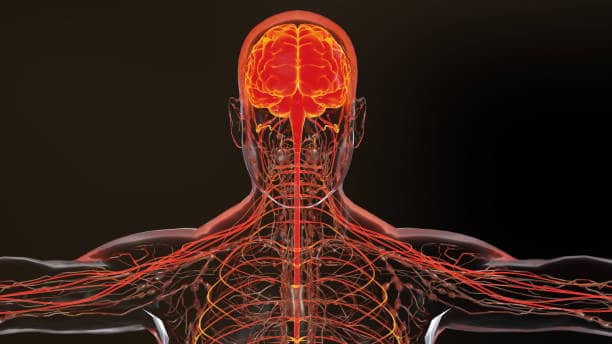
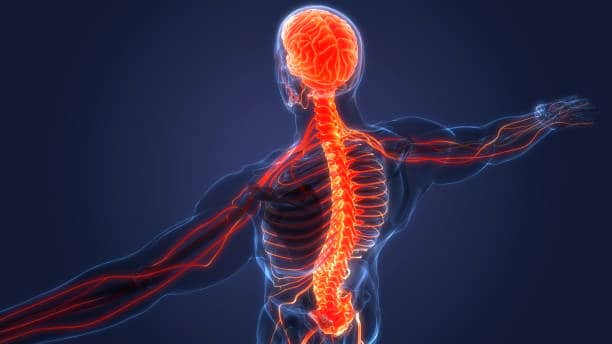
The vagus nerve is the primary nerve of the parasympathetic system. It runs from the brainstem down through the neck, thorax, and abdomen, innervating the heart, lungs, and digestive tract. Its name comes from the Latin for “wandering”, which describes its extensive reach.
When the vagus nerve is stimulated, heart rate slows, digestion resumes, and a measurable sense of calm follows. This is not a placebo effect. It is a documented physiological response, and several yoga practices trigger it directly.
Extended exhalations are the most reliable vagal stimulant available without clinical equipment. The ratio matters: an exhale longer than the inhale produces a greater parasympathetic response. This is why a simple four-count inhale and eight-count exhale, practised for five to ten minutes, can shift the nervous system state perceptibly.
What Heart Rate Variability Actually Measures
Your heart does not beat like a metronome. The interval between one beat and the next shifts constantly, and that shifting is what heart rate variability describes. It is measured in milliseconds between successive R waves on an ECG trace, then summarised using a small set of standard metrics.
The two you will meet most often are RMSSD and high frequency power. RMSSD is the root mean square of successive differences between beats, and it tracks the short, breath-linked fluctuations most closely. High frequency power isolates the 0.15 to 0.4 Hz band, which corresponds to ordinary breathing rates. Shaffer and Ginsberg’s overview of HRV metrics and norms sets out the full range of time domain, frequency domain, and non-linear measures, and it is the reference worth reading if you want to know what your app is calculating on your behalf.
Both metrics are used as proxies for cardiac vagal activity, which is why HRV appears in so much yoga research. Laborde and colleagues’ methodological guidance on cardiac vagal tone makes the conditions clear: recording length, posture, breathing rate, caffeine, and time of day all move the numbers. A reading taken sitting up after class is not comparable to one taken lying down before you get out of bed.
Higher is also not automatically better. HRV falls with age, alcohol the night before, broken sleep, dehydration, and hard training. It varies so much between individuals that your absolute figure tells you almost nothing about anyone else. What carries information is your own trend across weeks, measured the same way each time.
The Baroreflex and Why Six Breaths a Minute Keeps Coming Up
Something specific happens when your breathing slows to roughly six breaths a minute. Heart rate oscillations reach their largest amplitude, and the cardiovascular system starts behaving as though it has found a resonant frequency.
The mechanism is the baroreflex. Pressure sensors in your carotid sinus and aortic arch detect changes in blood pressure and adjust heart rate to compensate. That feedback loop has a built-in delay of around five seconds, which gives the system a natural period of about 10 seconds, or six cycles per minute. Breathe at that rate and your respiratory rhythm lines up with the reflex loop rather than working against it.
Vaschillo and colleagues mapped this directly in their work on resonance in heart rate variability, finding individual resonant frequencies clustered in a narrow band around 0.1 Hz. Lehrer and Gevirtz’s review of how HRV biofeedback works describes the same phenomenon: maximum heart rate oscillation occurs at approximately 0.1 Hz, equivalent to six breaths per minute, and training at that rate appears to strengthen baroreflex gain over time.
Russo and colleagues’ review of slow breathing reaches a consistent conclusion, reporting increased HRV and improved baroreflex sensitivity with slow breathing in healthy adults, alongside changes in ventilation efficiency.
This is why the traditional yogic instruction to lengthen and smooth the breath is not arbitrary. A 5:5 count, or a 4:6, lands you close to the resonant zone without any equipment. Your own resonant frequency may sit anywhere between about 4.5 and 6.5 breaths per minute, so treat six as a starting point rather than a target.
Which Styles Are Most Effective?
Yin yoga, restorative yoga, and yoga nidra produce the strongest parasympathetic response because they use long holds, passive shapes, and minimal muscular effort. These conditions allow the nervous system to downregulate without distraction.
Hatha and vinyasa practices are effective too, particularly when paired with a strong pranayama component and a generous savasana. The SNS activation during dynamic movement makes the parasympathetic recovery that follows more pronounced, not less. Think of it as training the nervous system to shift gears efficiently.
Pranayama practices on their own, such as nadi shodhana, bhramari (humming bee breath), and sitali (cooling breath), offer direct vagal stimulation without asana. They are especially useful as standalone tools for stress management. Our Online Yin Yoga Teacher Training and Online Meditation Training both include dedicated modules on autonomic regulation and breathwork science.
How to Build a Practice That Actually Works
Consistency matters more than duration. A daily twenty-minute practice, combining five minutes of pranayama, ten minutes of asana, and five minutes of savasana, produces more measurable nervous system change than a weekly ninety-minute class. The nervous system learns by repetition.
Morning practice helps regulate the cortisol awakening response, the natural spike in cortisol that occurs within thirty minutes of waking. Evening practice supports sleep onset by lowering core body temperature and SNS activity before bed. Both have merit. The best time is the time you will actually show up.
Start simple. Diaphragmatic breathing, a few rounds of cat-cow to stimulate the vagal branches in the spine, a supported forward fold, and legs-up-the-wall. Five elements, twenty minutes. You do not need complexity to move the nervous system in the right direction.
What Changes in a Single Session, and What Takes Weeks
A single slow breathing session produces measurable acute effects. Zaccaro and colleagues’ systematic review of slow breathing found consistent within-session increases in HRV, alongside EEG changes and self-reported reductions in arousal, greater comfort, and improved alertness. Those effects are real, and they are also largely temporary.
The longitudinal picture is different in kind. Pascoe and colleagues’ meta-analysis of yoga, MBSR, and stress-related physiological measures reported reductions in resting cortisol, resting heart rate, and blood pressure across intervention studies, which points to a change in baseline rather than a change in the moment.
Ma and colleagues’ trial on diaphragmatic breathing, attention, and negative affect gives a rough sense of dose. Participants completed 20 sessions across eight weeks and showed improved sustained attention, reduced negative affect, and lower cortisol relative to a control group. The single-session effects were not what drove that result.
The practical implication is unglamorous. Ten minutes most days for eight weeks will do more for your baseline than an hour-long session once a fortnight, and the first fortnight will feel like nothing much is happening. If you want to understand this progression from the inside, structured study helps: our 200-hour yoga teacher training in Bali builds daily practice around exactly this kind of accumulation.
How to Tell Whether It Is Working Without a Wearable
Wearables are useful, but they are not necessary, and their overnight HRV readings are noisy enough that daily interpretation often misleads. Several markers you can observe yourself track the same underlying shift.
Your resting breath rate. Count your breaths for one minute at rest, before practice, once a week. A slow drift downward over a month is meaningful.
How long the exhale becomes without effort. When the parasympathetic branch has more influence, exhale lengthening stops feeling like something you are imposing.
Recovery speed after a stressor. Not whether you get activated, but how quickly you settle afterwards. This is the more informative signal.
Sleep onset. Time to fall asleep is a crude measure, but it is responsive to autonomic state and you already have the data.
Track two of these, not five. Write them down weekly rather than daily, because week-to-week trends survive the noise that day-to-day readings drown in.
What Yoga Actually Does to the Nervous System
Reduces Cortisol and Stress Hormones
Multiple studies show that a consistent yoga practice lowers circulating cortisol. This reduces the inflammatory load on the body, which in turn improves mood, memory consolidation, and immune function.
Improves Heart Rate Variability (HRV)
HRV measures the variation in time between heartbeats and is one of the most reliable indicators of autonomic health. Higher HRV reflects a more responsive parasympathetic system. Yoga, particularly pranayama-heavy practice, consistently improves HRV in clinical trials.
Reduces Pain Perception
Sustained tension, whether from sedentary work or accumulated stress, causes muscles to shorten and compress. Yoga mobilises connective tissue, reduces myofascial tension, and lowers the body’s overall threat response, all of which reduce pain. Asana is not merely stretching. It is nervous system regulation through movement.
Sharpens Interoception
Interoception is your ability to sense what is happening inside your body. It is regulated by the same neural circuits as autonomic function. Regular yoga practice, which demands sustained attention to internal sensation, increases interoceptive accuracy and strengthens the neural pathways that support emotional regulation.
Builds Self-Awareness and Resilience
The more you practise turning inward with curiosity rather than reactivity, the more your nervous system learns that internal experience is safe to observe. This is the neurological foundation of emotional resilience, not a spiritual concept, but a trainable skill.
Where the Evidence Is Weaker Than the Claims
Yoga and breathwork content routinely overstates what the research shows, and the honest position is more interesting than the marketing one.
Start with the yoga literature specifically. Posadzki and colleagues’ systematic review and meta-analysis of yoga for heart rate variability concluded that the evidence is not convincing. Small samples, weak controls, inconsistent protocols, and short follow-up run through the trial base. Individual studies show effects; the pooled picture does not yet support strong claims about yoga reliably changing HRV.
The measure itself is also contested. Grossman’s 2024 paper on respiratory sinus arrhythmia and vagal tone argues that RSA is not an invariably reliable index of cardiac vagal tone, since respiratory rate and tidal volume independently affect it. A protocol that slows your breathing will raise RSA-based HRV partly for mechanical reasons, which complicates the inference that vagal tone itself has changed.
Thayer and colleagues’ meta-analysis of HRV and neuroimaging studies does link HRV to activity in prefrontal and amygdala circuits, which supports the broad model. Those findings are correlational, and they do not license the causal stories often built on top of them. The same caution applies to the popular framing of autonomic function, which we cover in more detail in our article on polyvagal theory and its influence on yoga and breathwork.
None of this means the practice does not work. It means the mechanism is less settled than confident explanations suggest, and you should be sceptical of anyone who tells you otherwise.
Measuring whether it is working, and why the numbers mislead
Wearables have made heart rate variability a consumer number, and students now arrive asking whether their practice is moving it. The honest answer is that it might be, and that a week of readings will not tell you.
Heart rate variability is the variation in time between heartbeats, and under controlled conditions it tracks vagal activity reasonably well. Reviews of yoga and heart rate variability report increases with practice, though the studies pooled are typically small and short (Tyagi, International Journal of Yoga, 2016). A meta-analysis of randomised trials was less encouraged, concluding that the evidence is not convincing (Posadzki, Applied Psychophysiology and Biofeedback, 2015).
Your own readings are noisier still. Alcohol the night before, a short night, an illness you have not noticed yet, a hot room, and the position you were lying in all move the number more than a fortnight of practice will. One reading tells you almost nothing. A trend across two or three months tells you something.
There is a specific trap in measuring during practice. Slow breathing raises heart rate variability while you are doing it, for mechanical reasons to do with how the breath paces the heart, so a reading taken during pranayama describes your breathing rate at that moment rather than your baseline.
If you want a usable signal, watch the dull markers over months: how you sleep, your resting heart rate first thing, how quickly you settle after something stressful, and whether you still want to practise during a bad week. None of those need a subscription.
This is not an argument against measuring. It is an argument against reading one morning’s number as a verdict on your practice.
Learn the Science of Calm
For the framework behind this, read how polyvagal theory influences yoga and breathwork.
Our course on Understanding the Vagus Nerve and Polyvagal Theory shows how to work with the nervous system directly.
Frequently Asked Questions
How quickly does yoga affect the parasympathetic nervous system?
A single session of pranayama or restorative yoga can produce measurable shifts in heart rate and cortisol within twenty to thirty minutes. Longer-term structural changes to vagal tone and HRV develop over weeks to months of consistent practice.
What is the vagus nerve and why does it matter in yoga?
The vagus nerve is the main highway of the parasympathetic nervous system, connecting the brain to the heart, lungs, and gut. When stimulated through slow breathing, sound, or sustained stillness, it triggers the body’s rest-and-digest response and lowers stress biomarkers.
Which pranayama techniques most effectively activate the parasympathetic system?
Extended exhalations, nadi shodhana (alternate nostril breathing), bhramari (humming), and coherent breathing at around five to six breaths per minute are the most evidence-supported pranayama techniques for parasympathetic activation and vagal tone improvement.
Can yoga help with anxiety and chronic stress?
Yes. Clinical studies consistently show that regular yoga practice reduces cortisol, improves heart rate variability, and lowers self-reported anxiety. The effects are most pronounced when the practice includes pranayama and some form of meditation or sustained stillness.
Do I need to practise yoga daily for nervous system benefits?
Daily practice produces the strongest results, but even three sessions per week create measurable improvement in autonomic regulation over time. Consistency and quality of attention matter more than total volume.
The Loka Newsletter
Enliven your routine with exclusive spiritual content. There’s so much to learn.

Find us on Instagram
@lokayogaschool