Last updated on July 31st, 2026 at 06:56 pm
Downward Dog, Done Right: Alignment Cues That Change the Pose
Downward Facing Dog is one of the most practised postures in yoga, and one of the most misunderstood. Done well, it lengthens the whole back body and builds strength through the shoulders and core. Done poorly, it strains the wrists and shoulders and does little for the spine. The difference comes down to a few alignment cues.
If the backs of your legs protest the moment you straighten them, it helps to understand why your hamstrings feel tight, and how that connects to what yoga teachers know about fascia.
How to Get Into the Pose
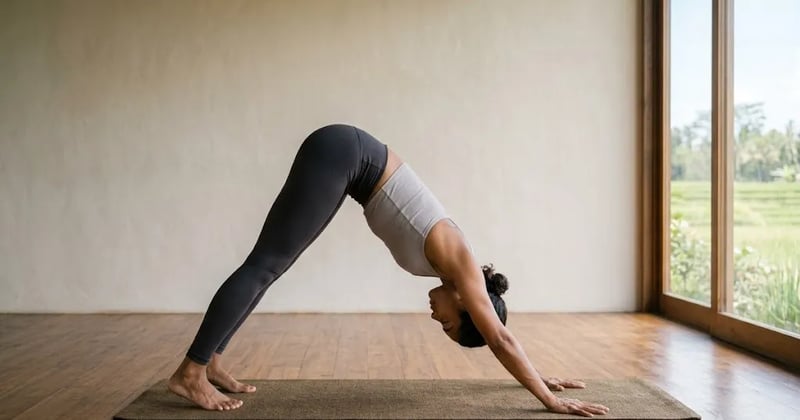
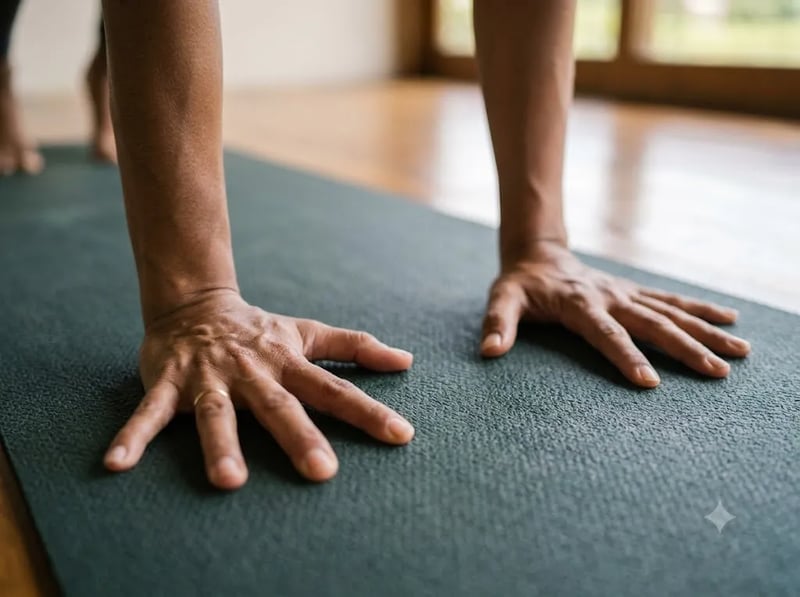
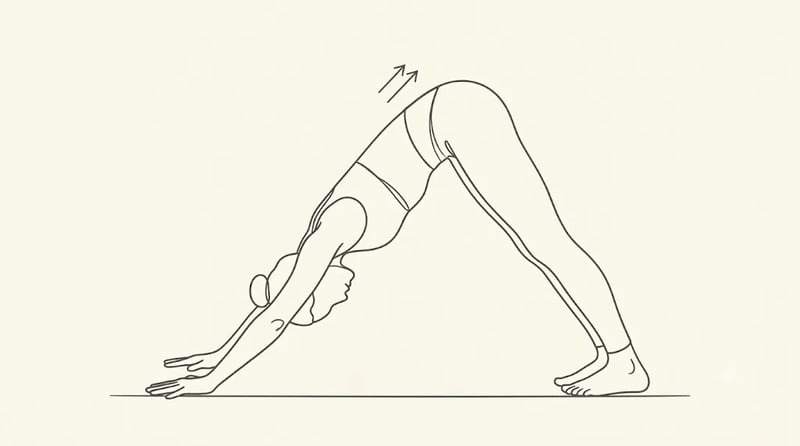
Start on hands and knees, wrists under shoulders, knees under hips. Spread your fingers wide and press evenly through the whole hand, especially the base of the index finger, to protect the wrists. Tuck your toes, lift your knees, and send your hips up and back, as if a string were pulling your tailbone to the ceiling.
The Cues That Matter
Lead with the hips, not the heels. The shape is an inverted V, with length through the spine, not flat heels.
Bend your knees generously if your hamstrings are tight. A long spine with bent knees beats a rounded spine with straight legs.
Externally rotate the upper arms so the elbow creases face forward, which creates space in the shoulders.
Press the floor away through the hands to lift out of the shoulders, rather than sinking into them.
Let the head hang, ears between the arms, neck relaxed.
Common Mistakes
The most common error is rounding the spine to force the heels down. The heels do not need to touch the floor. Another is dumping weight into the wrists; spread the load across the whole hand and engage the arms. Finally, avoid shrugging the shoulders up to the ears; draw them down the back.
The anatomy behind the shape
Downward dog looks like a stretch, and it is partly that, but structurally it is a load-bearing pose that asks three regions to cooperate: the shoulders, the hamstrings, and the wrists. Understanding what each is doing makes the difference between a pose that opens you up and one that grinds at a joint over time.
At the shoulders, the goal is flexion combined with external rotation, so the upper arms rotate outward and the shoulder blades widen across the back rather than creeping up towards the ears. If your shoulders lack that range, your body borrows it from the lower back, which is why so many people feel the pose in their spine instead of their arms. The work is to press the floor away through the whole hand and let the chest sink towards the thighs without collapsing between the shoulder blades.
At the back of the legs, the hamstrings and calves are lengthened as you lift the sitting bones towards the ceiling. This is the sensation most people call the stretch, and it is also the one they most often force. The hips lead the pose; the heels do not have to touch the floor for the pose to be correct.
At the wrists, you are bearing a meaningful share of your body weight through a joint that was not designed as a primary weight-bearer. The load runs through the base of the palm and the finger pads, and how you distribute it determines whether the wrist feels supported or pinched. Those three regions, working together, are the whole pose.
Modifying for tight hamstrings
The single most useful modification in this pose is to bend the knees, and it is also the one people resist because it feels like giving up. It is the opposite. Bending the knees lets you tilt the pelvis forward and lengthen the spine, which is where the real value of the pose lives, instead of rounding the lower back to chase straight legs you do not yet have.
It helps to know what stretching is actually doing when your hamstrings feel tight. Work by Konrad and colleagues in Clinical Biomechanics found that the range-of-motion gains people get from stretching are not explained by the muscle or tendon becoming physically longer; the more likely mechanism is an increase in your tolerance of the stretch. In plain terms, forcing straight legs today will not lengthen the tissue, and it may well overload it.
So bend the knees generously, lift the hips high, and let the heels stay wherever they land. Over weeks and months your tolerance shifts and the legs straighten on their own, without you ever having yanked them there. If tight hamstrings are a recurring theme for you across your whole practice, it is worth reading our detailed guide to working with tight hamstrings safely and what the evidence really says.
One more point: hamstring tightness at the top of the leg sometimes travels from the hips rather than the muscle belly itself, so a stiff, sitting-heavy lifestyle often shows up here. Addressing the pose alone will only take you so far if the hips never move the rest of the day.
Wrist care and useful props
Wrist pain is the most common reason people quietly start avoiding downward dog, and it is usually a load-distribution problem rather than a weak wrist. The fix begins with the hands. Spread the fingers wide, press firmly through the pads of the fingers and the mound at the base of the index finger, and stop the weight from dumping into the outer heel of the palm.
Think of gripping the mat lightly, as if you could make a shallow suction cup under each palm. That active hand takes pressure off the wrist crease and shares the load across the whole hand. A hand that lies flat and passive sends everything into the joint at its most vulnerable angle.
Props help genuinely here. Wedge a folded mat or a slim foam wedge under the heels of the hands to reduce the angle of wrist extension, which is often the exact position that hurts. If the wrists are recovering or simply cranky that day, taking the pose onto the forearms as dolphin removes the wrist question entirely while keeping almost all of the shoulder and hamstring benefit.
Build wrist tolerance the way you would build any tissue tolerance: gradually. Short, frequent exposure with good hand mechanics beats long holds through pain, and a minute of gentle wrist mobility before you practise is rarely wasted.
Building towards a longer hold
Downward dog is often called a resting pose, and it can become one, but not on day one. Early on it is demanding, and trying to hold it for two minutes before you are ready just teaches your body to compensate. The path to a comfortable long hold is built from short, honest holds.
Start with five even breaths, then rest in child’s pose, then return for another five. Repeat that a few times rather than gutting out one long, deteriorating hold. Quality of shape under fatigue is what you are training, and short repeats keep the shape clean while still building capacity.
Watch the breath as your gauge. As long as you can breathe smoothly through the nose, the pose is within your range. The moment the breath turns short and effortful, or the shoulders start climbing towards the ears, you have found your current edge, and that is where you stop, not where you push through.
Over a few weeks the shoulders strengthen, the hamstring tolerance shifts, and the hand mechanics become automatic, at which point the pose genuinely does start to feel restful. If you want to understand this kind of graded, anatomy-led progression across a whole practice, it is the backbone of how we teach on our 200-hour yoga teacher training in Bali.
Using the shape as a check-in through your practice
Most people treat this pose as somewhere to pass through on the way to something else. It is more useful as an instrument. Because you return to it repeatedly within a single session and across years, it gives you a stable reference point against which to notice what has actually changed.
Take a reading early in a session, before anything has warmed up. Notice three things and no more: how far your heels are from the floor, whether your lower back is rounding, and how much weight is sitting in your hands. Do not correct anything yet. You are taking a measurement, and correcting first destroys the measurement.
Take the same reading later in the same session. The difference between the two is far more informative than either one alone. A cold version that is noticeably worse than a warm version is completely ordinary and tells you your first few minutes should be gentle. A cold version that is close to your warm version tells you that you can start with more.
Across weeks, watch the trend rather than the day. Sleep, hydration, the previous day’s training and how long you sat at a desk all move this pose around, and any single reading is mostly noise. What matters is whether the three-month average is going somewhere. Heels descending is the change people look for and the least important of the three, because heel height is substantially a matter of individual proportions and will not change much for some people no matter what they do.
A rounding lower back is the reading worth acting on. It usually means the hamstrings are limiting the shape and the spine is compensating, and the response is to bend the knees generously rather than to work harder at straightening the legs. A version with soft knees and a long spine is a better pose than a version with straight legs and a curved one, at every level.
Watch the wrists as your honest load meter. If they ache after a session, weight is sitting too far forward and the fix is to press the base of the index finger down and send more of your weight back towards the hips, not to build tolerance. Persistent wrist pain, shoulder pain that lingers past the session, or numbness in the hands are worth a proper assessment from a physiotherapist rather than another month of adjusting your set-up.
If the shape refuses to make sense, put your hands on a wall instead of the floor and walk your feet back until your body forms roughly the same angle standing up. The same relationship between arms, spine and hips is available there with a fraction of the load, and many people feel where the pose is supposed to work for the first time in that version. Blocks under the hands do a similar job on the floor. Neither is a lesser option, and using one for a few months while the strength and length arrive is a reasonable plan rather than a concession.
What Downward Dog will not tell you
There is one reading this pose will not give you, and it is worth naming so you do not go looking for it. Downward Dog tells you almost nothing about strength. You can hold a beautifully long, open shape and still be weak through the shoulders, and you can be strong through the shoulders and hold a shape that looks unremarkable.
The reason is that the pose is largely isometric and largely supported by your own body weight distributed across four points. Nothing in it asks a muscle to move a load through range, which is what builds strength. If you want a strength reading, take it somewhere else, from a plank hold or from how a chaturanga descent feels on the third repetition.
What the pose is unusually good at is telling you about tissue length and about habit. Both of those change slowly, which is exactly why a slow-changing measurement suits them. Treat it as a long-range instrument and it will serve you for years; treat it as a daily scorecard and it will mostly report on how you slept.
If you want a single practical rule, take the reading in the same conditions each time. Same point in the practice, same warm-up, same time of day where you can manage it. A measurement taken cold on a Tuesday and warm on a Sunday is two different measurements, and comparing them tells you about your schedule rather than about your body.
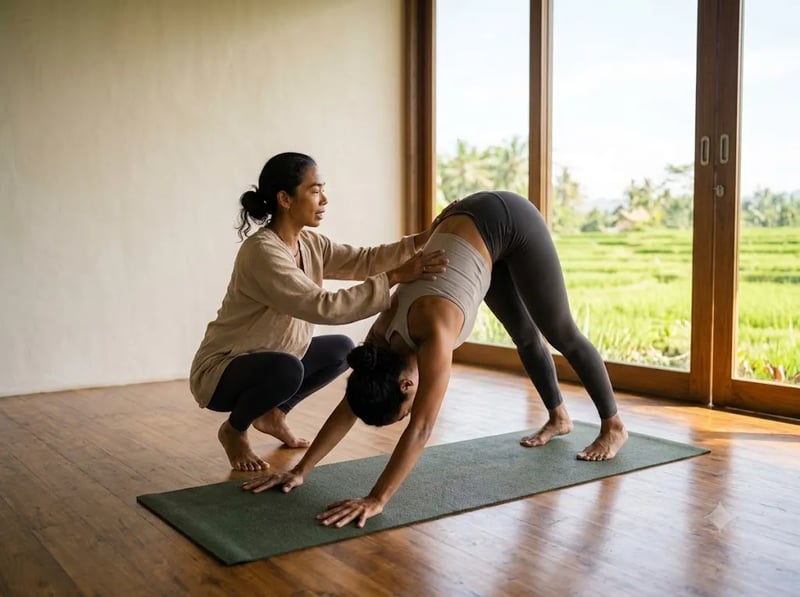
One practical consequence: if you are teaching, resist the urge to correct every Downward Dog you see. A student who is taking their own reading learns more from three seconds of being left alone than from a hands-on adjustment that resets the measurement before they have read it. The pose anchors the sun salutations at the heart of Ashtanga yoga, where you will meet it dozens of times in a single practice.
Train With Loka
Alignment is where safe, sustainable practice begins. If you want to understand how the body actually works in postures like this, our Online Yoga Mechanics Course breaks down functional anatomy pose by pose. For the muscles behind the stretch, see hip flexor anatomy for yoga.
Frequently Asked Questions
Should my heels touch the floor in Downward Dog?
Not necessarily. Heel height depends on your hamstring and calf length. A long spine matters far more than flat heels.
Why do my wrists hurt in Downward Dog?
Usually from dumping weight into the heels of the hands. Spread the load across the whole hand and press up out of the shoulders.
Is Downward Dog a resting pose?
It is often called one, but it is an active, full-body posture. It becomes restful only once the alignment and strength are in place.
How long should I hold it?
Three to five slow breaths is a good start. Build up as your strength and understanding of the pose grow.
How far apart should my hands and feet be?
Roughly a plank’s distance: from hands and knees, plant your palms, tuck your toes, and lift without stepping in. Too short a stance crowds the shoulders and rounds the back; most people err short. If your spine cannot lengthen, walk the feet back a little and bend the knees.
Is this pose safe during pregnancy?
Often, in the earlier stages and with a doctor’s or qualified prenatal teacher’s guidance, though many practitioners shift to hands-and-knees variations or wall versions as pregnancy progresses. This is exactly the situation to raise with your teacher before class rather than adapting alone.
The Loka Newsletter
Enliven your routine with exclusive spiritual content. There’s so much to learn.

Find us on Instagram
@lokayogaschool