Last updated on October 22nd, 2026 at 08:43 am
What Is Vinyasa Yoga? Breath, Movement, and Flow
Vinyasa yoga is the flowing, breath-led style you will find in most modern studios. Instead of holding postures one at a time, you move continuously from one to the next, each movement paired with an inhale or an exhale. If you have ever taken a “flow” class, you have practised Vinyasa.
Vinyasa is just one branch of a much larger tree. Our overview of types of yoga schools maps out where it fits, and if you want to see the slower, foundational style it evolved from, take a look at what Hatha yoga is.
The Meaning of Vinyasa
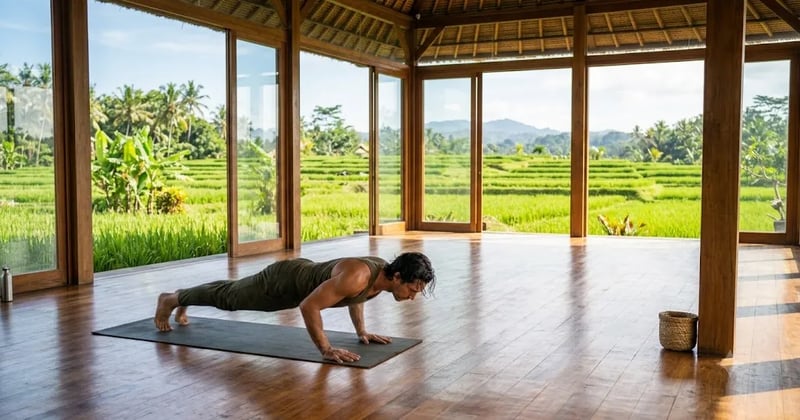
Vinyasa can be translated as “to place in a special way.” In practice it means linking breath to movement, so that the breath leads and the body follows. This continuous linking is what gives Vinyasa its meditative, dance-like quality.
How a Vinyasa Class Flows
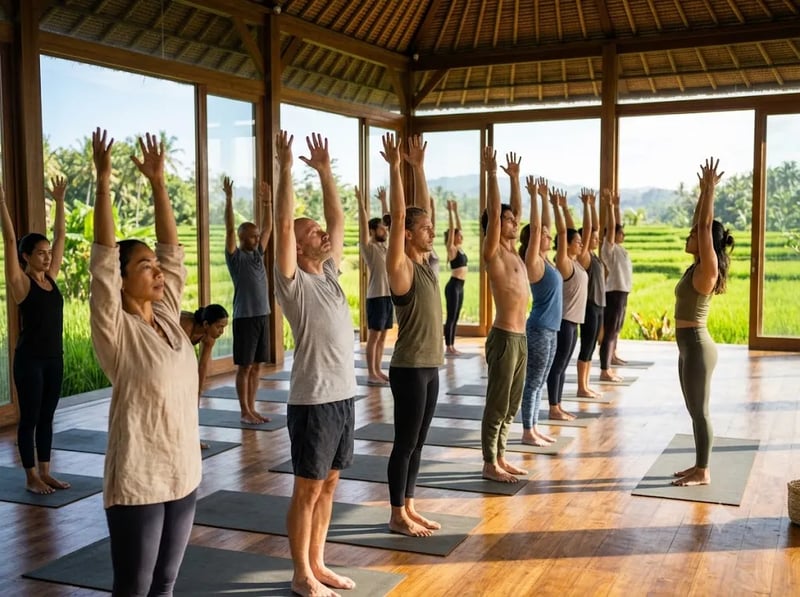
A typical class builds through a warm-up, often Sun Salutations, into a peak sequence of standing, balancing, and sometimes inverted postures, before cooling down into seated poses and relaxation. No two Vinyasa classes are exactly alike, because teachers sequence creatively. The constant is the breath, which sets the rhythm throughout.
Vinyasa vs Hatha
The simplest way to understand Vinyasa is against Hatha. Hatha holds postures with the breath at a slower pace; Vinyasa flows continuously and is generally more vigorous. Vinyasa grew directly out of the Hatha foundation, adding movement and flow. If you want a slower, more precise practice, choose Hatha. If you want movement, heat, and rhythm, choose Vinyasa.
The Benefits
Builds cardiovascular fitness, strength, and stamina.
Trains steady, rhythmic breathing under movement.
Improves focus, as the continuous flow leaves little room for distraction.
Offers endless variety, which keeps a practice fresh.
Breath-led movement, explained
The idea that defines this style is simple to say and takes a while to feel: you let the breath lead, and the movement follows it. Rather than holding a pose for several slow breaths, you pair one movement with one breath, so the practice becomes a continuous, breathing sequence rather than a series of stops.
In practice that usually means you inhale as the body opens or lengthens, and exhale as it folds or lowers. Reaching the arms overhead rides an inhale; folding forward rides an exhale. Once this pairing clicks, the breath sets the pace for you, and the class stops feeling like a list of poses to get through.
This is also why the breath is treated as the priority when things get hard. If your breathing turns ragged or you find yourself holding it, that is the signal to slow down or rest, not to push on. A steady breath is the thread the whole practice hangs from. If you are newer to yoga, the slower foundations of Hatha yoga are a good place to learn how breath and pose fit together before you speed things up.
What your first class actually feels like
Your first flowing class can feel busy. Things move more quickly than you expect, the teacher names poses you may not know yet, and there is a fair chance you will spend part of it half a beat behind everyone else. This is ordinary, and it passes faster than you think.
Do not try to match the room. Take the gentler options when they are offered, pause in a resting pose whenever you need to, and let the sequence come round again, as it usually will. Following the breath rather than the choreography is the shortcut: if you keep breathing steadily, the movements gradually fall into place.
Expect to work up a light sweat and to feel your heart rate lift, since the continuous movement warms the body in a way slower practices do not. Expect, too, to finish pleasantly tired rather than wrung out, especially once you stop trying to keep up with everyone else and settle into your own pace.
Building stamina without straining
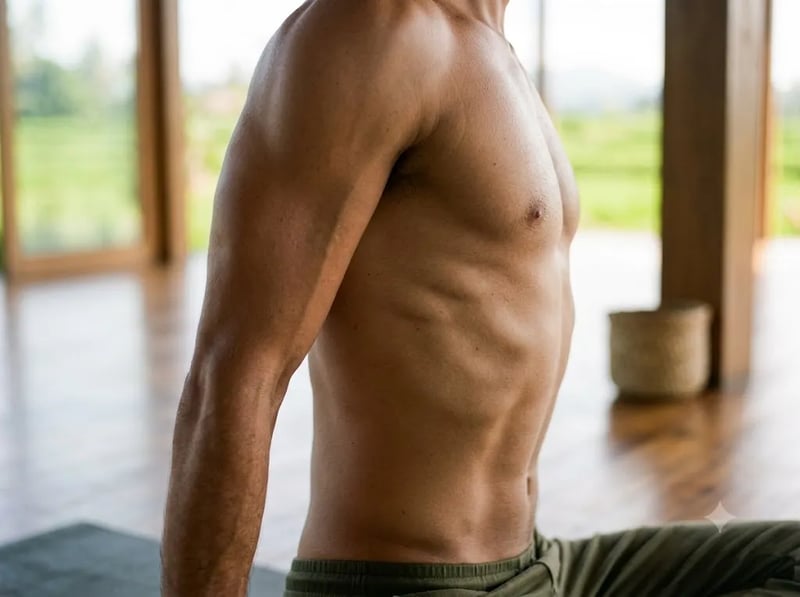
Stamina in this style is built gradually, and rushing it is the quickest way to strain something or burn out. The sensible path is to let your capacity grow through regular attendance rather than through white-knuckling a class that is beyond you today.
Rest is a skill, not a failure. Dropping into a child’s pose or a gentle resting position for a few breaths, then rejoining when you are ready, is exactly how you train the body to handle more over time. Teachers expect it, and taking that rest is what lets you finish strong rather than fading halfway through.
Pay attention to the difference between effort and pain. Working muscles, a warm body, and a faster breath are signs of good effort. Sharp joint sensations, dizziness, or a breath you cannot steady are signs to stop and recover. Progress shows up as sequences that once left you gasping starting to feel manageable, and that change comes with weeks, not single sessions.
Who it suits, and how to modify
This style tends to suit people who enjoy movement and warmth, who like a class that keeps them engaged, and who already have some basic familiarity with common poses. If you prefer long, quiet holds and plenty of stillness, a slower practice may serve you better, and there is no hierarchy in that choice.
That said, almost anyone can practise with the right modifications. Lowering the knees in a plank, stepping rather than jumping between poses, and taking a shorter range in the deeper shapes all keep the flow accessible without watering it down. A good teacher will offer these without being asked, and a good student will take them without embarrassment.
If you are recovering from injury, pregnant, or managing a health condition, check with a professional and tell your teacher before class so the practice can be adapted for you. Approached sensibly, a flowing practice can meet you where you are and grow with you for years.
Pacing yourself when the room is moving fast
The defining difficulty of this style is not any individual pose. It is that the class sets a pace and you have to decide, repeatedly and quickly, whether that pace is yours. Getting that decision right is most of what separates a sustainable practice from an injury.
Use your breath as the arbiter. If you can still breathe through your nose in an even rhythm you can more or less keep up with, you are working at a reasonable intensity. Once the breath becomes ragged, held, or something you are gasping through your mouth, you have gone past your working pace, and no amount of keeping up with the room will change that. The breath is a more honest instrument than how the class looks.
Know your two exits before you need them. Coming down to your knees during a sequence, and resting in a simple forward fold or child’s pose for a round. Decide now that using either is normal, because deciding in the moment while everyone around you is moving is much harder. Taking a round off and rejoining is not dropping out of the class. It is how experienced practitioners get through a fast one.
The transitions are where things actually go wrong, more often than the poses. Moving quickly between shapes tempts you to reach the destination before your weight has arrived, which is how wrists, shoulders and lower backs take load they were not ready for. Slowing your own transitions while the room moves at its pace is completely acceptable, and it is a sign of good practice rather than of falling behind.
Resist matching the person in front of you. Every room contains someone who has been doing this for a decade, and comparing your third month to their tenth year produces nothing except a rushed practice. Their version is not the correct version, it is simply theirs. Yours is whatever you can do while still breathing evenly.
Build the frequency before you build the intensity. Two moderate classes a week for a couple of months does more for you than one class a week where you push hard and spend two days sore. Heat and speed are the most visible parts of this style and the least important to get right early. Consistency is what makes the fast rooms feel manageable, and it arrives sooner than you expect.
Heated rooms deserve a separate decision. Heat makes you feel more open than you are, which is pleasant and occasionally how people go further than their tissues were ready for. It also adds a real cardiovascular load on top of the movement. If you are new, pregnant, prone to dizziness or managing blood pressure, start in an unheated room and come to the heated ones later if you want to. Drink water beforehand rather than mainly during, sit down the moment you feel light-headed, and know that leaving a hot room early is a sensible decision rather than a failure.
The transitions deserve as much care as the poses
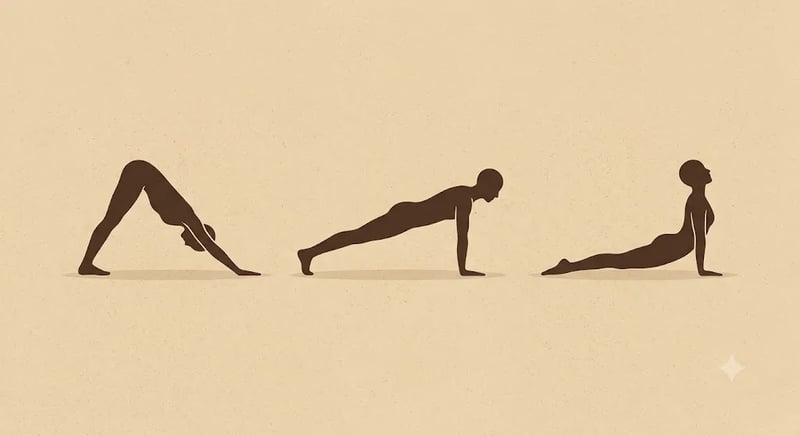
Most of the injuries and most of the wasted effort in a flowing practice happen between the poses, not in them. The repeated passage from plank down towards the floor and through to an upward-facing shape is the busiest junction in the whole class, and it rewards a little technique disproportionately.
Lowering from plank is the honest checkpoint. Done well, the elbows stay close to the ribs, the shoulders stay above elbow height, and the whole body lowers as one piece. Done tired, the hips sag, the shoulders dip and roll forward, and the joint takes load the muscles should be taking. Dropping the knees to the floor first removes most of that risk while keeping all of the pattern, and experienced practitioners use that option freely on later rounds when fatigue sets in.
Stepping rather than jumping between shapes is a similar case. Jumping forward looks tidy and adds impact through the wrists and shoulders on every repetition. Stepping quietly costs you nothing except spectacle, and over a class of many rounds the arithmetic favours the quieter option, especially if your wrists have opinions.
Treat the transitions as poses in their own right and the class changes character. Move at the speed of your breath rather than the speed of the room, arrive in each shape before you begin leaving it, and let the join between two postures be as deliberate as the postures themselves. This is also the fastest route to the practice feeling like the moving meditation teachers describe, because rushed transitions are where attention leaks out.
If one transition consistently defeats you, ask your teacher for the piece rather than repeating the whole. Two minutes of specific attention on how you lower to the floor will improve every class that follows, and good teachers are glad to be asked.
The breath gives you an honest gauge for all of this. A transition taken at the speed of one full exhale is almost always safer and cleaner than the same transition rushed between breaths, because the slower pace gives your shoulders time to organise and your attention time to arrive. If you notice you are habitually holding your breath through the lowering phase, that is the clearest sign the movement is still costing more than it should, and the kindest response is to take the knees down for a week and rebuild.
None of this is about doing the cautious version forever. It is about earning the full version in a way that keeps your joints enthusiastic for years of practice, which is the only timeline that matters.
Why two flow classes can feel nothing alike
The word on the timetable tells you less than you would hope. Two classes carrying the same label can run at completely different speeds, hold poses for different lengths, and expect entirely different things of you.
Teacher lineage explains most of the variation. Someone trained through an Ashtanga background will run a fixed sequence with strong, repeating shapes. Someone from a more creative or somatic training will build towards a peak pose and improvise the route there. Neither is more correct, but the first feels demanding and predictable, and the second feels varied and occasionally chaotic.
Music and room temperature account for much of the rest. A heated room with a playlist pushes the pace and encourages you to go further than you might, and a quiet unheated room tends to slow everything down. If you tried this style once and disliked it, there is a fair chance you tried one version of it.
Class length matters more here than in slower styles. A 45-minute session usually cuts the standing sequence short and rushes the closing, while 75 or 90 minutes leaves room for the transitions to be taught rather than merely performed. It is also worth knowing how this compares with a slower, floor-based style before you decide the pace is the problem.
The useful move is to read the description for verbs rather than adjectives. Words like build, hold, and refine describe a slower class. Words like link, move, and continuous describe a faster one. Adjectives such as dynamic and energising appear in both and tell you almost nothing.
If a timetable gives you nothing to go on, ask the studio which teacher trained where. It is a slightly odd question and it will get you a straight answer, which is more than the class name will.
Train With Loka
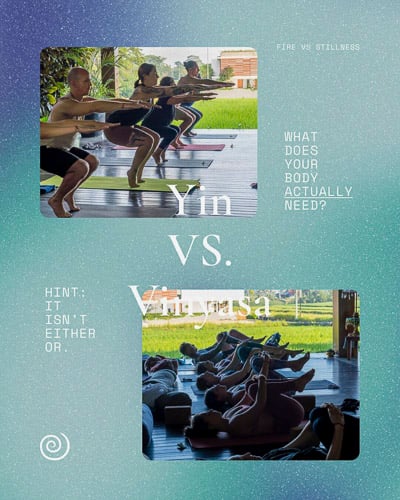
Vinyasa rewards a strong foundation in alignment and breath. If you want to practise it safely and perhaps teach it, our 200-Hour Yoga Teacher Training covers sequencing and breath-led movement in depth. To see how it compares with a slower practice, read our Yin yoga vs Vinyasa compared.
Frequently Asked Questions
Is Vinyasa yoga good for beginners?
It can be, though its pace is quicker than Hatha. Beginners often find it easier after a few foundational Hatha classes.
Is Vinyasa a good workout?
Yes. Its continuous flow builds strength, stamina, and cardiovascular fitness.
What is the difference between Vinyasa and flow?
They are essentially the same. “Flow” is the common studio name for Vinyasa.
Do I need to be flexible?
No. Flexibility develops with practice. Breath awareness matters more than how deep you can go.
How many times a week should I practise this style?
Two to three classes a week builds stamina and familiarity quickly without overloading wrists and shoulders, which take the most repetition in a flowing practice. On the days between, a few minutes of gentle mobility keeps the body ready. More is not better until the transitions feel easy.
Why is it called flow yoga?
Because each movement is linked to a breath and strung together into a continuous sequence, so the practice flows from one pose to the next rather than stopping and holding. The breath sets the pace, guiding when you move and when you pause, which gives the class its steady, moving-meditation quality.
The Loka Newsletter
Enliven your routine with exclusive spiritual content. There’s so much to learn.

Find us on Instagram
@lokayogaschool