Last updated on October 24th, 2026 at 06:10 pm
How Does Practising Yoga Help Strengthen Athletes?
Yoga builds what most athletic training misses. Not muscle mass or cardiovascular output, but the connective tissue integrity, breath capacity, proprioceptive awareness, and psychological regulation that determine whether an athlete reaches their ceiling or stays below it. Here is the science.
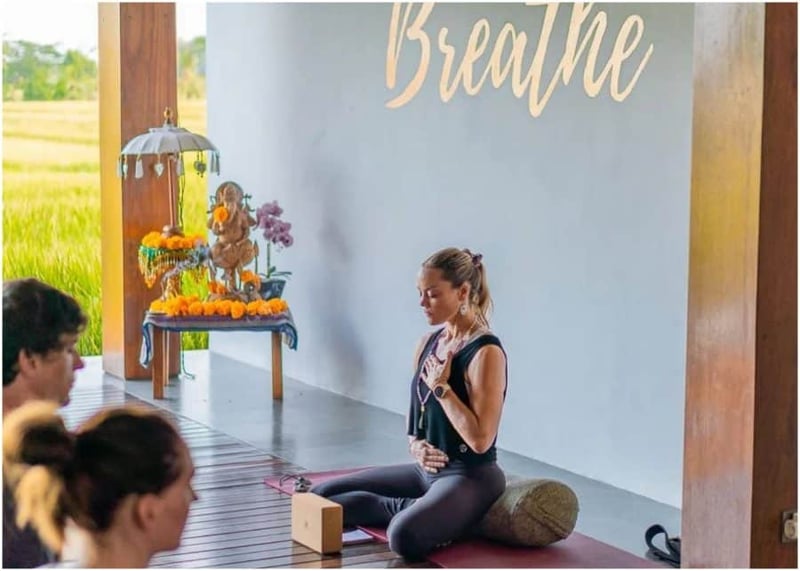
What Yoga Offers That Athletic Training Alone Does Not
Most training programmes are good at building the things you can easily measure: strength, speed, power, endurance. They are less good at addressing the things that quietly limit performance and increase injury risk.
Joint mobility, fascial health, breath efficiency, and the ability to regulate arousal under pressure are all trainable qualities. Yoga addresses all four directly. This is why athletes across elite football, swimming, surfing, martial arts, gymnastics, and distance running increasingly have yoga as a mandatory component of their programming.
Connective Tissue Health and Injury Prevention
Athletic training places repeated, high-load stress on muscles, tendons, and joints. Muscles adapt quickly. Connective tissue adapts slowly and breaks down more catastrophically when pushed past its tolerance.
Yin-style yoga, with its sustained passive holds targeting fascia and ligaments, is the most direct tool available for maintaining connective tissue health. Regular Yin practice reduces chronic tightness in the hips, hamstrings, shoulders, and thoracic spine, the areas most commonly implicated in sports injuries.
Studies on athletes who incorporated biweekly yoga sessions showed significant improvements in flexibility within ten weeks. More importantly, reduced soft tissue restrictions translate directly into reduced injury risk. A tight hamstring under load is a torn hamstring waiting to happen.
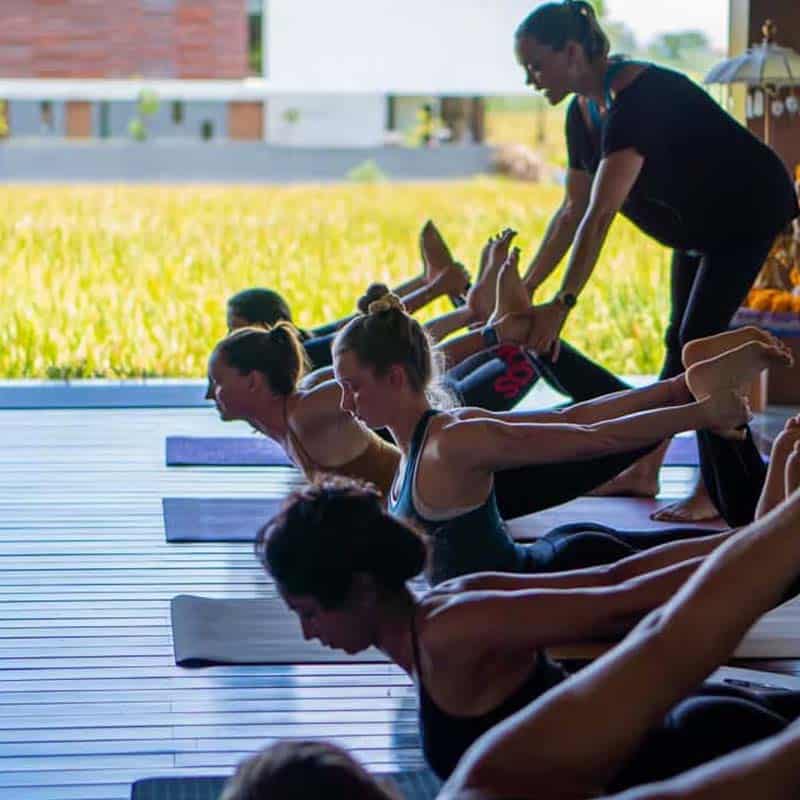
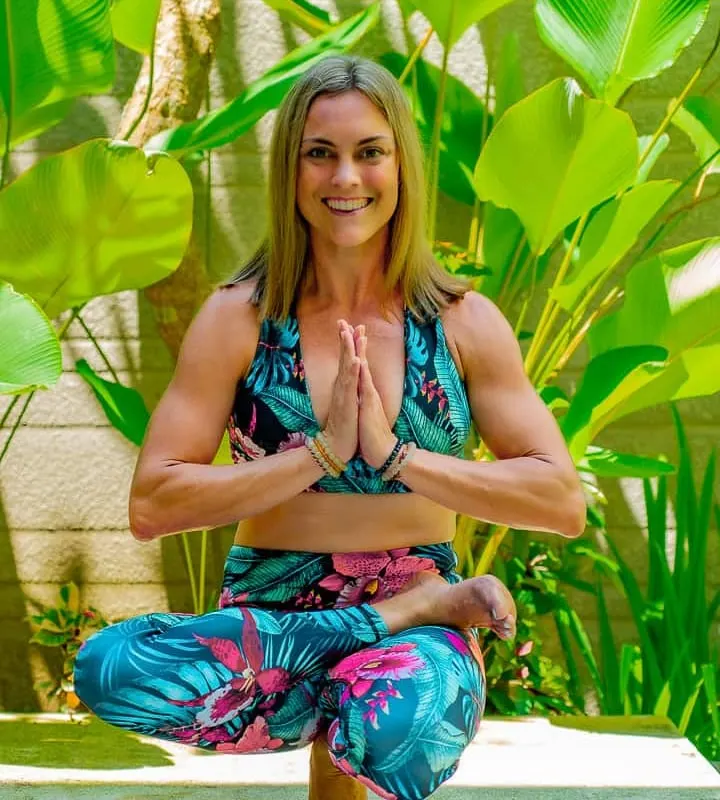
Specific poses with particular value for athletes include Pigeon Pose (hip external rotators and hip flexors), Supta Padangusthasana (hamstrings and adductors), Supported Bridge (hip flexors and lumbar spine), Garudasana (shoulder girdle), and Gomukhasana (external hip rotators and triceps).
Balance and Proprioception
Athletic excellence depends on proprioception, your nervous system’s ability to know where your body is in space and to make rapid postural adjustments. This capacity is trainable, and yoga is one of the most effective tools for developing it.
Single-leg balance poses like Vrksasana (Tree Pose), Virabhadrasana III (Warrior III), and Ardha Chandrasana (Half Moon Pose) challenge the proprioceptive system under conditions of increasing complexity. Over time, this translates to better dynamic stability in sport: harder runs, cleaner changes of direction, and more accurate technique under fatigue.
Breath Efficiency and Oxygen Utilisation
Pranayama is one of yoga’s most underutilised performance tools. Most athletes breathe primarily through the chest, using accessory muscles of the neck and shoulders that are inefficient and contribute to postural tension. Diaphragmatic breathing, the foundation of pranayama practice, is biomechanically efficient, calming to the nervous system, and associated with improved oxygen exchange.
Research on breath training in athletes shows improved VO2 max, reduced perceived exertion at equivalent workloads, and faster heart rate recovery post-exercise. These are not marginal gains. For a competitive athlete, they are significant.
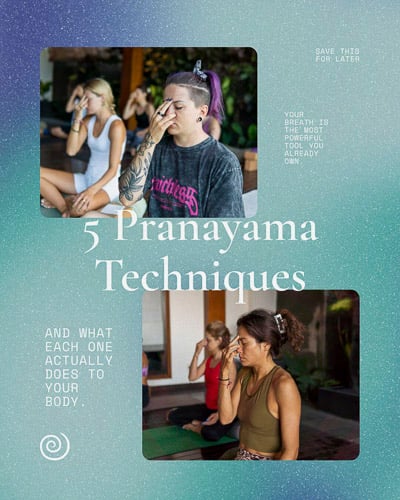
Nadi Shodhana (alternate nostril breathing) and Ujjayi pranayama are two techniques with direct applicability to athletic preparation and recovery.
Mental Focus and Performance Under Pressure
The psychological dimension of athletic performance is increasingly recognised as a genuine performance variable. Concentration lapses, performance anxiety, and emotional reactivity under pressure cost athletes results they are physically capable of achieving.
Yoga’s emphasis on dharana (focused concentration) and the cultivation of equanimity in difficult physical situations trains exactly the mental qualities that determine performance under pressure. The practice of remaining focused through a sustained difficult pose, without collapsing or bracing with excessive tension, is a transferable skill.
Studies show that yoga and meditation reduce cortisol, lower baseline anxiety, and improve the quality of attentional control. Athletes who meditate demonstrate more consistent performance and faster recovery from mistakes.

Recovery: the Missing Variable
Recovery is where adaptation actually happens. Training provides the stimulus. Sleep and recovery provide the conditions for the body to respond to that stimulus.
Yoga supports recovery through multiple mechanisms: increased parasympathetic activation reduces post-training sympathetic overdrive; gentle movement enhances circulation to recovering tissues; pranayama improves sleep quality; and the reduction of cortisol supports anabolic hormonal balance.
Restorative yoga and Yoga Nidra (yogic sleep) are particularly valuable recovery tools. Yoga Nidra has been shown to produce physiological states equivalent to deep sleep within a guided practice of thirty to forty-five minutes, making it extraordinarily useful for athletes during high-volume training periods.
Nutrition completes the recovery picture. A balanced diet reduces inflammation and gives recovering tissue the raw materials it needs, and the recovery benefits of yoga are amplified when eating supports them.
What the Research Actually Shows
Yoga’s reputation among athletes rests on claims that are easy to make and hard to test. The literature is smaller than the marketing suggests, and reading it properly changes what you should expect from a weekly class.
Start with flexibility, since that is what most athletes come for. Stretching reliably increases the range of motion you can access, but a 2014 study in Clinical Biomechanics found the gain was not explained by any measurable change in muscle or tendon structure (Konrad and Tilp). What changes is your tolerance of the stretch, which is a nervous system adaptation rather than a tissue one.
That matters practically. If range of motion is largely a tolerance effect, it decays when you stop practising and it does not transfer automatically into loaded positions. A more open hip in pigeon pose does not guarantee a deeper squat under a bar.
For runners, a 2019 trial in the Journal of Strength and Conditioning Research tested a hip flexor stretching programme and recorded changes in running kinematics (Mettler et al.), and a 2021 review examined how stretching the hip flexors affects performance parameters (Konrad et al.). The direction is encouraging. The effect sizes are modest and the samples are small.
Breathing is better evidenced than flexibility. Slow breathing at around six breaths per minute produces reproducible cardiovascular and autonomic effects (Russo et al., Breathe, 2017), and a 2018 systematic review found consistent effects on attention and arousal across breath-control practices (Zaccaro et al.). For an athlete that is a usable recovery tool with a mechanism behind it.
Where the Evidence Is Thin
A page that only lists benefits is not much use to someone deciding how to spend four hours a week. Here is what the research does not support.
Injury prevention is the weakest claim in the category. No adequately powered trial has shown that adding yoga to a training programme reduces injury rates in any sport. The mechanisms are plausible, and the outcome data does not exist.
Claims about releasing fascia deserve the same scepticism. The 2018 consensus statement on fascial tissue research in sports medicine is careful about what is established and what is extrapolated (Zügel et al., British Journal of Sports Medicine), and a 2016 systematic review found the evidence for myofascial chains as they are usually described in yoga teaching is partial at best (Wilke et al.). Connective tissue does adapt to mechanical loading (Kjaer, Physiological Reviews, 2004), but over months, not inside a class. We go through this properly in our article on what yoga teachers should know about fascia.
On soft tissue work more broadly, a 2020 meta-analysis in Sports Medicine found foam rolling produces small and short-lived range of motion gains (Wilke et al.). The honest reading is that these interventions help you access a position today rather than remodel you.
And on autonomic benefit, a 2015 meta-analysis of randomised trials concluded the evidence that yoga improves heart rate variability is not convincing (Posadzki et al.). We cite it because it is the strongest counterweight to a claim our own industry repeats constantly, and you deserve to know it exists.
Sport by Sport: Where the Return Is Highest
Yoga is not equally useful across sports. Match the practice to what your sport under-trains rather than to what looks impressive on a mat.
Endurance athletes get most of their return from breath work and from thoracic and hip mobility. Running and cycling load a narrow range repeatedly, so the value sits in the ranges the sport never visits, plus a slow-breathing protocol used on rest days. For cyclists and rowers the hip flexors are usually the limiting tissue, and our guide to hip flexor anatomy for yoga explains why.
Strength and power athletes benefit most from single-leg balance work, controlled end-range positions, and anything that trains position under low load. Keep the volume light in the 48 hours before a heavy session, and do not use long static holds immediately before a maximal effort.
Court and field athletes, who change direction under fatigue, get the most from rotational and balance work, plus breath practices that shorten the time it takes to settle between efforts. The measurable win there is usually recovery rather than performance.
Contact and combat athletes need mobility they can defend under load rather than passive range. Prioritise active work over long passive holds, and treat restorative practice as a separate session rather than a warm-down.
Swimmers sit in an odd middle ground. The shoulder takes thousands of rotations a week, so more stretch is rarely what’s missing. What helps is the opposite: control at end range, scapular stability, and thoracic rotation work that lets the catch come from the torso instead of the shoulder capsule. Pair that with breath training and the return compounds, because a swimmer who’s comfortable holding a longer exhale carries that calm straight into race pace.
Masters athletes, anyone competing past about thirty five, arguably get the biggest return of all. Recovery slows with age faster than strength does, and the restorative end of the practice buys back training days that would otherwise be lost. Two short sessions a week is usually enough to notice the difference within a training block, and it costs nothing from the strength or endurance budget.
Fitting It Into a Training Week Without Losing Sessions
The common mistake is treating yoga as another training stimulus. Programme it as recovery or as skill work and the calendar mostly solves itself.
Two sessions a week is enough for most athletes: one longer session on a rest day or after the easiest session of the week, and one 15-minute session attached to an existing warm-down. Beyond that it starts competing with the training that actually makes you better at your sport.
Put slow passive work furthest from your hardest efforts and active mobility work closest to them. Never introduce a new long-hold practice during a competition week.
Track it the way you track everything else. Two numbers are enough: how you sleep, and how one familiar position feels at the same point each week. If you want to understand the physiology rather than follow a protocol, that is most of what we teach in the anatomy module of our 200-hour YTT in Bali.
How to tell whether it is working
Athletes are used to measurable feedback, and yoga gives less of it than a training block does. That is not a reason to skip the measurement, only a reason to choose markers that actually move.
Track three things over eight weeks. First, morning stiffness on the day after your heaviest session, scored out of 10 before you get out of bed. Second, a single held position you can repeat exactly, such as a lunge with the back knee down, timed to the point where form breaks. Third, the number of sessions you cut short or modified because something felt tight.
None of those are performance metrics, and none of them will tell you whether your yoga is making you faster. They will tell you whether your recovery and your tolerance for load are improving, which is where the return on this work sits. If all three are flat after eight weeks, change the practice rather than adding more of it.
Eight weeks is the shortest window worth judging on, and it is shorter than most of the flexibility literature would suggest. Range-of-motion changes show up earlier than tissue changes do, so an improvement in week three is usually your nervous system tolerating a position it already had rather than a tissue that has genuinely lengthened. Both are useful; only one of them holds when you stop practising.
Keep the measurement cheap. Three numbers in a training log take fifteen seconds a week, and the temptation to build something more elaborate is the main reason athletes stop tracking this at all. If you already run a training diary, the yoga markers belong in the same place rather than in an app of their own.
One caveat worth stating plainly: none of this is evidence that yoga prevents injury. The trials that exist are small, short, and mostly on non-athletes, so treat the injury claim as unproven and judge the practice on recovery and tolerance instead. Adding breath efficiency work gives you a second marker that is easier to measure than either.
Practical Application: How to Integrate Yoga into Athletic Training
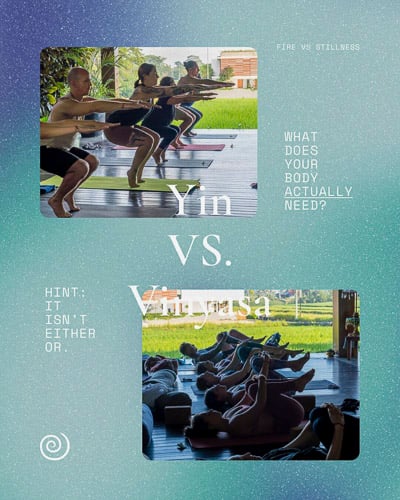
Two to three yoga sessions per week is sufficient to produce meaningful benefits for most athletes. The type of yoga matters. A vigorous Vinyasa session immediately before heavy training is likely to reduce performance. A Yin or Restorative session the evening after a hard training day supports recovery without additional fatigue.
Morning sessions, particularly pranayama and fifteen to twenty minutes of mobility-focused asana, serve as an excellent activation and mental preparation tool.
Our 200-Hour Yoga Teacher Training in Bali includes a dedicated module on yoga anatomy taught by Yann Cadic, our anatomy and physiology specialist. Understanding the biomechanics of movement is invaluable for any teacher working with athletic populations.
Train Smarter With Loka
Mobility starts at the hips. See our anatomy guide to hip flexor muscles and yoga.
Our Online Yoga Mechanics Course breaks down the biomechanics behind safe, strong movement.
Frequently Asked Questions
Which style of yoga is best for athletes?
Yin yoga for connective tissue health and recovery, Vinyasa for active mobility and breath training, and Restorative yoga or Yoga Nidra for deep recovery. Athletes benefit most from a combination of all three rather than any single style.
Can yoga replace stretching?
Yoga encompasses stretching but goes considerably further. A Yin practice provides deeper, more sustained connective tissue work than most static stretching routines. The addition of breath awareness and mindful attention also develops proprioception in ways that passive stretching does not.
How quickly will an athlete notice results from yoga?
Most athletes notice improved movement quality and reduced muscular tension within four to six weeks of consistent practice. Connective tissue adaptations take longer, typically three to six months of regular practice to become significant.
Is yoga good for injury rehabilitation?
Yes, when appropriately modified. Yoga supports rehabilitation through gentle mobilisation, breath-based pain modulation, and the restoration of movement patterns. Work with a teacher experienced in anatomy or therapeutic yoga for best results.
Can yoga improve mental performance in sport?
Yes, and the evidence base is strong. Regular meditation and yoga practice reduces performance anxiety, improves attentional control, and builds the capacity for equanimity under pressure. These are all measurable effects with direct performance implications.

The Loka Newsletter
Enliven your routine with exclusive spiritual content. There’s so much to learn.

Find us on Instagram
@lokayogaschool