Last updated on October 24th, 2026 at 10:45 pm
Comparison: How It Can Be a Good Thing
Comparison is hardwired into the human brain. The default mode network, the neural circuitry that activates when you are not focused on a task, runs a near-constant commentary comparing your situation to others. This is not a character flaw. It is biology. What matters is what you do with it.
Why We Compare
From an evolutionary standpoint, social comparison is adaptive. Knowing where you stand relative to others in your group gave your ancestors critical information about status, safety, resources, and potential partners. This circuit does not switch off just because you are sitting in a meditation class or scrolling your phone.
The suffering that comparison generates is not caused by the comparison itself. It is caused by comparing in ways that create a fixed narrative of inadequacy, in areas you cannot change, against benchmarks that are irrelevant to your actual values or goals.
Comparing your height to someone taller changes nothing about your height. Comparing your life to someone whose context is entirely different from yours produces a story that has no basis in meaningful reality. Comparing yourself to someone whose apparent success you actually envy for the wrong reasons keeps you focused on someone else’s path instead of your own.
This is disempowering comparison. It produces a stream of negative internal narrative that consumes mental energy, fosters resentment, and creates a felt sense of powerlessness.
Comparison as a Spiritual Practice
Yoga philosophy, particularly the Niyama of Svadhyaya (self-study), teaches us to observe our internal processes with honesty and without judgment. Applying Svadhyaya to the habit of comparison reveals something interesting: not all comparison is equal.
Empowering comparison uses the lens of others’ experience to generate clarity about your own potential and direction. You see someone who has built something you genuinely aspire to, in an area that aligns with your actual values, and you allow that to generate motivation rather than envy. The key word is genuine: the aspiration has to be yours, not one you have absorbed from social pressure or received cultural expectation.
There is also the comparison that moves in the other direction: measuring where you are now against where you were a year, or five years, ago. This form of comparison is almost always empowering, because it reveals growth that is easy to forget when you are living through it one day at a time.
The Yoga Practice of Santosha
The Niyama of Santosha, contentment, is often misread as passive acceptance of the status quo. It is not. Santosha means finding genuine satisfaction in what is, including what you have already done and who you already are, without using that satisfaction as an excuse to stop growing.
This is the counterpart to comparison-driven striving. The person who is never content is always chasing the next benchmark. The person who is genuinely content can be motivated by inspiration rather than lack, choosing to grow from a foundation of enoughness rather than from a place of deficit.
These two capacities, the drive to develop and the contentment with what is, are another pair of opposing qualities that yoga asks you to hold simultaneously. Neither one alone is sufficient.
A Practical Exercise
Write out every comparison you regularly make in your mind. All of them, without editing. Then divide the list into two categories.
The first category: comparisons that produce a clear and honest motivation toward something you actually value. These are worth keeping.
The second category: comparisons that produce a vague narrative of inadequacy, that relate to things you cannot change, that involve people whose context has nothing to do with yours, or that leave you feeling deflated rather than energised. These are the ones to work with.
For the second category, the practice is not suppression. When these comparisons arise, you notice them, name them accurately (this thought is not serving me), and redirect. Over time, with consistent practice, the neural pathways associated with disempowering comparison weaken through disuse.
This is exactly what meditation trains. The Online Meditation Training at Loka Yoga School includes a guided practice specifically designed for working with the mental patterns that generate unnecessary suffering, including the comparison habit.
The Role of the Ego
In yogic philosophy, the tendency to compare is a function of the ahamkara, the ego or the sense of separate self. The ego’s project is to establish and defend a particular identity, and it does this partly through the social comparisons that tell it where it stands.
This is why the deeper yoga practices, meditation, pranayama, and the sustained inquiry of svadhyaya, gradually reduce the grip of comparison. They do not do this by suppressing the ego, which does not work, but by creating enough distance between the observer and the thought that you can see the comparison happening without being wholly identified with it.
You notice the thought. You see it clearly. You decide, consciously, whether to follow it.
Two Directions the Mind Takes
Not all comparing does the same thing, and lumping it together is why the standard advice to stop is useless. There are two distinct moves and they have opposite effects.
Looking upward, at someone further along, is the one that stings. It also carries information, because the person ahead of you is a demonstration that the thing is possible and often a rough map of how it was done. The sting and the information arrive together and most people discard both.
Looking downward, at someone struggling with what you find easy, produces a brief lift and almost nothing else. It is the more comfortable move and the less useful one, and it is worth noticing how often the mind reaches for it after a difficult day.
The variable that decides which way upward comparison lands is whether you believe the gap is closeable. If you do, it reads as a direction. If you do not, it reads as a verdict, and the same observation about the same person becomes discouraging instead of clarifying.
So the useful question is not whether you compared. It is which way you were looking, and what you did with what you saw.
What It Looks Like in the Room
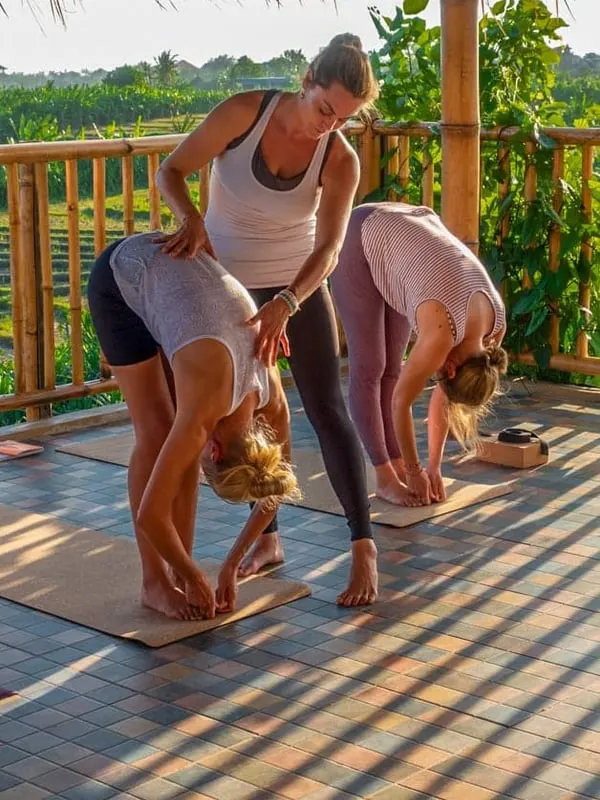
The yoga room is a laboratory for this because everyone is doing the same thing at the same time within sight of each other, which is rare in adult life.
The most common form is the sideways glance during a balance. It is worth being precise about what happens next: you see someone steady, your attention leaves your own foot, and you fall. The comparison did not make you worse at balancing. Leaving your own experience did.
The second form is quieter and more consequential. You see the shape someone else is in, you decide you should be in it, and you push into a range you have not earned. Most yoga injuries are this sentence, and no amount of talking about non-competition prevents it if the room is arranged so that everyone can see the front row.
The third form runs the other way. You watch someone approach a difficult posture with obvious care, you notice they set up more slowly than you do, and you copy the care rather than the shape. That is comparison working exactly as it should.
Teachers can shape which of these happens. Where people are placed, whether you demonstrate the hardest available version, and how you talk about the people who are struggling all decide the temperature of the room. Our article on balancing opposing qualities covers the same tension from the other side.
The Feed Problem That Deleting the App Does Not Solve
Social media is usually blamed for comparison, which is close enough to be believed and wrong in a way that matters. The mind compared before the feed existed. What the feed changed is the sample.
Ordinary comparison used to draw from the people you actually met, most of whom were roughly like you. A feed draws from the top of a global distribution, filtered again for whatever performs, which means the reference group you are measuring against is not a group you could ever have belonged to.
It also strips the process out. You see the posture, not the eight years and the two injuries. Comparison without process data reliably produces the conclusion that you are the problem.
Deleting the app helps for about a fortnight and then the mind finds a substitute, usually the person on the next mat. The more durable fix is to restore the missing information: follow people who show the unglamorous middle, and ask the person you admire how long it took, because they will almost always tell you and the answer is almost always longer than you assumed.
Meditation is not a way of not comparing. It is how you notice you are doing it early enough to choose what happens next, which is a smaller and far more achievable goal. Our guide to the benefits of meditation is honest about the size of that effect.
Turning It Into Information
Here is the practice, and it takes about a minute. When you notice the familiar tightening, run three questions in order.
What exactly did I see. Be specific: their shoulders stayed level, they were not holding their breath, they took two more breaths to set up than I do. Specifics are usable, and a general impression that they are better than you is not.
Is any of that available to me. Sometimes the answer is no, because of anatomy, history, or the fact that they have been at it for a decade. Naming that honestly ends the comparison rather than prolonging it.
What is the smallest thing I could take from it. One cue, one adjustment to how you set up, one change to how often you practise. Anything larger will not survive the week.
Then let it go, and expect to do this again on Thursday. The aim is not a mind that stops comparing. It is a mind that turns the comparison over, keeps the one useful thing, and puts the rest down. If you want to work on this properly rather than in passing, it is one of the threads that runs through our 200-hour YTT in Bali, where you spend a month practising in a room with the same 15 people and cannot avoid it.
Teaching a Room Where Nobody Can Avoid Seeing Anyone
If you teach, you are not a bystander to this. The room you set up decides how much comparison happens in it, and most teachers arrange it by accident.
Placement is the biggest single lever. A room in rows facing a teacher on a raised mat produces one kind of attention. A circle, or mats staggered so that nobody has a clear view of the person in front, produces another. Neither is correct in every case, and it is worth choosing rather than inheriting.
What you demonstrate matters just as much. If you show the fullest available version of every posture, you have set the reference point, and everything else in the room becomes a shortfall from it. Demonstrating the middle version and mentioning the others is a small change with a large effect on the temperature.
How you speak about the people struggling is the third lever, and the one students read most closely. Praising the person in the deepest shape, even warmly, tells everyone else what is being measured. Naming good work that is invisible from the outside, a steady breath, a sensible decision to come out early, moves the standard to something more people can meet.
None of this requires you to say the words “this is not a competition”, which every class hears and no class believes. The arrangement of the room is the argument, and students respond to that rather than to the disclaimer.
Comparing Yourself to Who You Were Last Year
The sharper version is often not the person on the next mat. It is a former self: fitter, freer, less tired, before an injury or a baby or a decade of desk work.
It runs in the same two directions as any other. Downward it produces a quiet complacency, resting on what you could once do. Upward it produces grief, and grief is not the same thing as motivation, however much it can be dressed up as it.
The difficulty is that memory is a poor archivist. It keeps the best day and discards the ordinary ones, so you end up measuring today’s average against a highlight. Someone who remembers practising every morning is usually remembering a good fortnight, not a good year.
There is a version worth keeping, though. Noticing that your breath is steadier than it was, or that a shape which used to frighten you no longer does, is real information about a direction of travel. Santosha does not require you to stop noticing change. It asks you not to make your contentment conditional on it, which is its own pull between two opposing qualities.
A practical distinction: if it ends in a specific next action, it was useful. If it ends in a story about what you should be by now, it was not. The second always feels more serious and delivers less.
And some losses are simply losses. Bodies age, injuries leave a mark, and lives get busier. Practising with the body you have today is not a lesser version of the practice, it is the only version there has ever been. The person you were last year was also working with whatever they had, and did not know it either.
Meet Your Mind on the Cushion
Comparison softens when compassion grows, a theme we explore in the power of empathy.
Our Online Meditation Training helps you notice the comparing mind without being run by it.
Frequently Asked Questions
ABOUT THE COURSE STRUCTURE
Yes. Comparison is a neutral cognitive process. Its effect on your wellbeing depends entirely on how you use it. Comparing yourself to someone who embodies a quality you genuinely want to develop, in a domain you actually care about, is a legitimate source of motivation.
ABOUT TARYN & YANN
Yoga, particularly meditation and the practice of Svadhyaya, builds the capacity to observe your own mental processes without being swept away by them. You begin to see the comparison arising as a thought rather than a fact. That perspective shift is the foundation for changing the pattern.
ABOUT ANATOMY
Santosha is the Niyama of contentment, one of Patanjali’s personal observances. It is the practice of finding genuine satisfaction in the present moment without using contentment as a reason to avoid growth. Research on gratitude, which is a secular version of the same practice, consistently shows its ability to reduce anxiety and depression.

The Loka Newsletter
Enliven your routine with exclusive spiritual content. There’s so much to learn.

Find us on Instagram
@lokayogaschool