Mudras Explained: How Hand Positions Direct Your Energy
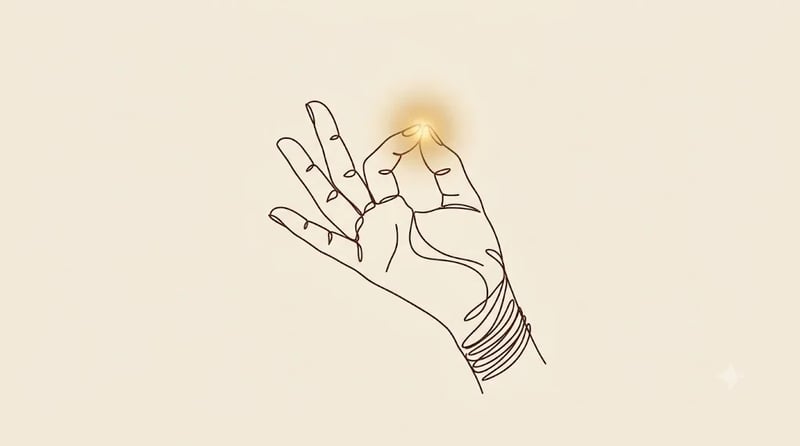
Mudras are symbolic hand gestures used in yoga and meditation to focus attention and, in the yogic view, to guide the flow of energy. You have likely seen the most famous one: thumb and index finger touching, the rest of the hand relaxed. Understanding mudras adds a subtle, useful layer to your practice.
Mudras appear often in Kundalini yoga, where they are paired with breath and chant, and they sit alongside the wider benefits of meditation as a simple way to focus the mind.
What a Mudra Is
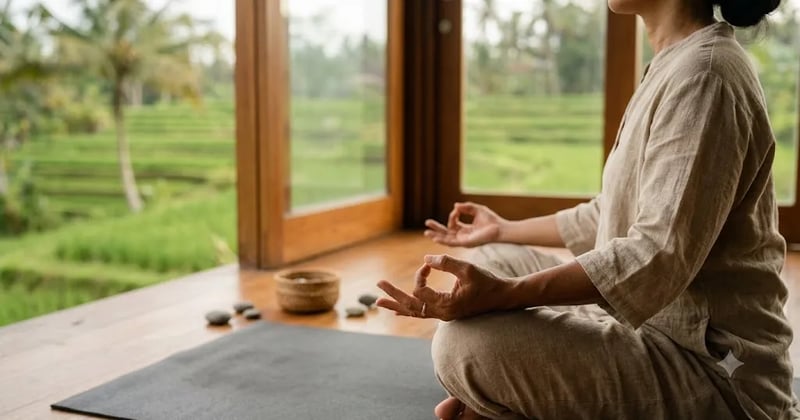
Mudra means “seal” or “gesture.” In practice, a mudra is a precise position, most often of the hands and fingers, held during meditation or pranayama. Each finger is associated with an element in the yogic system, and joining or extending fingers is said to balance those elements and settle the mind.
How Mudras Are Used
Mudras are not a standalone practice so much as a support for meditation and breathwork. Holding a mudra gives the restless mind a small, steady anchor, and the gentle physical focus helps deepen concentration. They are simple to add to any seated practice.
A Few Common Mudras
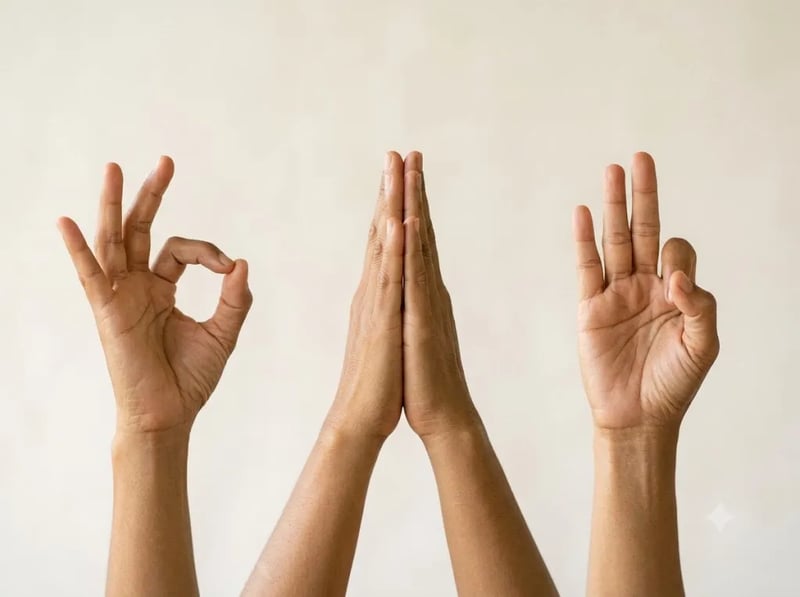
Gyan mudra: thumb and index fingertip touching, palms up. Used for concentration and calm.
Anjali mudra: palms together at the heart. A gesture of centring and gratitude.
Prana mudra: thumb, ring, and little fingertips together. Said to feel enlivening.
Do Mudras Really Work?
The evidence base is modest, and the energetic claims are traditional rather than proven. What is clear in practice is that a held gesture supports focus and presence. Approach mudras as a gentle aid to meditation, not a magic switch, and let your own experience guide you.
Hand gestures in the classical texts and in modern rooms
Mudras are older than the wellness-shop version suggests, and knowing where they come from helps you use them honestly. In the classical hatha yoga texts, the word mudra covers far more than hand positions: it includes whole-body seals and internal locks meant to work with the flow of prana during advanced practice. The delicate finger gestures most people picture are only one branch of a much larger family.
Those texts describe mudras as tools for concentration and for containing energy, always inside a committed practice of breath and meditation. They were never presented as quick fixes you could perform at a desk for an instant result. The setting mattered as much as the gesture.
The modern use is looser, and that is not automatically a problem as long as you are clear about it. Today a mudra is most often a simple hand position adopted during seated meditation or breathing, valued for the way it settles and focuses attention. That is a reasonable, modest use of an old idea.
The trouble only starts when the modern version borrows the grand claims of the classical one without the context. A hand gesture held for two minutes is not going to redirect your life force. Held as a small ritual of focus, though, it can genuinely help you settle, and that is worth keeping.
How to actually hold one in a seated practice
Holding a mudra well is quieter than it looks. Sit comfortably, either on a cushion or a chair, with your spine tall and your shoulders easy. Rest your hands where they can stay relaxed, on your thighs or in your lap, and form the gesture lightly rather than gripping it.
Take a common example. For a simple, widely used gesture, let the tip of each thumb touch the tip of each index finger, keeping the other three fingers softly extended, and let your hands rest palms up or down on your knees. The contact should be gentle, barely more than a resting touch, and your hands should feel soft, not tense.
Then, mostly, forget about your hands. The mudra is a background steadiness, not the object of concentration, and once it is set you can bring your attention to your breath. If your fingers drift apart, simply reform the gesture without fuss when you notice, the same way you return to the breath when the mind wanders.
Comfort is the real rule. If a gesture strains your fingers or distracts you, ease it or drop it, because a mudra that pulls your attention to discomfort is working against the practice. The point is a small, stable anchor, and the best anchor is one you can almost forget.
Gestures as attentional anchors, and what the evidence really says
The most honest way to describe what a mudra does is that it gives your attention a gentle place to rest. In meditation, small physical cues, the touch of the fingers, the position of the hands, help hold you in the practice, and returning to that cue when you drift is a large part of what meditation trains.
It is worth being clear that the evidence here is thin. There is no strong clinical base showing that specific mudras produce specific health effects, and the confident charts matching each gesture to an organ or ailment are tradition and folklore rather than tested findings. Saying so is not dismissive; it is what keeps the practice trustworthy.
What does have reasonable support is meditation itself. A large JAMA Internal Medicine review by Goyal and colleagues found that meditation programmes can modestly ease stress, anxiety, and low mood. A mudra is best understood as one small prop that helps some people settle into that meditation, and you can read more in our guide to the benefits of meditation.
So use mudras for what they reliably offer: a bit of ritual, a bit of focus, a gentle way into stillness. Expect no more than that, and you will not be disappointed or misled.
A short routine to try
Here is a simple way to bring a hand gesture into a five-minute sit, without any of the overclaiming. Treat it as an experiment in focus rather than a treatment.
- Sit tall and comfortable, and take three slow breaths to arrive, letting each exhale be a little longer than the inhale.
- Rest your hands on your knees and form a simple gesture, thumb tips lightly meeting index tips, fingers soft.
- Bring your attention to the breath, and let the gentle contact of your fingers sit quietly in the background.
- Each time you notice your mind has wandered, return to the breath and, if the gesture has loosened, reform it without judgement.
- After a few minutes, release the hands, sit for a moment longer, and notice how you feel before you get up.
That is the whole practice, and its value is in the repetition rather than any single session. Done a few times a week, it becomes a reliable little doorway into stillness, and the gesture becomes a familiar signal to your body that it is time to settle.
If you find the hands help, keep them; if they distract you, let them go. The gesture serves the practice, never the other way around, and a mudra you have quietly outgrown is nothing to hold onto.
Fitting mudra practice into the bigger picture
A hand gesture is a small thing, and it works best as part of something larger rather than on its own. On its own it is just a shape; woven into regular breathing and meditation, it becomes a useful cue that helps you drop into practice more quickly each time.
Think of it the way a musician thinks of a warm-up ritual. The ritual does not create the skill, but it reliably puts you in the right frame to practise, and that is genuinely valuable over months and years. A familiar mudra can do the same quiet work for your meditation.
Keep your expectations honest and your curiosity open. You may find certain gestures feel steadying and others do nothing for you, and both responses are fine, because this is a personal practice rather than a prescription. Trust your own experience over any chart.
If exploring mudras leaves you wanting to understand the tradition they come from properly, rather than in isolated fragments, that is worth following. Our 200-hour yoga teacher training in Bali places mudra, breath, and meditation inside the wider practice they were always meant to belong to.
Adding hand gestures to a practice you already have
Mudras go wrong when they are treated as a separate discipline requiring its own session, its own schedule and its own commitment. They are far easier to keep as a small addition to something you already do, and that is also where most people find them useful.
Start with the practice you are most consistent about. If you already sit for a few minutes in the morning, add one mudra to that sitting and change nothing else. If your reliable practice is the last few minutes lying down at the end of a class, use that instead. The point is to attach the new thing to a habit that is already load bearing rather than building a new one from scratch.
One mudra is enough for a long time. Working with a single gesture for a month teaches you more than rotating through a dozen, because the familiarity is what lets you notice anything at all. When the position stops needing your attention to maintain, you can start observing what else is happening, and that is the point at which it becomes interesting rather than fiddly.
Comfort matters more than precision. If your fingers ache, your shoulders creep up, or you are gripping to hold the shape, the tension will occupy the attention you were trying to free. Rest your hands on your thighs or in your lap so the arms are supported, keep the contact between fingers light enough that it would not hold a sheet of paper, and let the shape soften as the sitting goes on.
Give it a realistic window before you judge it. Five minutes is enough to try, ten is better, and a fortnight of most days is roughly when people start reporting that a gesture has begun to carry a mood with it. That association is built by repetition rather than by the shape itself, which is precisely why switching gestures constantly stops it forming.
Keep your expectations modest and specific. The realistic return is that a particular hand position becomes a reliable cue for settling, in the way a familiar chair or a particular piece of music can be. That is genuinely worth having, especially somewhere you cannot close your eyes or lie down. Carrying a small, portable way of gathering yourself is not a minor thing, and it does not need to be more than it is.
The most useful application is often outside practice entirely. A gesture you have made familiar can be formed under a desk, in a waiting room, on a train, or in the minute before a difficult conversation, with nobody noticing. That portability is the real advantage over practices that need you to close your eyes or find a quiet room. Use it in the ordinary places where you would otherwise reach for your phone, and you will discover fairly quickly whether the association has taken hold, because a shape that carries a mood will do so anywhere.
When the gesture gets in the way
Some days the hands are the problem rather than the help. You settle, place them carefully, and then spend the whole sit aware of nothing but your fingers. If that is happening most times you practise, the gesture has become the object of attention instead of a support for it, and the fix is usually to drop it for a few weeks rather than to try harder.
Physical comfort matters more than precision here. Holding the thumb and forefinger together sounds effortless until you have done it for 20 minutes with the shoulders slightly hunched, and the ache that follows will pull you out of the practice every time. Rest the backs of the hands on the thighs rather than holding them in the air, keep the arms heavy, and let the contact between the fingers be a touch rather than a press. If your hands are stiff in the morning, or you live with arthritis in the fingers, let them rest open on your knees instead. Nothing in the tradition requires you to hurt.
There is also the question of what you are expecting. A hand position is a small, deliberate signal to yourself that a particular kind of attention has begun, in the same way that sitting on the same cushion at the same hour is a signal. That is a real and useful thing. It is not a switch that produces a state, and treating it as one tends to end in disappointment and a conclusion that you are doing it wrong.
Keep it simple. One gesture, held loosely, on days when it helps, and none at all when it does not. The benefits of a meditation practice come from turning up regularly, and the hands are a detail of how you sit rather than the reason it works.
Train With Loka
Mudras come alive inside a settled meditation practice. Our Online Meditation Training teaches the breath and concentration skills that give gestures like these their context. For a related focusing practice, see mantra meditation techniques.
Frequently Asked Questions
What is a mudra in yoga?
A symbolic hand gesture held during meditation or pranayama to focus the mind and, in the yogic view, guide energy.
Which mudra is best for meditation?
Gyan mudra (thumb and index fingertip touching) is the most common for concentration and calm.
How long should I hold a mudra?
For the length of your meditation or pranayama, from a few minutes upward. Comfort matters more than duration.
Do mudras have scientific backing?
The energetic claims are traditional. In practice, holding a gesture reliably supports focus and presence.
Can I use mudras while walking or at my desk?
You can, and a discreet gesture works fine as a momentary cue to slow the breath. Just hold expectations accordingly: outside a settled practice, a mudra is a reminder rather than a technique, and two conscious breaths at your desk are doing the real work.
Do left and right hands matter in a mudra?
Traditions differ, and most modern teachers treat symmetrical gestures as interchangeable between hands. Comfort and consistency matter more than sidedness. If a text or teacher you trust specifies a hand, follow it for that practice; otherwise choose what lets your hands stay relaxed.

The Loka Newsletter
Enliven your routine with exclusive spiritual content. There’s so much to learn.

Find us on Instagram
@lokayogaschool