Last updated on October 24th, 2026 at 06:01 pm
Sound Healing and Gong Baths: What to Expect
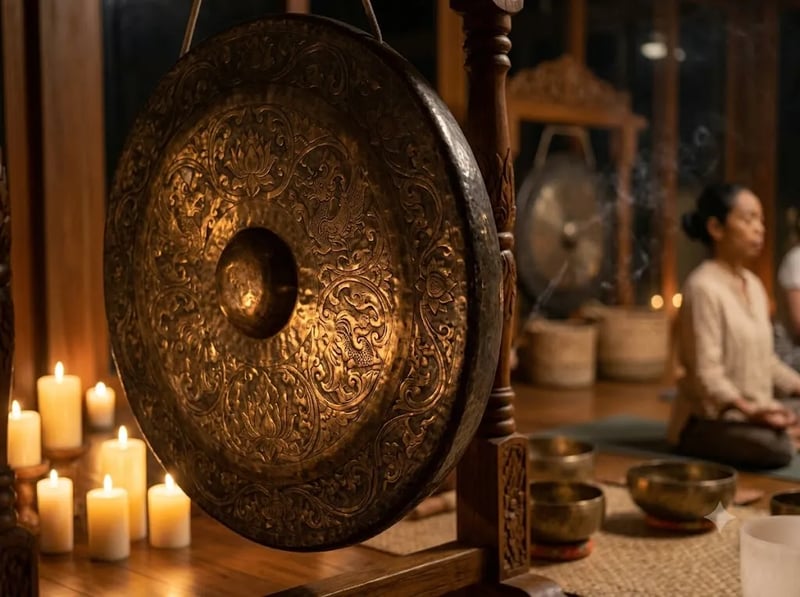
Sound healing, often experienced as a gong bath or sound bath, is a practice where you rest while an instrument, gongs, singing bowls, or chimes, fills the room with sustained tones. There is nothing to do but lie down and listen, which is part of why it appeals to people who find seated meditation hard.
It shares common ground with mantra meditation and sound, and if what you are really after is deeper sleep, our sleep meditation guide is a close companion practice.
What Happens in a Session
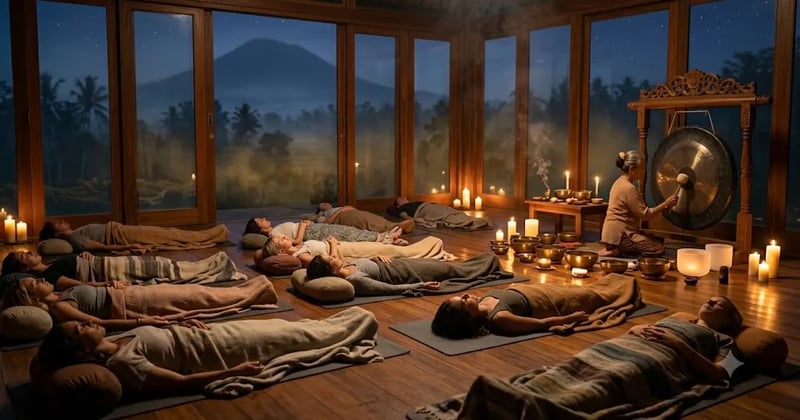
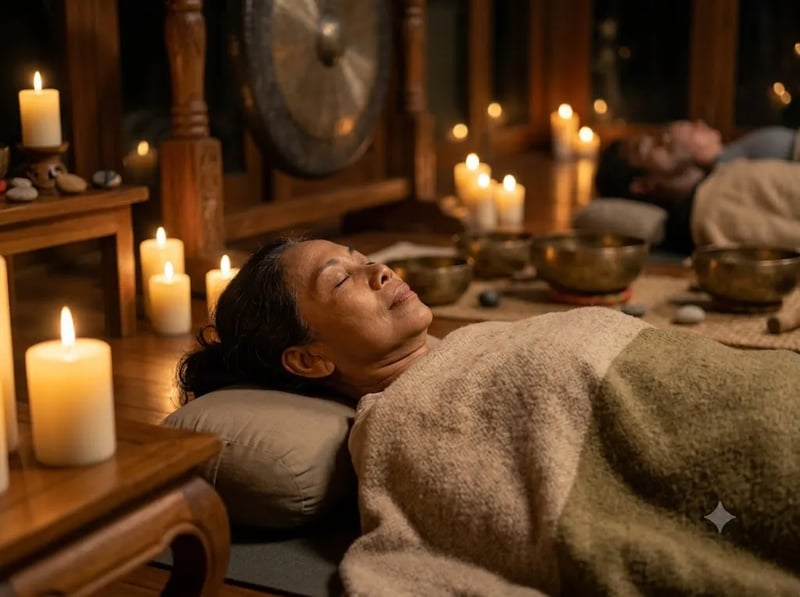
You arrive, lie down comfortably with a blanket, and close your eyes. The facilitator plays instruments that produce rich, overlapping tones and vibrations. Sessions usually run 30 to 60 minutes. Many people drift between waking and sleep, and some feel physical sensations of vibration or waves of emotion.
Why It Feels So Restful
Sustained, predictable sound gives the mind something simple to rest on, which quiets mental chatter. Lying still and passive lets the nervous system shift toward its rest and digest state. For many, this combination produces a depth of relaxation that is hard to reach through effortful practices.
What the Evidence Says
Research on sound healing is early but encouraging, with small studies pointing to reductions in stress, tension, and low mood after sessions. As with much of this field, the effects are best understood as deep relaxation rather than a medical treatment. Enjoy it for what it reliably offers: rest.
Who It Suits
Sound baths are especially good for people who struggle to sit and focus in traditional meditation, or who simply want to be guided into stillness. No experience is needed, and there is no right way to do it beyond turning up and lying down.
What is defensibly happening in your body
It helps to separate what a gong bath can plausibly do from the bigger claims that sometimes surround it. Lying still in a dim room, doing nothing but listening to slow, enveloping sound, is a reliable way to trigger what researchers call the relaxation response: breathing slows, muscles let go, and the mind stops racing. That is real, and it is most of the benefit.
What is not defensible is the language of cellular healing, tuning your frequencies, or realigning your energy field. There is no credible evidence that sound waves from a gong repair cells or retune the body, and claims like that quietly undermine the genuinely restful thing that is actually happening.
The honest version is quieter and still worth having. You are giving your nervous system a rare stretch of stillness, with a continuous sound to hold your attention so the usual mental chatter has less room to run. For a tired, over-stimulated system, that is a meaningful rest.
Think of the sound as a container for stillness rather than a treatment applied to your body. Held that way, the experience keeps everything that makes it valuable and drops the claims it cannot support.
Being honest about the evidence
If you go looking for strong science on sound baths, you will not find much, and it is fair to say so. The studies that exist are few, small, and generally of low quality, often without proper control groups, so the confident health claims made in some marketing run well ahead of what has actually been shown.
That does not mean the experience is worthless. It means the reasonable claim is modest: many people feel calmer and more rested afterwards, and that self-reported calm is genuine even if it has not been rigorously measured. Relaxation is a real and useful outcome; it just is not the same as a proven medical treatment.
The more defensible evidence sits with closely related practices. Deep relaxation techniques such as yoga nidra have been shown to shift the body towards its calmer state, with one study by Markil and colleagues finding yoga nidra increased heart rate variability, a marker of parasympathetic activity. A sound bath likely works through the same restful mechanism rather than anything unique to the instruments.
So approach it with clear eyes. If it helps you rest, that is reason enough to go, and you do not need to believe any of the grander claims to enjoy the real thing it offers.
How to get the most from a session
A little preparation makes a real difference to how deeply you settle. Arrive with time to spare rather than rushing in, and let yourself land in the room before things begin, because a nervous system that is still braced from traffic takes longer to soften.
Get genuinely comfortable, since you will be lying still for a while. Bring or borrow a bolster for under your knees, a blanket in case you cool down, and something for your head, so that no small discomfort keeps pulling you back to the surface. The warmer and more supported you are, the easier it is to let go.
Let go of trying to do it right. There is nothing to achieve and no correct experience, so if your mind wanders, or you drift towards sleep, or you feel nothing dramatic, all of that is fine. The invitation is simply to rest and let the sound wash over you.
Afterwards, resist the urge to leap straight back into your day. Give yourself a few slow minutes and some water before you drive or rush off, the same way you would ease out of a deep rest, so the calm has a chance to stay with you.
Where it fits alongside restorative yoga and yoga nidra
A gong bath is not a standalone cure, and it sits most comfortably as one member of a family of restful practices. Restorative yoga, yoga nidra, and slow meditation all work towards the same thing: a genuine, supported rest that most modern lives are short on.
Each has its own texture. Restorative yoga holds your body in a few well-propped shapes for several minutes at a time. Yoga nidra guides your attention through the body while you lie still, and our guide to yoga nidra and how to practise it walks through what that involves. A sound bath simply uses continuous sound as the anchor instead of a pose or a voice.
Being honest, even these better-studied practices have modest evidence. In one careful trial, ordinary stretching outperformed a restorative yoga programme on a stress marker, as the PRYSMS randomised trial by Corey and colleagues found. The sensible takeaway is that these are pleasant, low-risk ways to rest, not medical interventions.
Choose whichever helps you actually stop, and rotate them if you like variety. What matters is the rest itself, and a sound bath is a lovely, low-pressure way into it for people who find sitting meditation hard.
Who should be a little cautious
A sound bath is low-risk for most people, but a few situations deserve a word of care, and an honest article names them. If you have a history of seizures triggered by sound, significant sound sensitivity, or serious ear conditions, it is worth checking with a health professional before you lie down for an hour of continuous resonance.
Pregnancy is not a barrier for most, but some practitioners keep certain heavy instruments away from the belly as a precaution, and it is reasonable to mention it to the facilitator beforehand. If you live with a mental health condition that deep relaxation sometimes unsettles, go gently and let someone know you may want to sit up or leave.
For everyone else, the main thing is comfort and consent. You can move, adjust, or leave at any point, and a good facilitator will make that clear at the start. Treating it as an optional, adjustable rest rather than a fixed treatment keeps it safe and genuinely enjoyable.
If these restful practices draw you in and you want to understand how relaxation, breath, and the nervous system actually fit together, our 200-hour yoga teacher training in Bali gives that curiosity a grounded, evidence-aware home.
What the days afterwards tend to look like
Most guides stop when the last gong fades. The hours and days afterwards are where people are most often surprised, and knowing what is common makes it much easier to take it in your stride.
The first hour is usually slow. People report feeling porous, a little dreamy, and slower to find words than usual. Plan for that rather than against it. Leave the drive home to someone else if you can, avoid booking anything that needs sharp attention straight afterwards, and give yourself twenty quiet minutes before you rejoin the day properly.
Sleep that night can go either way. Plenty of people sleep unusually deeply. A smaller number find themselves wide awake and busy minded, particularly after their first session, and are then convinced something has gone wrong. Neither response means much on its own. If you are the wakeful sort, keep the evening dim and undemanding rather than trying to force the deep sleep you were promised.
Emotional weather in the following day or two is common enough to be worth naming. Some people feel unexpectedly tearful, or find an old irritation surfacing with no obvious trigger. Lying still in the dark for an hour with nothing to do is itself unusual in most lives, and things tend to surface when you finally stop moving. Let it pass through rather than treating it as a problem to solve.
Keep the follow-up simple. Drink water, eat something proper, and get outside for a short walk. Avoid stacking another intense experience on top of it the same day. If you want to keep a record, three lines is plenty: how you felt during, how you slept, and how the next day went. Across four or five sessions that tells you far more than any single one can.
Know the point at which this stops being about the sound. If low mood, disrupted sleep or anxiety persist for more than a few days, or if they were already established before you went, that deserves a conversation with a doctor or a qualified mental health professional rather than another session. A gong bath is a restful, absorbing experience and it can sit happily alongside proper care. It is not a substitute for it, and no honest practitioner would suggest otherwise.
Choosing who you sit with matters more than the instruments. Look for someone who explains what will happen before it starts, who tells you plainly that you can leave at any point, and who leaves time at the end rather than finishing on the last note and turning the lights up. Ask about volume and proximity if you are sensitive to sound, since the difference between a gong two metres from your head and one across the room is considerable. Anyone making specific claims about curing conditions is a reason to look elsewhere, however pleasant the room.
Choosing a session, and what to ask first
Sound work is unregulated, so the quality of a session rests almost entirely on the person running it. There is no register to check, and no qualification that means the same thing everywhere. That sounds discouraging, but it makes the useful questions fairly obvious.
Ask how long the facilitator has been playing and who they trained with. A straight answer, even a modest one, tells you more than a long list of modalities. Somebody who has played weekly for four years is generally a safer bet than somebody with six certificates and no regular practice.
Ask about the room and the numbers. Twelve people in a small studio is a different experience from forty in a hall, and neither is wrong, but the larger the group, the less likely it is that anyone will notice if you are struggling. If you have never done this before, a smaller session gives you room to leave quietly.
Ask what the session includes besides the instruments. Some facilitators open with breathwork or guided relaxation, some talk throughout, some say almost nothing. If you are sensitive to spiritual framing you do not share, it is better to know that beforehand than to work out how you feel about it while lying on the floor.
Volume is the one thing worth being firm about. Gongs get genuinely loud, and a facilitator who plays close to people or builds long, sustained peaks should be willing to say so and to seat you further back. If a question about volume gets a vague answer, that is information too.
Otherwise, trust the ordinary signals you would use anywhere else. Somebody who answers plainly, keeps to time, and does not oversell what an hour of listening can do is usually somebody worth lying down for.
Train With Loka
If deep rest appeals but seated meditation feels hard, sound is a gentle doorway in. Our Online Meditation Training offers a range of ways into stillness, so you can find the one that suits you. For the science of relaxation, read how yoga affects the parasympathetic nervous system, or try Yoga Nidra as another restful practice.
Frequently Asked Questions
What is a gong bath?
A sound healing session where you lie down and rest while gongs and other instruments fill the space with sustained tones and vibrations.
Do I need meditation experience for a sound bath?
No. You simply lie down and listen. It suits people who find seated meditation difficult.
Is sound healing scientifically proven?
Early research suggests it reduces stress and tension. It is best understood as deep relaxation rather than a medical treatment.
What should I bring to a sound bath?
Comfortable clothing and a blanket for warmth. Some people bring an eye pillow. Everything else is usually provided.
How often should I go to a sound bath?
There is no dosage, because it is rest rather than treatment. Once a month suits most people as a reset; weekly is fine if it genuinely helps you unwind and the cost sits comfortably. Let how you sleep afterwards, and how you feel the next day, set the frequency.
Can I do a sound bath at home with a recording?
You can approximate one: good headphones or decent speakers, lying supported and warm, no interruptions. Recordings lack the physical resonance of live instruments in a room, which is part of the experience, but the rest response is still available. Treat it as a guided rest rather than a lesser copy.
The Loka Newsletter
Enliven your routine with exclusive spiritual content. There’s so much to learn.

Find us on Instagram
@lokayogaschool