Last updated on October 24th, 2026 at 10:40 pm
7 Benefits of Taking an Online Meditation Course
Loka Yoga School’s online meditation course is a Yoga Alliance accredited, self-paced teacher training built for practitioners who want genuine depth, not just a credential to print. It covers 25+ distinct meditation techniques, blends classical philosophy with contemporary neuroscience, and is accessible from anywhere in the world.
You have probably felt what a steady practice does: the settling, the clearer attention, the space that opens between you and your reactions. At some point many practitioners feel called to go further, either to teach or to understand the practice at a depth that self-study rarely reaches.
Here is what you actually gain when you commit to a structured programme rather than piecing practice together from free videos. And if a course sparks something bigger, our guide to the 8 best meditation teacher trainings maps the next step.
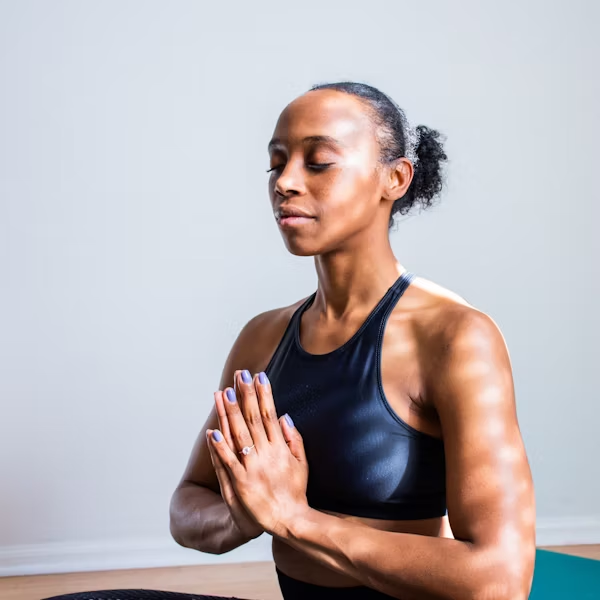
1. 25+ Techniques Across Multiple Traditions
A casual practice typically settles into one or two familiar techniques. Our curriculum covers the full landscape: mantra meditation, yoga nidra, loving-kindness, visualisation, walking meditation, Vipassana, the body scan, and more.
You move from someone who meditates to someone who understands why each approach produces the effects it does. It is the difference between repeating a technique you were taught and knowing which practice a particular student needs on a particular day. That understanding is what lets you guide others with real skill and discernment.
2. Your Personal Practice Deepens Significantly
There is a particular quality of attention that comes when you study something in order to teach it. You notice the subtleties you previously skipped over. You sit with practices you would otherwise have abandoned after one uncomfortable session.
Many Loka students report that the training produces the most significant shift in their personal sadhana of anything they have done. Studying the benefits of meditation in depth, then practising them daily, breaks through the plateaus that self-directed practice rarely can.


3. Yoga Alliance Accreditation That Actually Means Something
Loka Yoga School’s meditation teacher training is structured to meet Yoga Alliance Continuing Education Provider (YACEP) standards. Your certification carries professional weight with studios, corporate wellness programmes, and retreat organisations.
If you are an existing Registered Yoga Teacher, these hours count toward your continuing education requirements. If you are building a new career in wellness, this is a credible foundation from which everything else grows.
4. You Learn How to Teach, Not Just How to Meditate
Knowing how to meditate and knowing how to guide someone else through meditation are entirely different competencies. Facilitation requires clear, invitational language, an understanding of how to sequence practices for different contexts, and the ability to hold space when students meet difficult emotions.
These skills are explicitly taught in the Loka programme. Without them, even a practitioner with years of personal experience can struggle in front of a group. With them, confidence is built from competence.
You also learn directly from Loka’s experienced instructors rather than anonymous videos. Feedback on your assignments, guidance through the harder material, and mentorship from teachers who have spent years in practice are what turn theory into capable facilitation. You get a community of fellow trainees to practise with, not a stack of recordings to watch alone.
5. Self-Paced, With Lifetime Access
The Loka online format means you learn when your life permits rather than when a schedule dictates. You can revisit complex material as many times as you need, and integrate practices into your daily routine gradually rather than in one overwhelming immersion.
Lifetime access means the course grows with you. You are not racing a deadline.
6. Genuine Depth at a Price Point That Respects You
Loka’s Online Meditation Teacher Training is USD $345 as a standalone course. The depth of curriculum, the Yoga Alliance accreditation, and the quality of instruction are not reflected in that number the way most of the market prices them.
We price this way on purpose. Accessible pricing for a genuine education reflects the value we place on reaching more people, not reduced quality. Compare it against other meditation teacher trainings priced at three or four times the amount before drawing conclusions.
7. A Community and a Lineage
Teacher training places you within a community of practitioners at a similar stage of their journey. Beyond peers, you become part of a lineage. You are not just acquiring a skill set. You are stepping into a tradition refined over thousands of years, and that continuity gives your teaching its depth.

What the Evidence Says About Learning to Meditate Online
Remote delivery is often treated as a compromise. The research is more encouraging than that, though not unqualified. Spijkerman and colleagues’ meta-analysis of 15 randomised controlled trials in Clinical Psychology Review found that internet-delivered mindfulness interventions produced small but significant improvements in depression, anxiety, stress, and wellbeing.
The field has grown quickly since. Sommers-Spijkerman and colleagues’ updated meta-analysis of 97 trials reached broadly similar conclusions, with effects on mental health that were still present at follow-up.
Two caveats matter. The effect sizes are small, and trials that included some form of human guidance tended to outperform fully automated ones. That is a direct argument for choosing a programme with a real teacher attached rather than a library of recordings.
Set that beside Goyal and colleagues’ review in JAMA Internal Medicine, which found moderate evidence for anxiety, depression, and pain, and insufficient evidence for several other outcomes. The format is not the limiting factor. The evidence for meditation itself is narrower than the marketing around it.
What Remote Study Cannot Give You
A recording cannot see you. It cannot notice that your jaw is clenched through every sitting, that you hold your breath at the top of each inhalation, or that you have quietly stopped practising and started performing calm.
That gap matters more than it sounds, because meditation is not risk-free. Farias and colleagues’ systematic review of adverse events found an overall prevalence of 8.3% across 83 studies, and a population-based survey found that around a third of people with meditation experience reported some unwanted effect.
Anxiety, resurfacing memories, and heightened emotional sensitivity are the usual forms. They are manageable when someone experienced is available. They are frightening when you are alone with a video late at night.
So the question to ask of any remote programme is not how many hours of content it holds. It is what happens when something difficult comes up.
Self-Paced Is Not the Same as Unstructured
The most common reason a remote programme changes nothing is that it is never finished. Flexibility removes the friction of a fixed timetable, and it removes the pressure that a fixed timetable supplies.
Structure is what fixes that, and you can impose it yourself. Put the sessions in your calendar as appointments. Decide in advance which day you take in new material and which days you only practise. Tell someone what you are doing and when you expect to finish.
Treat the flexibility as a scheduling convenience rather than permission to drift. The people who get the most out of remote study are usually the ones who make it look most like a timetabled class.
That is also the honest reason in-person immersion still works. For a few weeks, someone else holds the structure and you simply turn up.
How to Judge a Programme Before You Pay
Check accreditation directly with the registering body rather than trusting a logo on a sales page. Yoga Alliance registration can be confirmed on their own site in a couple of minutes.
Then look for contact time. A programme offering scheduled live sessions, or at least a channel where a named teacher answers questions, is doing something a recording cannot.
Read the curriculum for mechanism rather than volume. If it teaches twenty techniques and never explains why a lengthened exhalation settles the nervous system, you will not be able to adapt anything for a student who does not fit the script.
Finally, check what continues after you finish. Lifetime access to materials is common and cheap to offer. Continuing access to teachers is rarer and worth considerably more.
Who Should Wait, and What to Do Instead
If you are in acute distress, in the early stages of grief, or managing a psychiatric condition that is not currently stable, beginning an intensive self-directed practice alone is not the right first step. Speak to a clinician, and add meditation later with support in place.
A significant trauma history does not rule practice out, but it argues for live teaching over recordings, shorter sittings, and techniques with an external anchor such as sound or movement.
If you are curious rather than committed, start smaller. Our overview of what meditation actually does and our guide to mantra practice will tell you more, at no cost, than most paid introductions.
When you are ready to study properly, our meditation teacher training teaches the mechanisms alongside the practices. If you would rather learn face to face and in a full yogic context, the meditation and pranayama modules of our Yoga Alliance certified 200-hour YTT in Bali do the same work in person.
The Two Honest Objections
Two questions come up constantly, and the answers are less flattering to the format than you might expect.
Does it work without a group? Partly. The trials that included human contact did better than the automated ones, and there is no reason to think a chat channel replaces a room of people breathing together. It is a reasonable substitute, not an equivalent.
Is a certificate worth anything if nobody watched you teach? Only as far as it is honest about what it certifies. A registered qualification earned remotely says you completed a curriculum. It does not say you have held a room of strangers through a difficult sitting, and the schools worth trusting will tell you that plainly.
Both answers point the same way. Remote study is a good way to learn the material and a poor way to learn presence. Plan to get the second part somewhere else, eventually.
What the first month actually looks like
The first month of a self-paced course is where most people either build the habit or quietly stop, and it rarely looks the way the sales page implies.
Week one is usually enthusiastic and slightly frantic: you watch more modules than you practise, because watching is easier. Week two is where the gap shows up, and the practice starts competing with everything else in your evening. Weeks three and four decide it. If you have found a fixed slot by then, even a short one, the course tends to finish. If you are still practising whenever there is a gap, it tends not to.
The practical fix is to schedule the practice and let the theory float. Twenty minutes of sitting at a fixed time, plus whatever module you get to, will take you further than an hour of video and an intention to practise later. A self-paced programme rewards a fixed anchor more than a flexible one, which is the opposite of what most people expect when they choose self-paced in the first place.
Two smaller things help more than they sound like they should. Set the slot at a time you are already reliably awake and already reliably alone, rather than the time you would like to be a person who meditates. And decide in advance what the minimum version is, so that a bad day produces five minutes rather than nothing.
It also helps to expect the boredom. Somewhere around week three the novelty of a new programme wears off and the practice stops feeling like progress, which is the point at which it starts actually being practice. Nobody warns you about that stretch, and it is the reason most self-paced courses are abandoned two thirds of the way through rather than at the start.
If the online format suits you and you later want the residential version of the same work, a 200-hour teacher training in Bali builds on exactly these habits over three weeks rather than twelve.

Start Your Online Meditation Course With Loka
The self-paced format is built for real lives: busy professionals, parents, and practitioners in time zones far from any studio. It suits existing Registered Yoga Teachers who want YACEP continuing-education hours, career-changers moving into wellness, and committed meditators who simply want to understand their practice at a teacher’s depth. A background in yoga helps but is not required.
Our Online Meditation Training is self-paced, Yoga Alliance accredited, and priced to keep genuine education within reach. You can start today and move at the pace your life allows, with lifetime access to every module.
Frequently Asked Questions
How long does the Loka meditation training take to complete?
The programme is self-paced with lifetime access. Most students complete it over two to six months depending on their schedule. There is no deadline.
Do I need an existing yoga or meditation background to enrol?
A personal meditation practice is helpful, but formal yoga training is not required. What matters most is genuine interest and a willingness to engage seriously with both study and practice.
What can I do with a meditation teacher certification?
You can lead group classes in yoga shalas, wellness centres, schools, and corporate settings. You can offer private sessions or build an online teaching practice. Many certified teachers fold meditation facilitation into existing careers in psychology, healthcare, education, and coaching.
Is online meditation teacher training as effective as in-person?
For content delivery and independent study, online training is equally effective and adds the advantage of repetition and flexibility. The Loka programme includes mentorship and peer connection to cover the community component.
How is Loka's training different from other programmes?
The Loka programme combines breadth of curriculum (25+ techniques), yogic philosophical grounding, and accessible pricing. It is designed for practitioners who want thorough education rooted in tradition without the cost of a multi-thousand-dollar programme. Yoga Alliance accreditation ensures professional recognition.
How much does Loka's online meditation certification cost?
Loka’s Online Meditation Teacher Training is USD $345 as a standalone course, with lifetime access and no recurring fees. Bundling it with other Loka online trainings brings the per-course price down further.

The Loka Newsletter
Enliven your routine with exclusive spiritual content. There’s so much to learn.

Find us on Instagram
@lokayogaschool