Last updated on August 3rd, 2026 at 02:38 pm
The True Meaning of Bali Offerings
The name Bali means “offering.” Once you have spent time here, that etymology makes complete sense. Walk anywhere on this island and you will encounter them: small, exquisite woven trays of flowers, rice, fruit, and incense, placed on doorsteps, at shop entrances, on temple steps, at road junctions, sometimes in the middle of a busy street where motorbikes curve around them without a second thought.
This is canang sari. And it is one of the most quietly profound spiritual practices we have encountered anywhere in the world.
What Canang Sari Actually Is
Canang sari are daily offerings crafted by Balinese women as an act of devotion to the gods of the Hindu Balinese tradition. The base is woven from young coconut leaf or bamboo. Inside, you will find flowers arranged by colour, rice, incense, and sometimes small food items, sweets, fruit, a coin, and occasionally a cigarette.
Every element carries meaning. The woven base itself represents the three primary forces of Hindu cosmology: Brahma (creation), Vishnu (preservation), and Shiva (dissolution and transformation). These are the same forces at work in every cycle, every breath, every lifetime.
The colours of the flowers are not decorative choices. They map to the cardinal directions and their presiding deities. White flowers face east, towards Iswara, the god of nature. Red faces south, towards Brahma. Yellow faces west, towards Mahadeva. Blue or green faces north, towards Vishnu. Each offering is a cosmological map held in a palm-sized tray.
A frangipani flower, known locally as jepun, is dipped in holy water and sprinkled over the offering to fuse the four elements and consecrate the whole arrangement before it is placed down. A prayer is spoken quietly. Incense is waved rhythmically, its smoke believed to awaken the gods and signal the beginning of worship.
Gratitude, Not Request
What strikes us every time we witness this practice is that canang sari is not petition. The Balinese are not asking for anything. They are expressing gratitude for what is already present: balance, abundance, beauty, life itself.
This is a distinction that takes time to fully absorb if you come from a religious tradition built around asking. Here, the offering comes first. The acknowledgement that the gods have already given comes before any request is made.
The food placed inside the offering is considered infused with prana, life force energy. Once offered to the gods, whatever remains is shared with animals and the earth. Nothing is wasted. Everything participates in the cycle.
The Island of the Gods
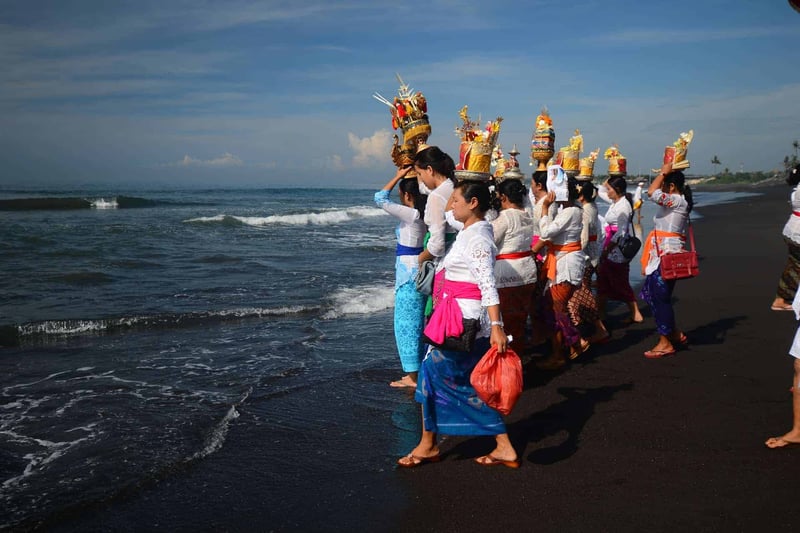
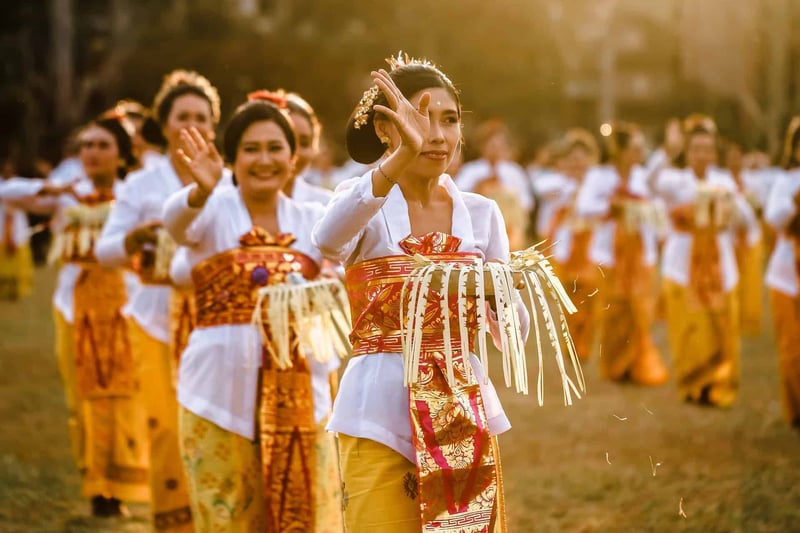
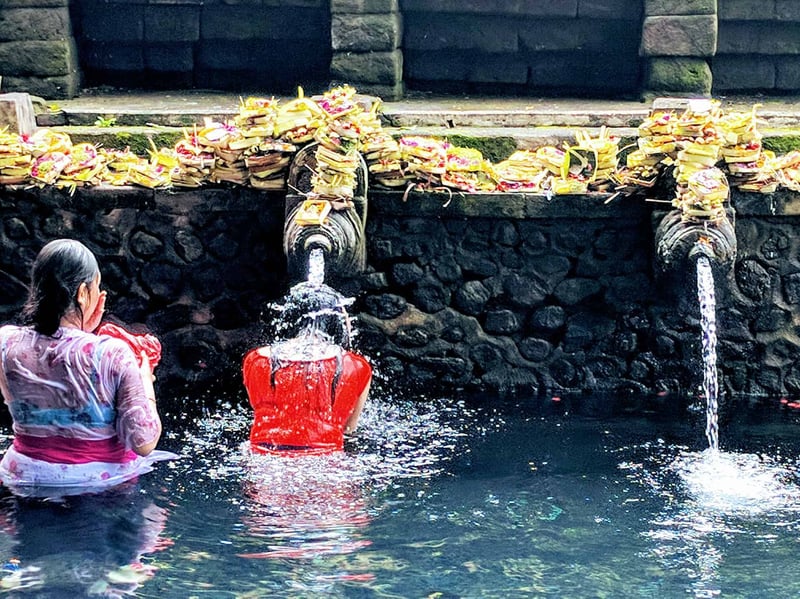
This practice, performed every single morning by virtually every Balinese household, is why this island carries the name it does. The Balinese believe that canang sari invites the gods to be present on the island, not as distant figures of worship, but as participants in daily life. This is not metaphor. It is lived theology.
Offerings pause during times of death in the community or family. Grief, too, is held by the ritual structure. When canang sari returns after a death, it marks a collective readiness to re-enter the cycle of gratitude.
We have been based in Bali for nearly two decades, first in Canggu and now also in Kedungu near Tabanan, and this daily practice still stops us. There is something in the combination of beauty, intention, and sheer consistency that cuts through. The women who make these offerings often begin before dawn. They have been doing it their whole lives. Their mothers did it before them.
That kind of continuity is its own form of teaching.
What This Means for Practitioners
For those who come to Bali to practise yoga, the island itself becomes a teacher. The canang sari on the pavement outside the shala is not incidental decoration. It is the same impulse that brings you to your mat: a desire to acknowledge something larger than the immediate self, to participate in a cycle of giving and receiving.
The concept of prana, life force energy, is central to both Balinese offering practice and to the yoga tradition. Watching a Balinese woman arrange flowers at five in the morning is a lesson in what it looks like to treat every ordinary moment as worthy of reverence.
Wherever you are in Bali, step around the canang sari rather than over them. Not out of superstition, but out of respect for a practice that has been maintained with extraordinary devotion for hundreds of years.
Our 200-Hour YTT in Bali takes place in this extraordinary environment, and we intentionally weave Balinese cultural context into the training. Understanding where you are, its history, its spiritual practice, and its living philosophy, deepens everything you carry back with you.
Who Makes Them, and What It Costs in Hours
The offerings you step around on a Bali pavement are not bought in the way a visitor assumes. In many households they are still made at home, and the making is a daily piece of work that falls mostly to women.
The small square tray is woven from a strip of young coconut leaf, folded and pinned with bamboo. A household with several shrines, a shopfront, and a vehicle can place a dozen or more in a morning, and a ceremony day multiplies that many times over.
Ready-made trays are sold in every market now, and buying them is not considered a shortcut so much as a practical accommodation to people having jobs. Larger ceremonial arrangements, the tall towers of fruit and cakes carried to the temple, are still made at home and represent days of collective work rather than hours.
Once you know this, the thing at your feet reads differently. It is not decoration and it is not a tourist detail. It is somebody’s morning, repeated every morning, in a household that is also running a business and getting children to school.
The Calendar Behind the Daily Ritual
Balinese ritual life runs on two calendars at once, which is why the island can feel like it is always mid-ceremony. Neither of them is the Gregorian one on your phone.
The Pawukon is a 210-day cycle built from concurrent weeks of different lengths. Galungan, which marks the victory of dharma over adharma and the period when ancestral spirits return, falls on it, followed 10 days later by Kuningan when they depart. Because the cycle is 210 days rather than 365, Galungan moves through the seasons and can happen twice in one Gregorian year.
The Saka calendar is lunar and gives the island Nyepi, the day of silence that opens the Balinese new year. For 24 hours the airport closes, the streets empty, lights stay off, and nobody works or travels. Visitors are expected to stay inside their accommodation, and this is not negotiable.
Odalan, the anniversary of a temple’s consecration, runs on the Pawukon too, so every temple has its own festival every 210 days. With thousands of temples on the island, something is always happening somewhere, which is exactly why the offerings never stop.
How to Behave Around Them
Visitors worry about causing offence and then get the details wrong in the same predictable ways. The rules are simple and they are mostly about attention.
Do not step on one. If the pavement is covered, step around, and if there is genuinely no way past, walk on rather than over it. Nobody expects you to levitate; people do notice whether you were looking.
Once an offering has been placed and blessed, its essence is considered received, which is why a tray flattened by a scooter an hour later does not distress anyone. That is not indifference to the object, it is what the object is for.
Do not move an offering to take a photograph of it. Photographing them where they lie is fine in public spaces; rearranging someone’s ritual for a better composition is not.
At a temple, wear a sarong and sash, keep your head lower than the priest’s, and do not walk in front of someone who is praying. Menstruating women are traditionally asked not to enter temple grounds. You may disagree with the rule, and it is still their temple.
What Goes Into One, and What Each Part Is For
Look at a canang sari closely and it stops being generic. There is a grammar to it, and most of the components are doing a specific job.
The base is the woven tray, with a layer of white lime and betel leaf beneath, standing for the three principal deities of the Balinese Hindu tradition. On top go the flowers, and their placement is directional rather than decorative: white towards the east, red to the south, yellow to the west, blue or green to the north, each associated with a deity and a quarter of the compass.
A little rice, a sliver of banana or sugar cane, and often a sweet or a biscuit sit alongside. Modern offerings frequently include a cigarette, a sachet of coffee, or a boiled sweet, which visitors find funny and which is entirely consistent: you offer something of value, and value is measured by what people actually want.
The incense matters more than any of it. The smoke is what carries the essence upward, which is why an offering placed without incense is considered incomplete, and why you will see someone return with a lit stick a minute later.
Water is sprinkled over the finished tray with a flower, and a short prayer is said. The whole sequence takes under a minute at a household shrine. Our practical tips for coming to Bali cover what to wear if you are invited to watch one properly.
What the Practice Asks of You
The framework underneath all of it is Tri Hita Karana, the three causes of wellbeing: harmony with the divine, harmony with other people, and harmony with the land. The offering is that idea made small enough to do before breakfast.
What is striking, if you watch it for long enough, is how unsentimental it is. Nobody appears moved while placing them. It is done quickly, competently, and then the day starts. The discipline is in the repetition rather than in the feeling, which is the opposite of how wellness culture usually frames a practice.
That is the transferable part, and it is why we mention it to students. A practice you do because it is what you do at that hour survives the weeks when you are not inspired. A practice that depends on feeling like it does not.
Adopting the ritual itself is not the point and would be borrowing something that is not ours. Learning from the structure is different, and it is available to anyone. Students on our Bali yoga teacher training live alongside this for a month, which teaches it better than any lecture does, and our honest guide to whether you need a retreat is worth reading if you are weighing up a shorter visit.
What Happens to Them Afterwards
An offering has done its work the moment it is placed. What stays behind is a leaf tray, a few flowers, some rice, and often a sweet or a small cup. By evening the rain, the street sweepers or the dogs have dealt with most of it.
That last part surprises visitors. A dog eating from an offering is not desecration, and neither is a passing scooter flattening one. The intention was completed at the moment of placing, so what remains is only material. Balinese people step around the fresh ones and pay no attention to the old ones.
The plastic is a newer problem, and Balinese people are the ones raising it. Wrapped sweets, cellophane and small plastic cups entered the practice as convenience items over recent decades, and they do not break down the way a banana leaf does. Provincial restrictions on single-use plastic, along with steady pressure from local environmental groups, have pushed parts of the practice back towards leaf, flower and cloth.
What this asks of a visitor is small. Do not sweep offerings off the step outside your accommodation, because somebody placed them there deliberately and will clear them in their own time. Do not collect the trays as souvenirs. If you want to photograph one being made or blessed, ask first, and accept a no without negotiating.
There is something worth sitting with in the repetition of it. The thing is made carefully in the morning and gone by nightfall, and it is made again the next day, and nobody treats the disappearance as a loss. If you have been reading about impermanence in a philosophy session, it is being demonstrated on every doorstep on the island before breakfast.
Experience Bali With Loka
Wondering whether an immersion is worth it? Read do you really need to go on a yoga retreat.
Our 200-Hour Yoga Teacher Training is based in Kedungu, Tabanan, where this living culture is part of the training.
Frequently Asked Questions
What does the name Bali mean?
Bali means “offering.” The name directly reflects the island’s central cultural and spiritual practice: the daily creation and placement of canang sari offerings as acts of gratitude to the Hindu Balinese gods.
What is canang sari?
Canang sari are small woven offerings made daily by Balinese women as a form of devotion to the gods. They contain rice, flowers arranged by colour according to cosmological symbolism, incense, food items, and sometimes coins or cigarettes. They are placed at doorways, temples, shops, and roadsides throughout Bali every morning.
Why do Balinese people make daily offerings?
Canang sari are expressions of gratitude and devotion, not petitions or requests. The practice acknowledges the presence and generosity of the gods, invites divine participation in daily life, and sustains the spiritual balance of the island. It is a form of selfless service performed consistently, regardless of circumstances.
What do the colours in canang sari represent?
Each colour of flower maps to a cardinal direction and its presiding deity: white (east, Iswara), red (south, Brahma), yellow (west, Mahadeva), and blue or green (north, Vishnu). Together they represent the totality of divine presence surrounding the offering.
Is it disrespectful to step on canang sari?
Yes. Stepping around rather than on or over canang sari is considered respectful. These are consecrated offerings placed with intention and care. Walking over them shows disregard for a living spiritual practice that the Balinese perform with extraordinary dedication.

The Loka Newsletter
Enliven your routine with exclusive spiritual content. There’s so much to learn.

Find us on Instagram
@lokayogaschool